// RECOVERY
Sleep Is the Foundation: A Faith-Driven Athlete's Guide to Recovery Through Rest
Most lifters chase recovery in a supplement tub. The real foundation is the eight hours they keep cutting short. Here is the theology of rest and the practical protocol for treating sleep as part of the training.
Pete Fluriach, founder of Alpha Omega Strength Team. For the first three years I trained seriously, I treated sleep as the thing I sacrificed to make room for everything else - work, training, family, the early alarm. I bought the supplements. I dialed in the protein. And I could not understand why my recovery had stalled. The answer was not in a tub. It was in the six hours of sleep I kept calling enough. This guide is what I wish someone had put in front of me: the theology of rest, the physiology of recovery, and the practical routine that fixed it.
Sleep is the most undervalued training variable in strength sports. It is not the reward you collect after the work is done. It is where the work becomes adaptation - where the body you broke down under the bar actually rebuilds. Skip it, and you are paying for a gym membership to get weaker.
What Every Faith-Driven Athlete Needs to Know About Sleep and Recovery
Recovery is the process of turning training stress into strength, and the overwhelming majority of it happens while you sleep. Growth hormone release, muscle protein synthesis, nervous-system repair, and the consolidation of the motor patterns you drilled all concentrate in deep sleep. Lose the sleep and you keep the fatigue without the adaptation.
Four levers decide whether your sleep actually rebuilds you:
- Duration - total time asleep (target: seven to nine hours for a training athlete)
- Consistency - the same lights-out and wake time, seven days a week
- Depth - uninterrupted cycles, which a cool, dark, quiet room protects
- Timing - sleep that lines up with your body's own night, not scattered across it
Hold those four levers in mind. Most lifters obsess over the last five percent - the supplement stack, the pre-bed casein - and ignore the ninety-five percent that consistency would fix for free. Before the protocol, it is worth seeing why Scripture treats rest as something other than wasted time.
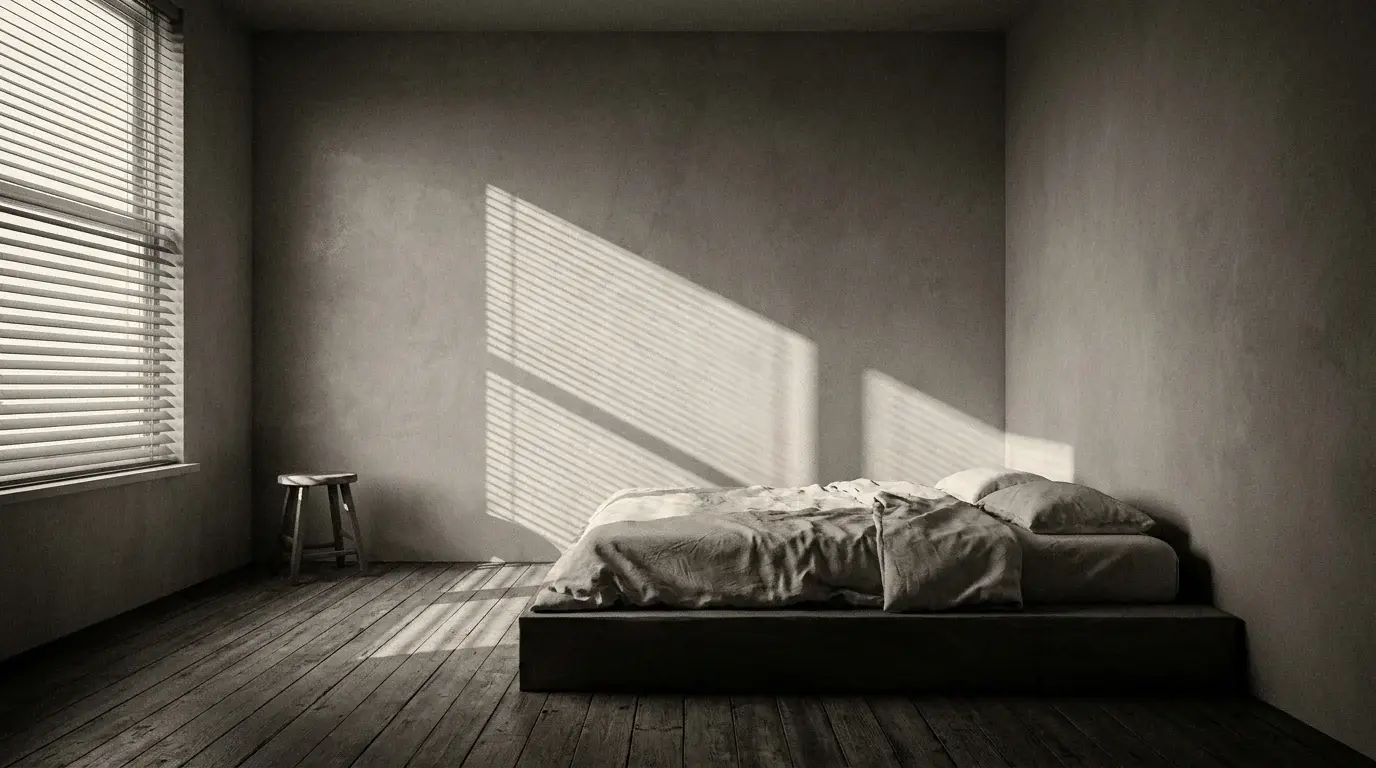
The Theology of Rest: Why Sleep Is Not Laziness
Christian men have a complicated relationship with sleep. We have absorbed a culture that treats exhaustion as evidence of seriousness - the early riser, the man who can run on five hours, the hustle worn like a badge. Scripture does not share the enthusiasm. From the first chapters of Genesis, rest is built into the design of the world, not bolted on as a concession to weakness.
In Genesis 2, God finishes the work of creation and rests on the seventh day - not because he is tired, but to establish a rhythm the rest of creation is meant to keep. The Sabbath command in Exodus 20 makes that rhythm law. Rest is not what you do when the work runs out. It is a boundary God draws around the work on purpose.
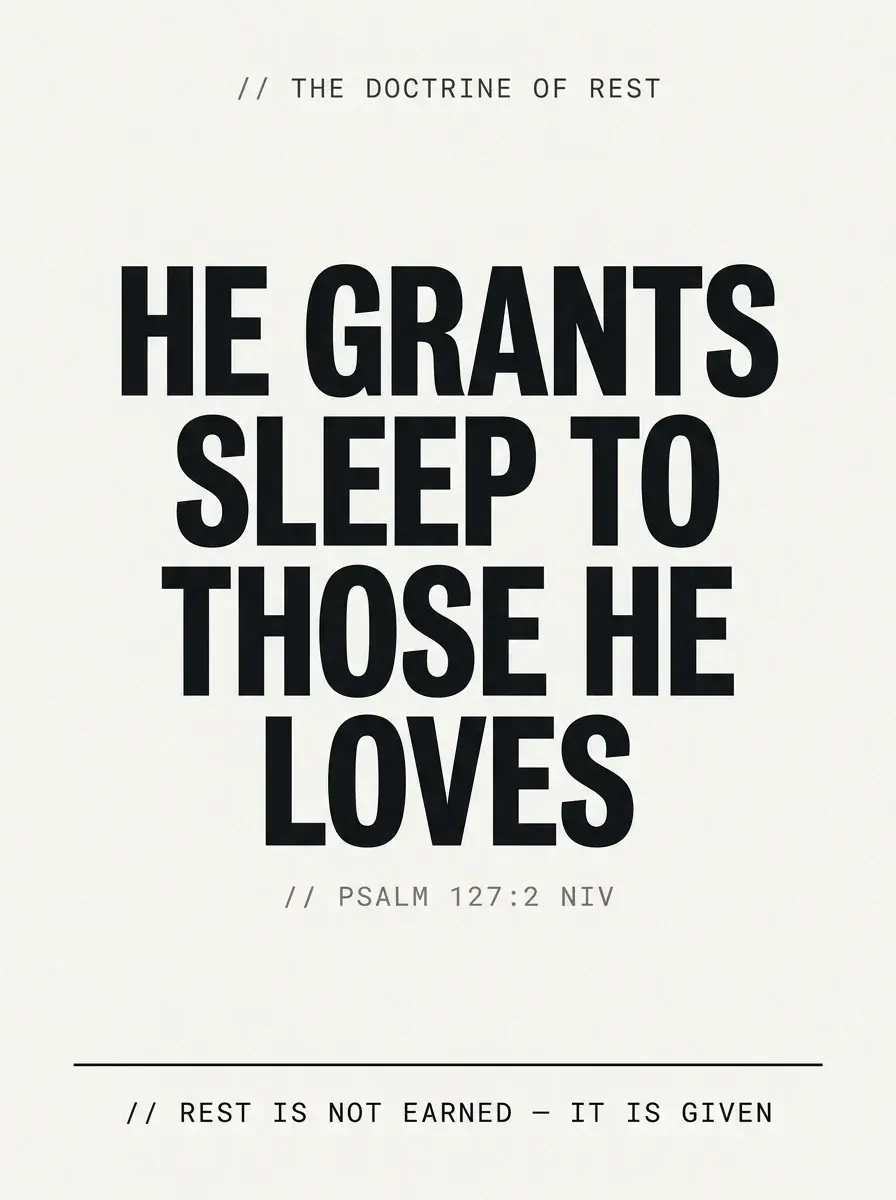
Sleep as a Gift, Not an Achievement
The clearest verse on sleep for the striving man is Psalm 127:2: "In vain you rise early and stay up late, toiling for food to eat - for he grants sleep to those he loves" (Psalm 127:2 NIV). Read it slowly. The early rising, the late nights, the toiling - the psalm calls them vain when they crowd out the rest God intends to give. Sleep is framed as a gift handed to the beloved, not a wage earned by the productive.
That reframes the whole project. If sleep is a gift, then refusing it is not discipline - it is a quiet refusal to receive what God is offering. The man who brags about five hours is not more devoted. He is declining a grace, and his training will eventually send him the bill.
There is a trust dimension, too. Psalm 4:8 reads, "In peace I will lie down and sleep, for you alone, Lord, make me dwell in safety" (Psalm 4:8 NIV). Sleep is the most honest act of trust a person performs daily - you lay down your vigilance and hand the night to someone else. The lifter who cannot sleep is often a man who cannot stop holding the weight of his own life.
And the God who gives sleep does not need it himself. Psalm 121:4 says of the Lord, "indeed, he who watches over Israel will neither slumber nor sleep" (Psalm 121:4 NIV). You can close your eyes precisely because he never closes his. Rest, biblically, is not negligence. It is the posture of a creature who knows he is not the one holding everything together.
Why Sleep Outperforms Every Supplement You Can Buy
Here is the claim, stated plainly: no legal supplement on the market will do for your strength what a consistent eight hours of sleep does. Creatine is the most well-supported supplement in the sport, and it is worth taking. It is also a rounding error next to sleep. If you are sleeping six hours and shopping for a better pre-workout, you are rearranging the furniture in a house with no foundation.
What the Research Actually Shows
The data on sleep restriction is not subtle. Cut a trained athlete down to five or six hours and you see measurable drops in time to exhaustion, peak power, and accuracy, alongside elevated cortisol and suppressed testosterone. One often-cited study restricted dieters to roughly five hours of sleep and watched their bodies preferentially burn muscle over fat. The body under-slept does not recover; it cannibalizes.
- Strength and power - decline measurably after even one week of short sleep, often before you feel it in the gym
- Body composition - under-slept dieters lose more muscle and less fat for the same calorie deficit
- Injury risk - chronic sleep debt is one of the strongest predictors of soft-tissue injury in athletes
- Appetite and discipline - short sleep raises hunger hormones and erodes the willpower a hard training block requires
| Nightly Sleep | Recovery & Adaptation | Strength & Power | What It Costs You |
|---|---|---|---|
| 8-9 hours | Full muscle repair and hormone release | Peak output, day after day | Nothing - this is the target |
| 7 hours | Adequate for most training blocks | Held, not gaining | The practical floor for a hard week |
| 6 hours | Incomplete; fatigue carries into the next session | Measurable drop within a week | Slower progress you will blame on the program |
| 5 hours or less | The body burns muscle over fat | Power and accuracy fall sharply | Lost gains and higher injury risk |
Expert tip: if you have a choice on a busy night between an extra hour of training and an extra hour of sleep, take the sleep. The session you are too tired to recover from is not an investment - it is a withdrawal.
None of this is an argument against supplements. Creatine, protein, vitamin D, and fish oil all earn their place. It is an argument about order. You do not get to skip the foundation and buy your way back to it. Sleep first; supplement the margins.
The Pre-Sleep Protocol for Every Kind of Training Week
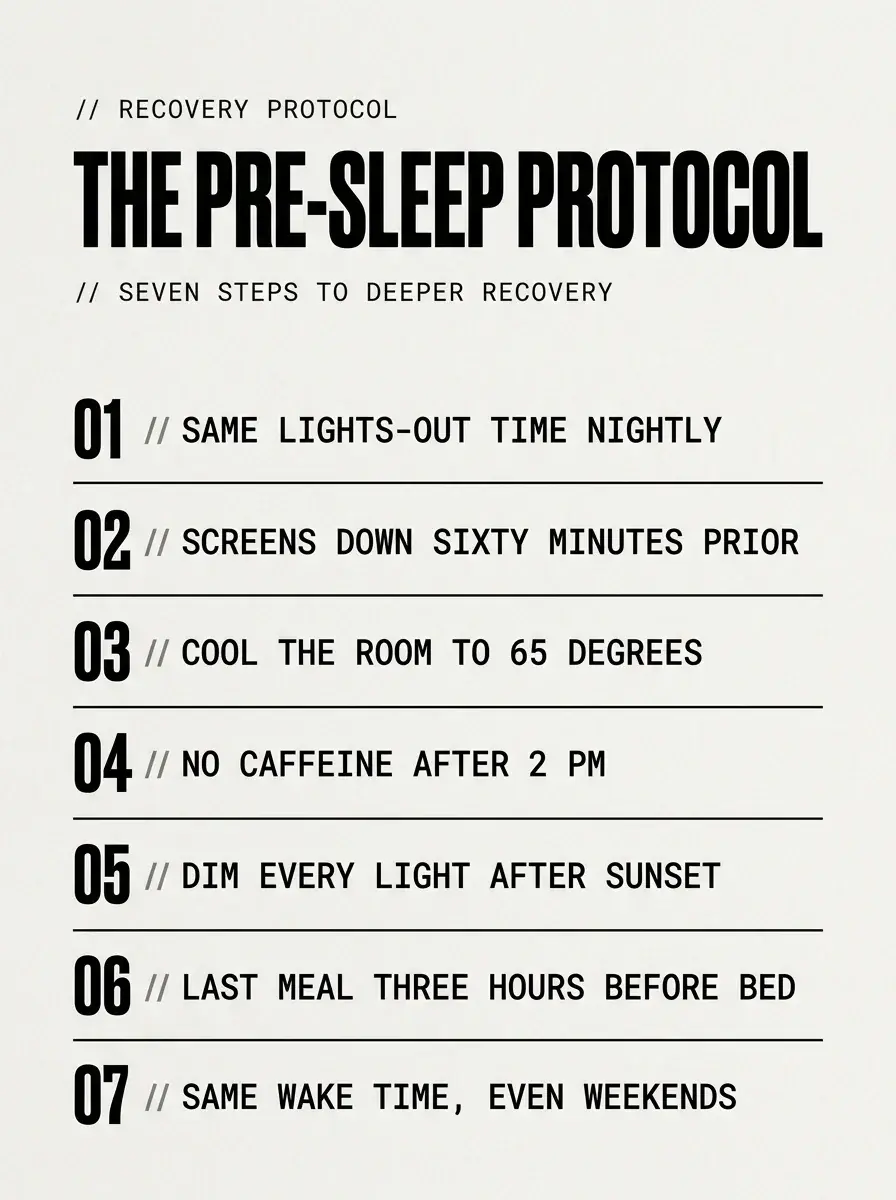
Knowing sleep matters changes nothing. A repeatable routine does. The protocol below is the same seven steps regardless of your schedule; what changes is which steps you have to defend hardest in a given season.
- Same lights-out time nightly - the highest-leverage habit; your body clocks consistency before duration
- Screens down sixty minutes before bed - blue light and the pull of the feed both delay sleep onset
- Cool the room to around 65 degrees - core temperature has to drop for deep sleep to start
- No caffeine after 2 p.m. - its half-life is long enough that a 4 p.m. coffee is still in your system at 10
- Dim every light after sunset - bright evening light tells your brain it is still midday
- Last meal about three hours before bed - active digestion fights the temperature drop sleep needs
- Same wake time, even on weekends - sleeping in on Saturday is a small dose of jet lag every week
The Hard-Training Week vs. the Deload vs. the Crisis Season
The protocol flexes with the season:
- Heavy training block - defend duration above all; you are accruing fatigue faster, so seven hours is a floor, not a target
- Deload week - defend consistency; it is tempting to let the schedule slide on an easy week, which is exactly when the rhythm breaks
- Crisis season (a newborn, a job loss, grief) - lower the training, not the sleep; this is the season the man under-sleeps and over-trains, and it ends in injury or burnout
When Life Will Not Give You Eight Hours
Some seasons genuinely do not allow a full night - a new baby, a sick parent, a brutal stretch at work. The answer is not guilt and it is not heroics. It is honesty: when sleep is short, pull the training back to match. A lighter program you can recover from will always beat an ambitious one you cannot. Protect the sleep you can get, nap when the day allows, and treat the season as temporary - because it is.
Why a Faith-Driven Identity Changes How You Rest
Most men who know all of this still will not sleep. They nod along, then stay up scrolling, then wonder why the program stopped working. The missing piece is rarely information. It is identity. If you secretly believe your worth is measured by output, you will always sacrifice the sleep, because rest feels like falling behind. The fix is not a better alarm. It is believing, at the level where decisions are actually made, that you are not what you produce.
- Quiet, unflinching conviction - that rest is obedience, not laziness; that the God who never sleeps is the reason you can - without the hustle theater the rest of the culture sells.
Getting the Most Out of Your Recovery
- Set a lights-out alarm, not just a wake alarm - the decision that matters happens at night, not in the morning
- Treat your bedroom as a tool - dark, cool, screen-free; the room itself should signal sleep
- Track sleep like a training variable - if your numbers stall, look at the seven nights before you look at the program
- Re-read this protocol every training block - the steps are simple, which is exactly why they erode
Frequently Asked Questions About Sleep and Recovery
How much sleep does a strength athlete actually need?
For most trained lifters, seven to nine hours is the working range, with eight as a sensible target. The harder your training block, the closer you should sit to the top of that range. The number that matters is total time asleep, not time in bed - budget an extra thirty to forty minutes to account for falling asleep and brief wakeups.
Can naps make up for bad sleep at night?
Partly. A twenty-to-thirty-minute nap can recover alertness and some performance, and a longer ninety-minute nap can capture a full sleep cycle. What naps cannot fully replace is the deep, consolidated sleep of a normal night. Use naps to patch a rough night, not as a strategy to run on five hours on purpose.
What if I genuinely cannot fall asleep?
Start with the controllable inputs - a cool dark room, no screens for an hour, no late caffeine, and a fixed wake time to anchor the rhythm. If sleeplessness persists for weeks despite those, treat it as a medical issue worth raising with a doctor rather than a willpower problem. Chronic insomnia is common and treatable, and white-knuckling it is not a virtue.
Conclusion
Strength is built in the gym and paid for in bed. You can run the perfect program, eat the right protein, and stack every supplement that works - and none of it will land if you keep cutting the eight hours where the adaptation happens. Sleep is not the thing you earn after the training. It is the training, finished.
Psalm 127:2 says God grants sleep to those he loves. Receive it. Set the lights-out alarm tonight, defend the rhythm for thirty days, and let your training finally cash the checks you have been writing under the bar.
// FREQUENTLY ASKED
Questions, answered.
How much sleep does a strength athlete actually need?
For most trained lifters, seven to nine hours is the working range, with eight as a sensible target. The harder your training block, the closer you should sit to the top of that range. The number that matters is total time asleep, not time in bed - budget an extra thirty to forty minutes to account for falling asleep and brief wakeups.
Can naps make up for bad sleep at night?
Partly. A twenty-to-thirty-minute nap can recover alertness and some performance, and a longer ninety-minute nap can capture a full sleep cycle. What naps cannot fully replace is the deep, consolidated sleep of a normal night. Use naps to patch a rough night, not as a strategy to run on five hours on purpose.
What if I genuinely cannot fall asleep?
Start with the controllable inputs - a cool dark room, no screens for an hour, no late caffeine, and a fixed wake time to anchor the rhythm. If sleeplessness persists for weeks despite those, treat it as a medical issue worth raising with a doctor rather than a willpower problem. Chronic insomnia is common and treatable, and white-knuckling it is not a virtue.
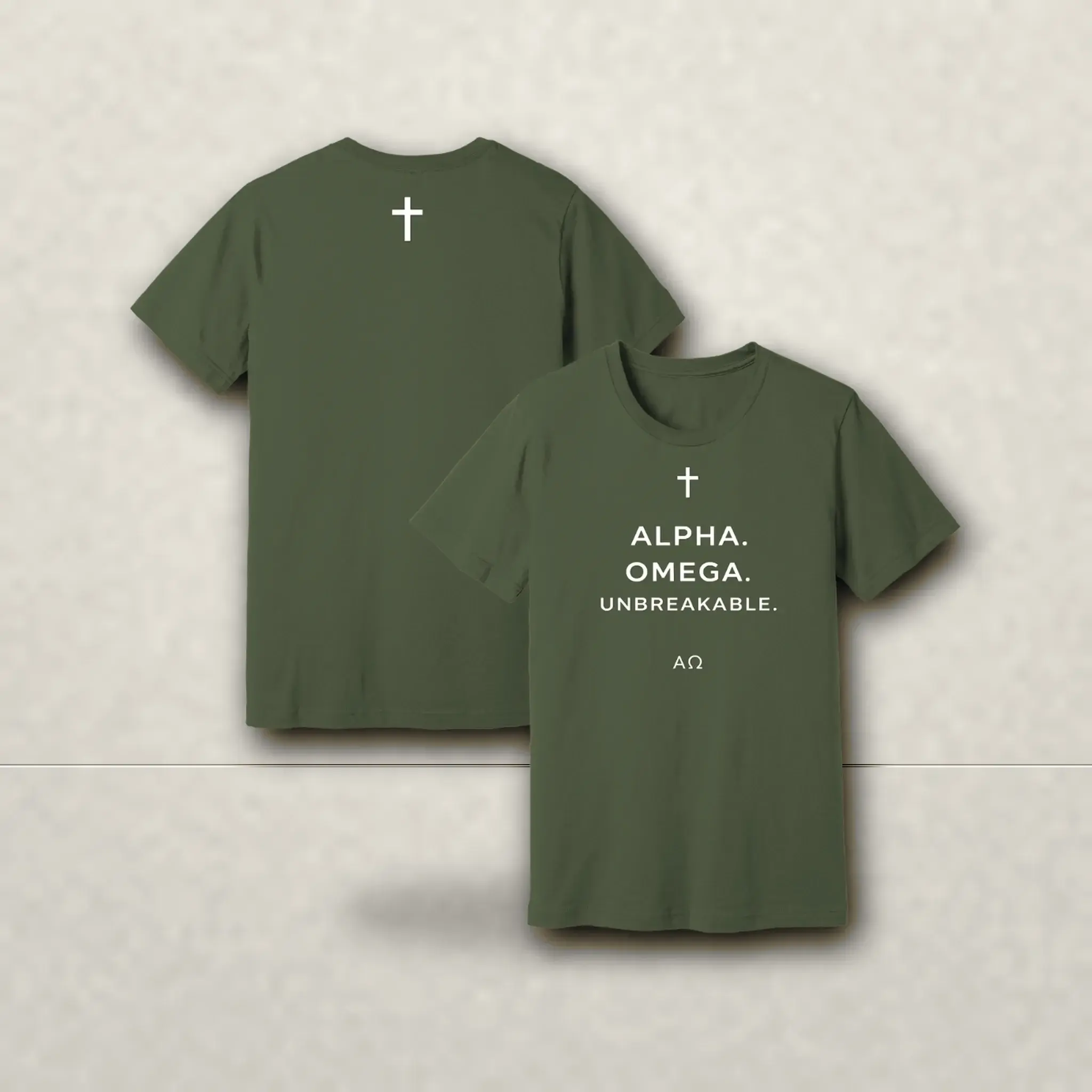
// GEAR WORN IN THIS TRAINING

PUBLISHED JUNE 10, 2026