
// FAITH
Finding a Faith-Driven Training Partner: How Iron Sharpens Iron in the Gym
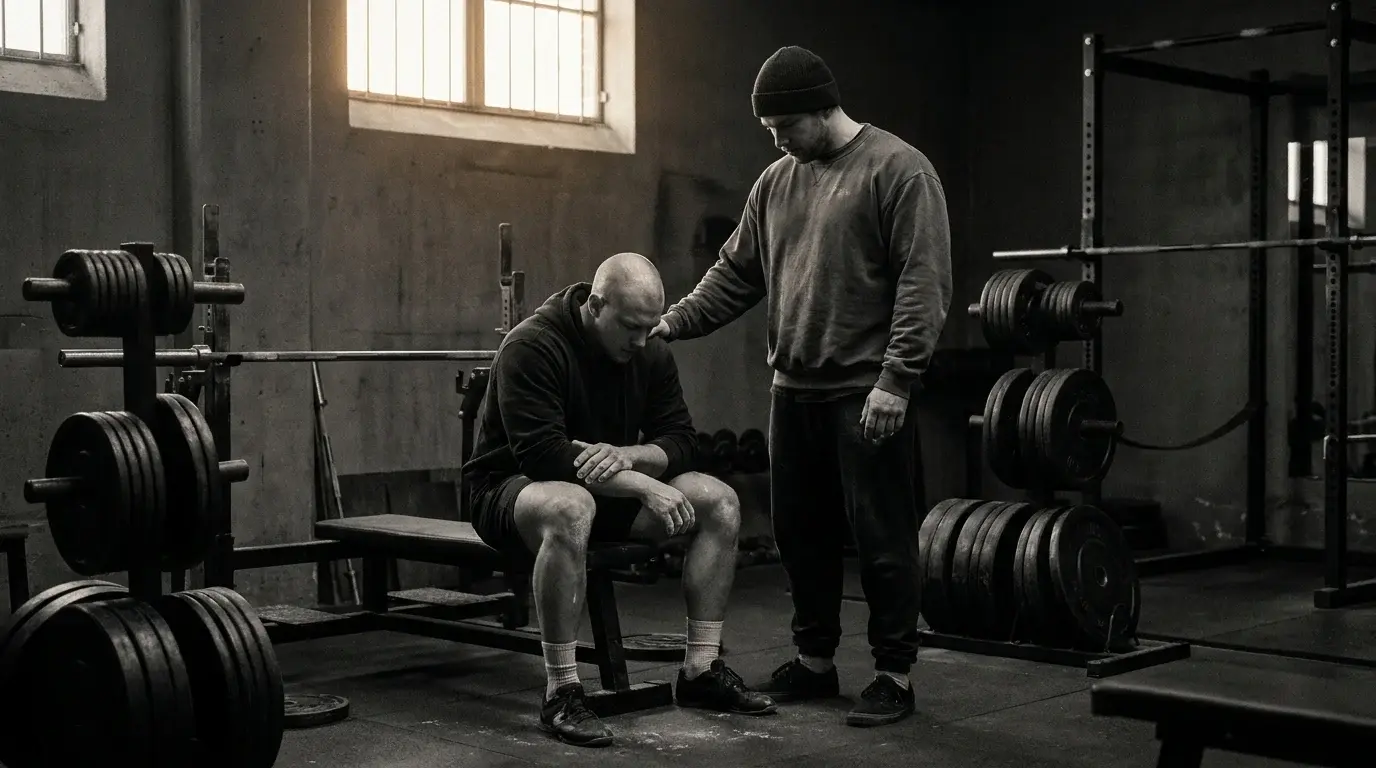
Solo training has a ceiling — the weight you won't attempt without a spot and the session you'll skip when no one notices. Here's how to find a faith-driven training partner, how to choose the right one, and why Scripture treated iron sharpening iron as obvious.
Pete Fluriach, founder of Alpha Omega Strength Team. I trained alone for the first three years I took the barbell seriously. Early mornings, empty garage, headphones in, nobody watching. I told myself I preferred it that way, and for a while the numbers went up anyway. Then they stopped. Not because my program was wrong, but because there is a ceiling every solo lifter eventually hits: the weight you will not attempt when there is no one there to catch it, and the training day you will quietly skip when no one notices you are gone.
A faith-driven training partner is the single cheapest, most underrated upgrade to a serious strength program. Not a hype man. Not a gym buddy who films your sets. A man who shows up, spots you honestly, tells you the truth about your form and your character, and points you back to the standard when you drift. This guide is about how to find one, how to choose the right one, and why Scripture treated this as obvious three thousand years before anyone racked a barbell.
What Every Faith-Driven Lifter Needs to Know About Training Partners
A training partner is anyone who trains alongside you regularly enough that your absence is noticed and your effort is witnessed. A faith-driven training partner adds one thing on top of that: a shared understanding that the body is being trained for something larger than the mirror. You do not have to attend the same church, agree on every doctrine, or pray between sets. You do have to share the standard.
There are a few kinds of training partner most men end up with:
- The steady partner — one man, same schedule, same program, for years
- The crew — a small group of three or four who lift loosely together
- The coach or trainer — paid, structured, one direction of accountability
- The remote partner — a friend you never lift beside but report to weekly
- The church-based partner — a brother from your congregation who trains too
Before you go looking, hold the four variables that decide whether a partnership survives contact with a real training year:
- Proximity — close enough that meeting up is never a logistics problem
- Schedule — training windows that actually overlap without heroics
- Standard — a comparable seriousness about effort, form, and showing up
- Character — someone you would still respect if you never touched a barbell together
By the end of this guide you will have a working filter for who to train with, a clear read on why solo training plateaus, and a concrete plan for finding a partner in the one place most lifters never think to look — their own church.
Why Solo Training Has a Ceiling — and What Scripture Says About It
Christian fitness content tends to fail in one of two directions. Half of it is verse-decorated bravado — a bar loaded past anyone's ability and a Scripture reference stamped underneath with no thought behind it. The other half is so gentle it never makes contact with the actual demands of a heavy program. The training-partner question sits between those failures, because it is at once deeply practical and deeply biblical. The Bible does not treat solo effort as the mark of a strong man. It treats isolation as a vulnerability.
The clearest text is one every lifter has seen on a wall somewhere: "As iron sharpens iron, so one person sharpens another" (Proverbs 27:17 NIV). But the sharper argument is in Ecclesiastes. "Two are better than one, because they have a good return for their labor: If either of them falls down, one can help the other up. But pity anyone who falls and has no one to help them up" (Ecclesiastes 4:9-10 NIV). That is not sentiment. Under a loaded bar, it is literal. The man training alone is the man with no one to help him up.
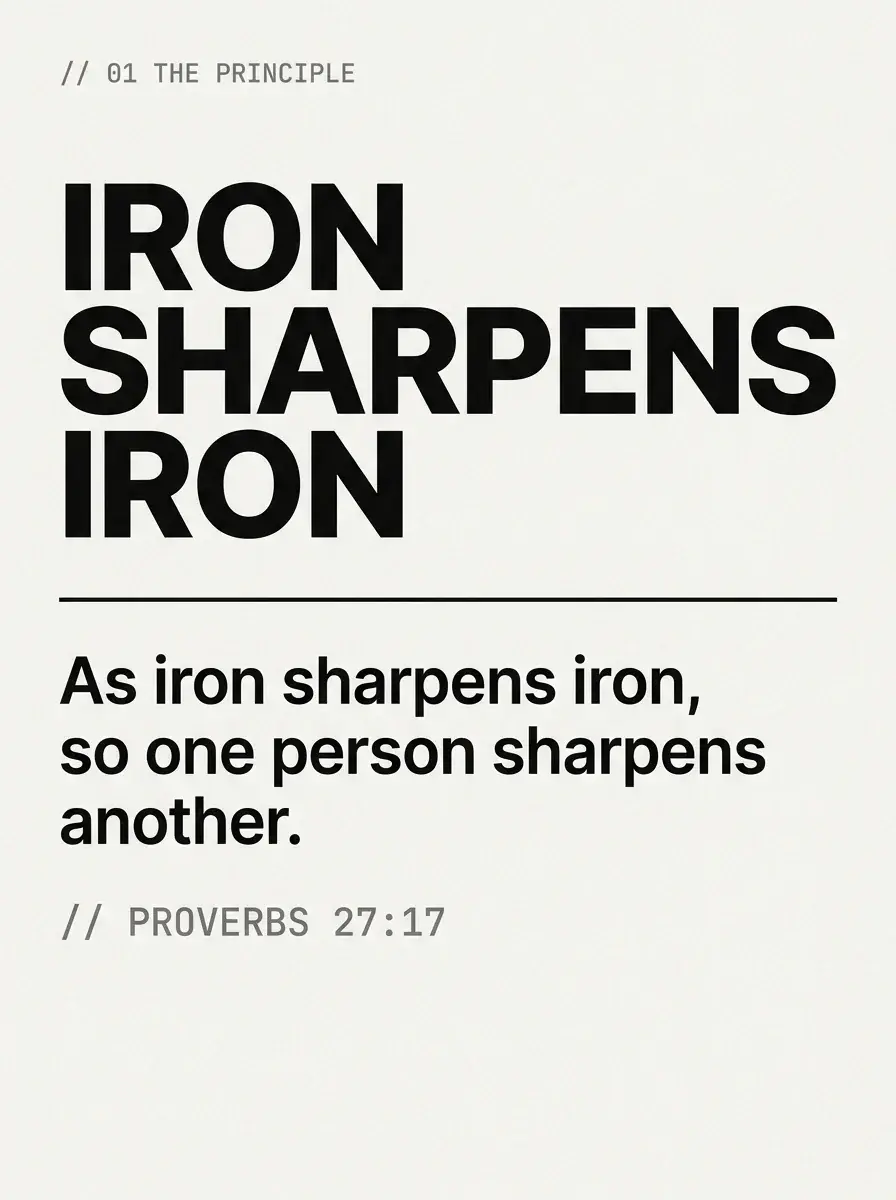
Iron Sharpens Iron Is Not a Metaphor for Comfort
Read the proverb carefully. Sharpening is abrasive. Two blades held gently against each other do nothing. Iron sharpens iron through friction, pressure, and heat — the exact conditions most of us organize our lives to avoid. A real training partner is not primarily there to encourage you. He is there to create productive friction: to notice when your last set was soft, to load the bar you were about to talk yourself out of, and to say the honest thing when you are making excuses. Comfort does not sharpen anyone.
- Function — creates productive friction, not constant applause
- Effect — raises the floor of your worst training days, not just the ceiling of your best
- Cost — requires you to be sharpened too, which most men quietly resist
The Cord of Three Strands
Ecclesiastes finishes the thought: "Though one may be overpowered, two can defend themselves. A cord of three strands is not quickly broken" (Ecclesiastes 4:12 NIV). Two men holding each other accountable is strong. Two men who both answer to God is stronger — that is the third strand. This is why a faith-driven partner is categorically different from a training buddy. The accountability does not stop at the two of you. It runs up to something neither of you can talk the other out of.
How to Choose the Right Training Partner
Most training partnerships die inside two months, and the reason is almost always a mismatch nobody named up front — one man wants to talk, the other wants to work; one treats the session as sacred, the other treats it as optional. Before you commit to lifting beside someone for a year, run the setup through the comparison below and be honest about which structure actually fits your life.
| Setup | Accountability | Strength Ceiling | Best For |
|---|---|---|---|
| Training alone | Self only — easy to skip | Capped at what you'll attempt with no spot | Veterans with deep discipline |
| One steady partner | High — your absence is noticed | High — you load what you wouldn't dare solo | Most lifters; iron-sharpens-iron by design |
| Small crew (3-4) | Broad but diffuse | Strong on lift day, weak on off days | Social lifters who need energy in the room |
| Coach or trainer | Paid, structured, one direction | Highest for skill; costs money | Beginners and technical lifts |
| Church-based partner | High, and spiritual | Sharpens body and character together | Faith-driven men who want both |
The Steady Partner — for the Long-Haul Lifter
- Best for: men who train the same days every week and value consistency over novelty
- Strength: your absence is felt; the relationship compounds over years
- Weakness: a bad match locks you into someone whose standard is below yours
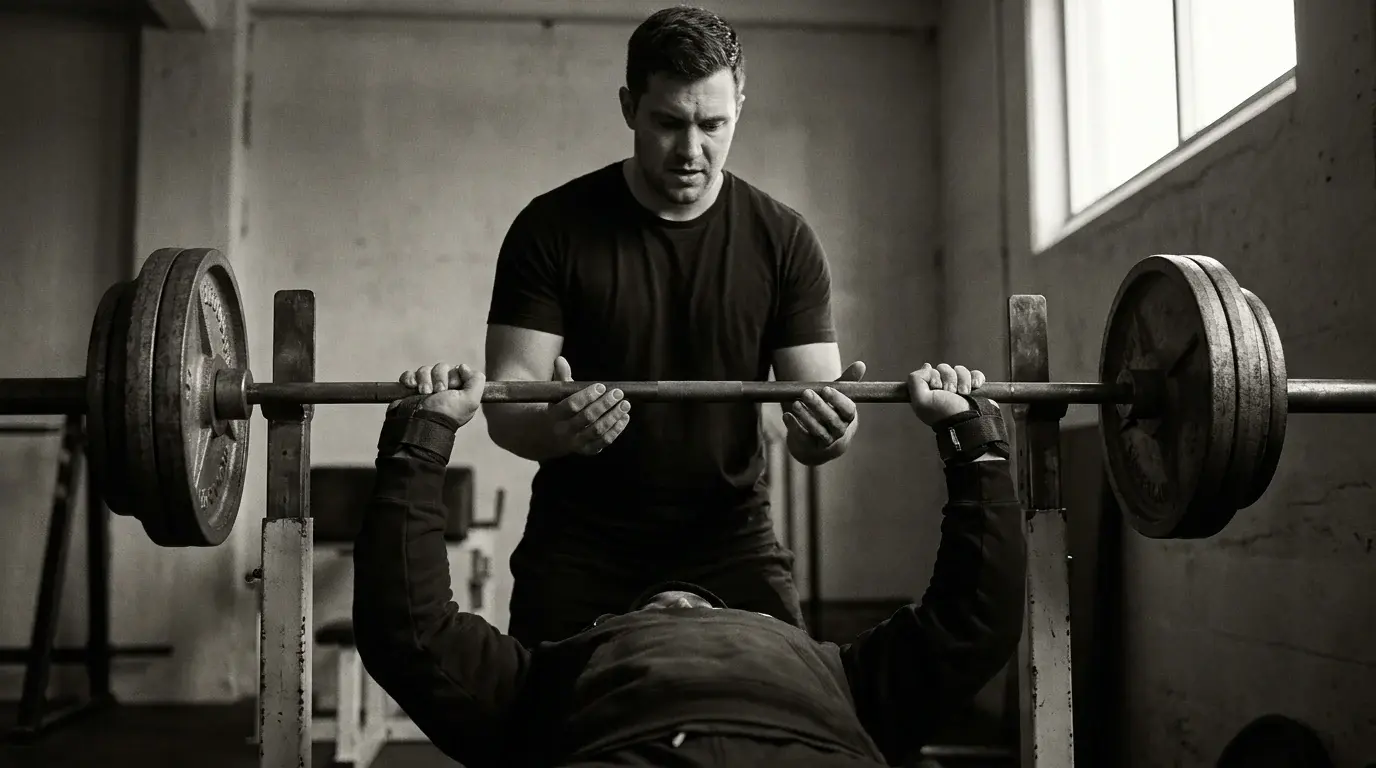
The Crew — for the Lifter Who Feeds Off the Room
- Best for: garage crews, powerlifting rooms, men energized by other men working
- Strength: hard to skip a session three other people are counting on
- Weakness: accountability gets diffuse — everyone assumes someone else will call you out
The Coach — for the Beginner or the Technical Lift
- Best for: your first year under the bar, or cleaning up a squat, bench, or deadlift
- Strength: expertise you cannot give yourself, and a fixed appointment you paid for
- Weakness: the accountability runs one direction, and it ends when the money does
Expert tip: if you are starting from zero, do not hold out for the perfect partner. Find one man whose seriousness roughly matches yours, agree on two fixed training days, and commit to eight weeks before you evaluate anything. Most great partnerships did not feel obvious in week one — they were built by showing up.
Where to Actually Find a Faith-Driven Training Partner
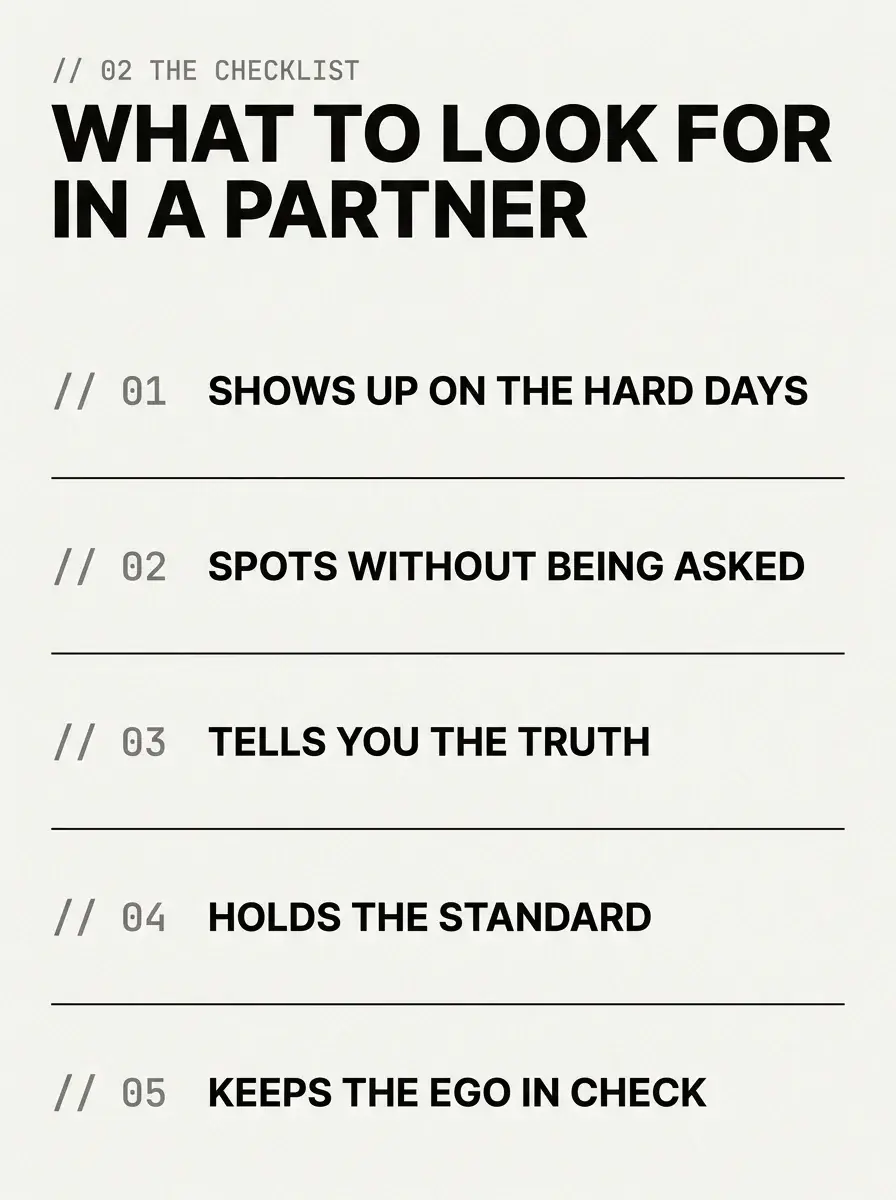
The checklist above is the filter. The harder question is where to find a man who clears it. The answer changes with where you are in your training life, and with where you already spend your time.
- The new lifter (0-12 months): prioritize a coach or a patient veteran over a peer. You need correction more than company right now, and a bad habit learned early takes years to unlearn.
- The intermediate lifter (1-4 years): this is the sweet spot for a steady partner. You know enough to train hard and not enough to keep your ego honest alone. Find your equal and let the friction do its work.
- The advanced lifter (5+ years): you are now the iron that sharpens someone else. Training a younger brother is not charity — teaching a lift is one of the fastest ways to deepen your own mastery of it.
Your Church Is the Best Recruiting Ground
Most men look for a training partner at the gym and never think to look at church, which is backwards. At the gym you are gambling on a stranger's character. At church you already have a read on the man before a single plate is loaded. Ask around the men's ministry. Float it after a service. Post it in the group chat. You are not looking for the strongest guy in the building — you are looking for the one who shows up when he says he will, because that is the whole game.
If You Train at a Commercial Gym
As of 2026, commercial gyms are louder, more screen-saturated, and more solitary than they have ever been. Rooms full of men, each sealed inside his own set of headphones. You can still find a partner there, but it takes deliberateness: train the same hours consistently until you recognize the regulars, offer a spot before you ask for anything, and let a partnership form over weeks. The man who spots you well twice is worth a conversation.
Why Faith-Integrated Training Identity Makes a Difference
Most men who try to train with intention quit within a couple of months. Not because they stop believing it matters, but because gym culture quietly pulls them back toward training that is only about appearance, ego, or escape. A partner is the counterweight. When the man beside you shares the conviction that this work is stewardship, not vanity, the standard holds on the days your own resolve does not. Identity is easier to keep when it is shared.
- Quiet, unflinching conviction — Alpha and Omega, the beginning and the end — carried by how you train, not by what you announce.
"I am the Alpha and the Omega, the First and the Last, the Beginning and the End" (Revelation 22:13 NIV). That is the frame the whole thing hangs on. A faith-driven partnership is two men training under the same beginning and the same end — which is exactly why it outlasts the partnerships built on nothing but a shared bench.
Getting the Most Out of a Training Partnership
- Set two fixed training days and treat them like appointments you cannot move
- Agree up front on how you want to be corrected — most partnerships die from unspoken resentment, not honesty
- Spot generously and honestly; never let ego turn a grinder into an injury
- Check on each other off the gym floor — the strongest partnerships are friendships that happen to lift
Frequently Asked Questions About Training Partners
What if I can't find anyone who trains as seriously as I do?
Lower the bar on strength, never on character. A partner two plates behind you who shows up every session and tells you the truth is worth more than a stronger man who flakes. You can pull someone up in the numbers over time. You cannot install reliability in a man who does not have it.
Isn't relying on a partner a sign of weakness?
Scripture says the opposite. "Two are better than one" is not a concession to weakness; it is a description of strength. The man who insists on doing everything alone is not stronger — he is just more exposed. A cord of three strands is not quickly broken, and neither is a lifter who trains inside real accountability.
How do I bring up faith with a training partner without being preachy?
You mostly do not have to. Train with integrity, keep your word, handle a bad day without falling apart, and the questions come to you. A faith-driven identity is more convincing carried than announced. If a brother from church is your partner, it is already shared and needs no speech at all.
Can an online or long-distance partner really work?
For accountability, yes; for spotting, obviously not. A remote partner you report to weekly can keep you honest about whether you trained and how hard. But he cannot hand you the bar you were afraid to attempt. If you train alone in person, a remote partner is a real upgrade over nothing — just know its ceiling.
Conclusion
Strength training rewards the man who keeps showing up, and almost nothing improves your odds of showing up like another man expecting you at the rack. A faith-driven training partner does not make the weight lighter. He makes you steadier under it — harder to talk out of the hard set, harder to excuse out of the early morning, harder to break when the program asks for years instead of weeks. Iron sharpens iron. It always has.
Find the man. Set the days. Then go deeper on why the work itself is worship in the Lifter's Guide to Training as Worship.
// FREQUENTLY ASKED
Questions, answered.
What if I can't find anyone who trains as seriously as I do?
Lower the bar on strength, never on character. A partner two plates behind you who shows up every session and tells you the truth is worth more than a stronger man who flakes. You can pull someone up in the numbers over time. You cannot install reliability in a man who does not have it.
Isn't relying on a partner a sign of weakness?
Scripture says the opposite. "Two are better than one" is not a concession to weakness; it is a description of strength. The man who insists on doing everything alone is not stronger — he is just more exposed. A cord of three strands is not quickly broken, and neither is a lifter who trains inside real accountability.
How do I bring up faith with a training partner without being preachy?
You mostly do not have to. Train with integrity, keep your word, handle a bad day without falling apart, and the questions come to you. A faith-driven identity is more convincing carried than announced. If a brother from church is your partner, it is already shared and needs no speech at all.
Can an online or long-distance partner really work?
For accountability, yes; for spotting, obviously not. A remote partner you report to weekly can keep you honest about whether you trained and how hard. But he cannot hand you the bar you were afraid to attempt. If you train alone in person, a remote partner is a real upgrade over nothing — just know its ceiling.
// GEAR WORN IN THIS TRAINING


PUBLISHED JULY 16, 2026