// FAITH
The Lifter's Devotional Guide to Training as Worship: Strength Training and Faith

What does it mean to lift weights as an act of worship? This devotional guide explores the Hebrew theology of avodah, the New Testament view of the body, and how every hard set can become an offering.
Pete Fluriach, founder of Alpha Omega Strength Team. This guide pulls together what I've learned about training as a form of worship - the Hebrew theology of avodah, the New Testament view of the body, and the practical rhythm that makes training a daily discipline of the soul, not just the muscles.
Most people who lift seriously come to a point where the surface motivation stops being enough. The aesthetic goal gets reached, or it doesn't, and either way the question underneath it surfaces: why am I actually doing this?
That question isn't a weakness. It's the right one. And for the person who walks with God, the answer available to you is deeper than anything the fitness industry can offer.
This post is for Christians two or more years into training - men and women who understand progressive overload and know their way around a barbell, but who want their training life to mean something more than a number on a log. We'll cover the theological foundation, the practical modes of integration, and the common failure points that turn training into an idol rather than an offering.
The Theological Foundation: What Scripture Actually Says About the Body
Start with a word most English readers have never encountered: avodah (עֲבוֹדָה). In biblical Hebrew, avodah is translated as both "work" and "worship" depending on context. The same word describes the Levitical priests performing their temple service and a farmer working his field. The conceptual wall we draw between sacred and secular labor - between a Sunday service and a Tuesday morning at the gym - is not a wall the original text builds.
Old Testament scholar John Walton, in his work on Genesis 2, argues that Adam was placed in the garden to perform avodah - to work it and keep it - and that this labor was from the beginning a form of service to God, not separate from it. The implication is significant: human physical effort, directed with the right intention, has always carried the possibility of being an act of devotion.
The Hebrew Concept of Avodah
Avodah appears 145 times in the Hebrew Old Testament. It covers the full range of human productive effort - from priestly sacrifice to agricultural labor to military service. What unifies all these uses is not the type of activity but the orientation of the person doing it. The work becomes worship when it is done as service to God rather than purely for self.
This is not a soft distinction. It has weight. It means the question "is lifting weights a spiritual act?" is the wrong question. The right question is: in whose name am I doing it?
Romans 12:1 - The Central Text
"Therefore, I urge you, brothers and sisters, in view of God's mercy, to offer your bodies as a living sacrifice, holy and pleasing to God - this is your true and proper worship." - Romans 12:1
Romans 12:1, NIV
Paul's language here is deliberate and physical. He is not speaking metaphorically about offering your thoughts or your intentions. He says bodies - soma in Greek, the same word used throughout the New Testament to describe the physical human form. And the Greek word translated "worship" in this verse is latreia, the same term used for the Levitical priestly service. Paul is mapping temple vocabulary onto everyday physical life.
The phrase "living sacrifice" is intentional. Old Testament sacrifices were killed. Paul flips the frame: this sacrifice keeps going - it shows up, it trains, it adds weight to the bar when it wants to stay comfortable. The discipline is the offering.
1 Corinthians 10:31 and Colossians 3:23
"So whether you eat or drink or whatever you do, do it all for the glory of God." - 1 Corinthians 10:31
1 Corinthians 10:31, NIV
"Whatever you do, work at it with all your heart, as working for the Lord, not for human masters." - Colossians 3:23
Colossians 3:23, NIV
These two verses bracket the question from both ends. First Corinthians establishes the universal scope - whatever you do. Colossians establishes the posture - as working for the Lord, with all your heart. Together they don't carve out an exception for the gym. They explicitly include it.
Five Modes of Worship Integration - Choosing What Fits Your Training
Knowing the theology is the foundation. The practical question is what it actually looks like to train with a worshipful orientation. Not every mode fits every person or every season. The table below maps five distinct approaches - ranging from contemplative silence to structured devotional practice - so you can identify what matches your temperament and schedule rather than trying to force a method that creates friction instead of depth.
Worship Integration Modes - How to Bring Faith into Your Training
Mode | Primary Focus | Best Context | Faith Depth | Potential Friction
Silent training | Intentional quiet; body as offering with no external aid | Early morning, solo sessions, heavy compound work | High - requires internal orientation | Easy to drift into just grinding
Scripture-meditated training | One verse memorized and mentally repeated through the session | Long rest periods; Olympic lifting; deadlift work | Very high - scripture anchors attention | Requires verse selected in advance
Worship-music training | Curated worship playlist; music as the ambient frame | Conditioning work, accessory lifts, hypertrophy days | Moderate - depends heavily on song selection | Can become performance-feel without intentionality
Devotional-before-set training | 5-minute Bible reading or prayer before entering the gym | Any training style; especially useful for morning sessions | High - sets the tone before load is on the bar | Easiest to skip when time-pressed
Prayer-paired training | Specific, spoken or silent prayer tied to each working set | Lower-intensity days, rehab work, deload weeks | Very high - each set becomes a discrete act of offering | Can interrupt flow on max-effort days
The honest observation from lifters who have practiced each of these: no single mode works every day, and none of them requires announcing itself to anyone else in the gym. The internal orientation is the practice. The external expression is optional.
Training Motivations - From Performance to Purpose
Before you can integrate worship into your training, it's worth being honest about what's currently driving it. Most people cycle through several of these motivations across a training career. The progression from aesthetics toward worship isn't a moral ladder - it's a maturity arc.
Aesthetics (look better): Driven by comparison. Produces diminishing returns and, without a deeper anchor, anxiety. Idol risk is real.
Performance (compete, PR): Achievement-focused. Progress is real, but ego attachment can crowd out everything else. Neutral to positive.
Health (live longer): Grounded in fear of illness more than love of life. Good habits, low joy. Neutral.
Identity (who I am in Christ): Driven by calling and stewardship. Sustainable, joy-producing. Spiritually aligned.
Worship (offering to God): Gratitude and discipline as the engine. Holistic - body and spirit together. Highest alignment.
Notice that the top motivation is not "discipline for its own sake." Discipline without a recipient becomes self-worship. That is one of the quieter dangers in faith-fitness culture - exchanging the pursuit of vanity for the pursuit of ascetic pride, which is the same root with a different label.
What Worship-Integrated Training Actually Looks Like
The mistake most people make when they first encounter the idea of training as worship is to picture something theatrical - praying out loud between sets, bringing a Bible into the squat rack, wearing a cross necklace over a lifting shirt. None of that is what this is about.
Worship-integrated training is almost entirely invisible from the outside. It's an interior posture. Here's what it produces concretely:
The Specific Moments Where It Shows
You add five pounds when you want to stay comfortable. Most people avoid that decision because it requires confronting real failure. When the orientation is worship, the calculus changes: this isn't about your ego - it's about stewarding the capacity God gave you. Staying comfortable when you have more to give is a different kind of failure.
You show up when nobody's watching. The workout nobody sees - Tuesday at 6am, empty gym, no PR attempt - is the one that most resembles what Paul means by a living sacrifice. It costs something and it goes unwitnessed by anyone except God.
You receive a failed rep without humiliation. Training teaches the body what it means to have limits. For the lifter whose identity is rooted in Christ and not in performance, a missed lift is data, not a verdict. The equanimity this produces is itself a spiritual formation outcome.
You stop training on days your body genuinely cannot. The same discipline that gets you to the gym must also know when to stay home. Caring for the body as a steward - not punishing it as an owner - is part of what offering it as a living sacrifice means. For a deeper exploration of what that boundary looks like, the post on training through the valley covers the mental and spiritual side of the hardest training seasons.
Avoiding the Idol Trap
It is possible - and common - to speak the language of training as worship while actually training for self. The signals aren't obvious, but they're consistent: anxiety when a training session gets missed, irritability when someone disrupts the program, identity destabilization when strength declines. These aren't signs of discipline. They're signs of misplaced worship.
Timothy Keller, in Counterfeit Gods, defines an idol as any good thing that becomes an ultimate thing. Training is not inherently an idol. But when your emotional wellbeing depends more on your gym log than on your relationship with God, the sequence has inverted. The test is simple: can you take a deload week without losing your sense of self?
The worshipful lifter can. Because the offering isn't the result - it's the practice. A week of intentional rest, offered with the same heart as the hardest training week, is still avodah.
Why This Framework Shapes Everything at Alpha Omega
Alpha Omega Strength Team was built around a single conviction: that the person who trains for the right reasons builds something that outlasts every aesthetic goal and every competitive season. The name - drawn from Revelation 22:13, the beginning and the end - frames training inside the arc of a life, not a program cycle.
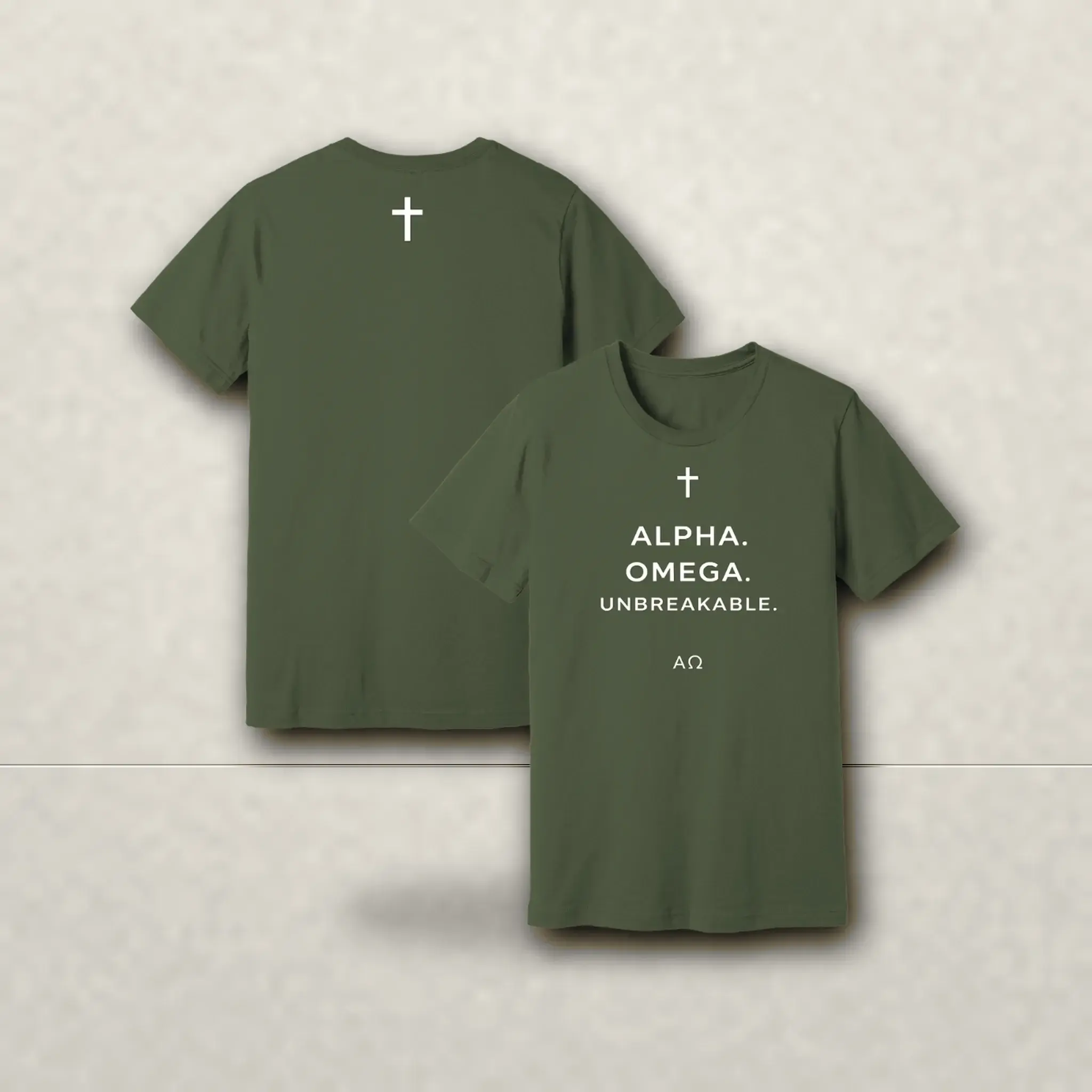
That's why the apparel doesn't carry aggressive slogans. It doesn't need to perform anything. The person wearing it knows what they're doing in the gym and why. The gear is just a quiet signal - a marker of an identity that was decided before the first rep.
If you want more background on the mission and why we built this brand to specifically serve the serious Christian athlete - not the devotional market, not the mainstream fitness market - the about page lays that out directly.
Building a Practical Rhythm
If the theology is right and the motivation is aligned, the rhythm becomes simple. You don't need a complicated ritual. Four things, consistently:
1. Set the intention before you start. One sentence - spoken or written - that names the offering. "This session is for You" is enough. It re-orients the purpose before any load is on the bar.
2. Choose a weekly anchor verse. One scripture that travels with you through the week's training. Not a verse you perform - a verse you live in. Romans 12:1, Colossians 3:23, and Hebrews 12:11 are strong starting points.
3. Train with full effort. Colossians 3:23 is explicit: with all your heart. Half-hearted effort offered as worship is not worship - it's going through the motions. The quality of the offering matters.
4. Close the session with gratitude. Thirty seconds. What moved today, what held, what you're grateful for. The bookending of training with intention and gratitude is the simplest structural change you can make - and it changes the texture of the whole session over time.
Frequently Asked Questions
Does God actually care about physical fitness, or is it only about spiritual health?
First Timothy 4:8 is the verse most often cited to minimize physical training: "physical training is of some value, but godliness has value for all things." It's a real verse, and the comparison is real. But "some value" is not "no value." Paul wrote to an audience that understood physical discipline deeply - the Greek athletic culture was the backdrop - and his point was proportion, not dismissal. The body is God's creation, the Spirit's temple (1 Corinthians 6:19), and stewarding it well is a form of faithfulness to both of those truths. Physical fitness is not the pinnacle of spiritual life. It is also not irrelevant to it.
How do I prevent training from becoming an idol if I'm serious about lifting?
The practical test is emotional response to disruption. A missed session due to illness, travel, or family obligation should not produce significant distress. If it does, the training has become load-bearing for your sense of self in a way it shouldn't be. The corrective isn't to train less - it's to be honest with God about what you're actually worshipping and ask for reorientation. The identity question and the intensity question are separate: you can be a very serious lifter with a very surrendered heart. The two are not in conflict. What creates the idol is the sequence - when performance precedes purpose.
What is a practical way to bring my faith into the gym without making it performative?
Start with the pre-session intention - one quiet moment before you walk onto the floor where you name the offering. No one else needs to see it or know about it. From there, pick one of the five modes in the table above that fits your temperament and try it for four weeks before evaluating. The most common failure is trying to be too comprehensive too fast - adding a verse, a prayer, worship music, and a devotional all at once until the added friction makes you drop all of it. One anchor, practiced consistently, will go deeper than five methods practiced sporadically.
The Gym Is Already Sacred Ground
The avodah concept doesn't require you to make the gym sacred. It reveals that it already can be. The work and the worship were never as separate as modern language made them sound. Every time you approach the bar with the intention of offering - not performing, not proving, not comparing - you're practicing one of the most ancient forms of devotion available to a human being: the sanctification of ordinary labor.
You don't need a different program. You need a different reason. Start with that, and the rest of the training life - the hard days, the stalled weeks, the seasons of injury and the seasons of breakthrough - carries a weight that no aesthetic goal ever could.
// FREQUENTLY ASKED
Questions, answered.
Does God actually care about physical fitness, or is it only about spiritual health?
First Timothy 4:8 is the verse most often cited to minimize physical training: "physical training is of some value, but godliness has value for all things." It's a real verse, and the comparison is real. But "some value" is not "no value." Paul wrote to an audience that understood physical discipline deeply - the Greek athletic culture was the backdrop - and his point was proportion, not dismissal. The body is God's creation, the Spirit's temple (1 Corinthians 6:19), and stewarding it well is a form of faithfulness to both of those truths. Physical fitness is not the pinnacle of spiritual life. It is also not irrelevant to it.
How do I prevent training from becoming an idol if I'm serious about lifting?
The practical test is emotional response to disruption. A missed session due to illness, travel, or family obligation should not produce significant distress. If it does, the training has become load-bearing for your sense of self in a way it shouldn't be. The corrective isn't to train less - it's to be honest with God about what you're actually worshipping and ask for reorientation. The identity question and the intensity question are separate: you can be a very serious lifter with a very surrendered heart. The two are not in conflict. What creates the idol is the sequence - when performance precedes purpose.
What is a practical way to bring my faith into the gym without making it performative?
Start with the pre-session intention - one quiet moment before you walk onto the floor where you name the offering. No one else needs to see it or know about it. From there, pick one of the five modes in the table above that fits your temperament and try it for four weeks before evaluating. The most common failure is trying to be too comprehensive too fast - adding a verse, a prayer, worship music, and a devotional all at once until the added friction makes you drop all of it. One anchor, practiced consistently, will go deeper than five methods practiced sporadically.
// GEAR WORN IN THIS TRAINING

PUBLISHED JUNE 10, 2026