// RECOVERY
The Faith-Driven Comeback: Returning to the Bar After Injury Without Losing Your Mind

An injury takes more than your training - it takes the identity you built around it. Here is the practical, four-phase protocol for returning to lifting after injury, and the faith frame that makes patience an act of obedience instead of a defeat.
Pete Fluriach, founder of Alpha Omega Strength Team. An injury does something a bad workout never does: it takes the thing you had ordered your week around and sets it out of reach. The lift you were proud of is gone for a while, and with it goes a quiet piece of how you saw yourself. I have watched strong men handle the pain of the injury fine and then come apart over the waiting. This guide is the return protocol I hand a cleared lifter, phase by phase, and the faith frame that keeps the long walk back from turning into a second injury.
First, the non-negotiable: get cleared by a doctor or a physical therapist before you touch a barbell again. Nothing below replaces a medical professional who has looked at your actual injury. What follows assumes you have that clearance and now face the real question no clinic answers well - how do you rebuild without rushing, and how do you stay sane while the numbers sit far under what they used to be.
What Every Lifter Needs to Know About Returning to Lifting After Injury
Returning to lifting after injury is the deliberate, staged process of reintroducing load to a healed structure so it adapts back to full capacity without breaking down again. The key word is staged. The tissue that healed is not the tissue you left - it is newer, less conditioned, and it earns back its strength on a timeline you do not control. Fight that timeline and you lose. Work with it and it pays out in full.
Before you load anything, hold the four things that decide whether a comeback works:
- Clearance - a medical professional has confirmed the structure is healed enough to load progressively
- Load - how heavy the bar is relative to your pre-injury best, kept intentionally low at the start
- Signal - what your body tells you during and the day after a session, which now matters more than the weight
- Patience - the willingness to advance on a rule instead of on your mood, phase by phase
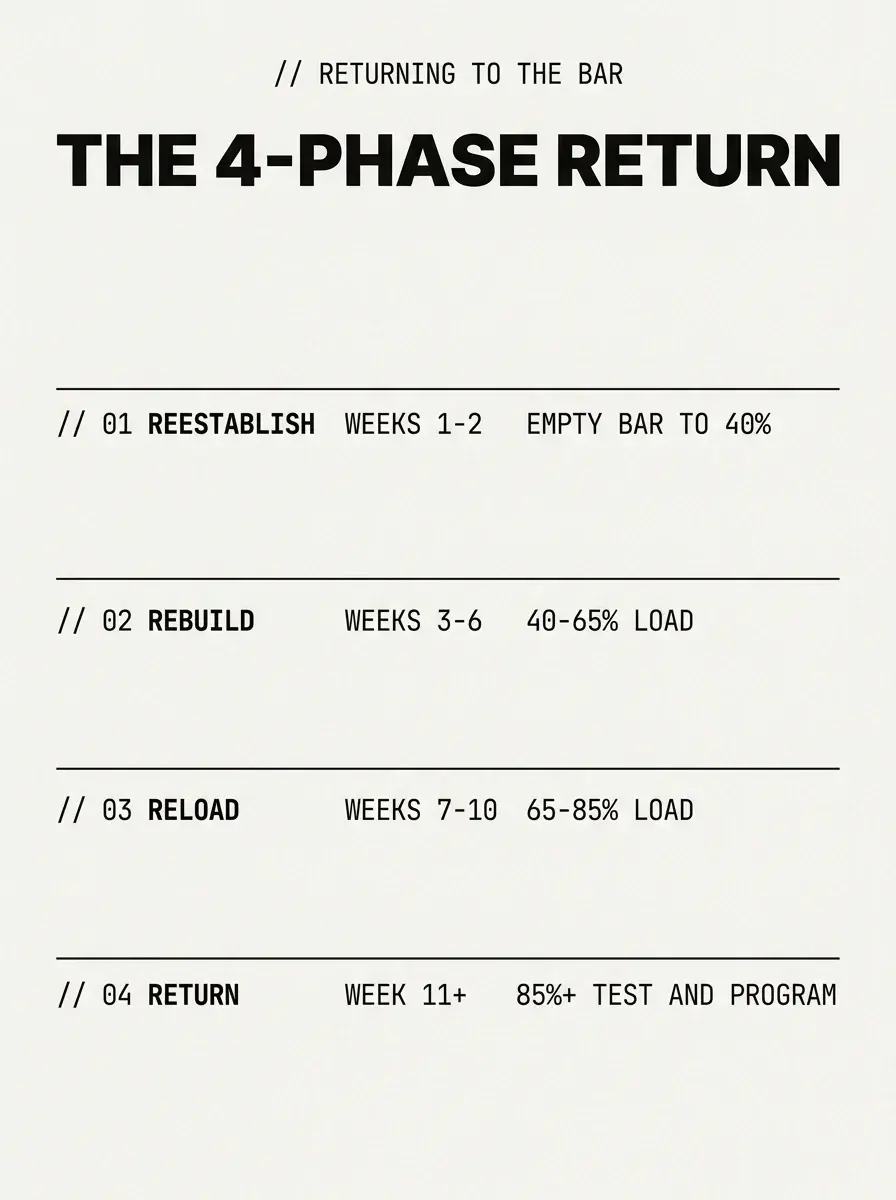
Get those four in order and the body does what it was made to do. Here is the whole return at a glance before we walk through it phase by phase.
Why the Waiting Hurts More Than the Injury
Most men expect the injury to be the hard part. It is not. The hard part is the season after, when the pain is mostly gone but the strength is not back, and every session is a reminder of what you used to move. That gap - between who you were under the bar and who you are today - is where a lot of good lifters quietly quit. They do not decide to stop. They just stop showing up, because showing up feels like grief.
This is where a faith-driven lifter has a real advantage, if he will take it. Scripture does not treat weakness as a verdict. Paul, who asked God three times to remove a thorn, was told this: “My grace is sufficient for you, for my power is made perfect in weakness” (2 Corinthians 12:9 NIV). Made perfect in weakness. The season where you feel least capable is not a detour from the work God is doing in you - it is often the road itself.
Patience Is Not Passivity - It's Obedience
We treat patience like a soft virtue - something you settle for when you cannot force the issue. In a comeback it is the opposite. Choosing to start with an empty bar when your pride wants three plates is one of the more disciplined things a strong man will ever do. Romans lays out why it is worth it: “we also glory in our sufferings, because we know that suffering produces perseverance; perseverance, character; and character, hope” (Romans 5:3-4 NIV). The waiting is not wasted. It is producing something the fast version never could.
- Function - a staged return redirects the drive you still have toward a target the healed tissue can actually reach
- Length - long enough for real remodeling of tissue, structured enough to keep you accountable: think in weeks, not days
- Cost - the ego hit of training lighter than the guy next to you who was never hurt
- Result - a body that comes back stronger and more durable than the one that got hurt, because it was rebuilt on purpose
How to Choose Your Approach to the Comeback
Every returning lifter picks an approach, whether he names it or not. Most pick badly, because fear and pride both push you toward the wrong extreme. The table below lays out the common ways men come back, who each one really serves, and where each one tends to fall apart. Read it honestly and find yourself in it.
| Approach | Best For | What It Looks Like | Where It Breaks Down |
|---|---|---|---|
| The ego return | No one, honestly | Back near old numbers in week one | Re-injury, usually worse than the first |
| The indefinite wait | The fearful | Avoiding the lift until it feels safe | Strength and confidence both keep shrinking |
| The feel-based return | The impatient | Loading by mood, no written plan | Flares up unpredictably, teaches you nothing |
| The phased return (this guide) | Every returning lifter | A written four-phase reload by rule | Asks for patience most men resist |
Why the Phased Return Wins
- It gives you a rule to advance on, so the decision is not left to the day your ego feels brave
- It rebuilds capacity in order - range of motion, then volume, then intensity - the sequence tissue actually heals in
- It turns a scary, open-ended return into a plan with a visible finish line you can trust
Learn to Read the Signal Before You Load
In a normal training block the weight tells you what to do. In a comeback the signal does. Learn the difference between two kinds of discomfort: the ordinary ache of muscle doing work, which is fine, and sharp, localized, or joint-line pain at the injury site, which is a stop sign. The most important data point is not how the set felt - it is how the injury feels the next morning. Loading that leaves you sore but stable is progress. Loading that leaves the injury angry the next day is a message to back off.
Expert tip: keep a one-line log after every session for the whole return - load used, pain during (0-10), and pain the next morning (0-10). Do not advance a phase if the next-morning number is climbing. That single habit prevents most second injuries, because it replaces your feelings with a record you cannot argue with.
The Four-Phase Return, Phase by Phase
The return runs in four phases. Each has a load range, a focus, and a green-light rule you must meet before you move up. The rule is the whole point - it is what keeps you from advancing on a good day and paying for it on a bad one. Take the phases in order and do not skip.
- Phase 1, Reestablish (weeks 1-2): empty bar up to about 40 percent of your pre-injury working weight, high control, full pain-free range of motion. You are relearning the movement, not testing it. Green light to advance: full range with zero pain, on the day and the morning after.
- Phase 2, Rebuild (weeks 3-6): 40 to 65 percent, moderate volume, controlled tempo. This is where you lay down the base your later strength is cut from. Green light: complete every prescribed set at an easy effort with no next-morning flare for a full week.
- Phase 3, Reload (weeks 7-10): 65 to 85 percent, intensity climbing week to week while volume tapers slightly. The base becomes real strength here. Green light: loads move up on schedule while recovery stays consistent and the injury stays quiet.
- Phase 4, Return (week 11 and on): 85 percent and up, testing a new top set, and folding back into normal programming. You are not being careful anymore - you are being a lifter again. Advance here only after the injury has been symptom-free under load for at least two straight weeks.
The Deload and the Setback You Should Plan For
A comeback is not a straight line, and planning for that is what separates the men who finish from the men who quit at the first bad week. Two things to build in from the start:
- A planned deload - a lighter week at the end of Phase 2 or 3, the week you will most want to skip and most need to take, because it is what lets the next block land
- A setback plan - if the injury flares, drop back one full phase, hold there until it is quiet again, and re-advance by the same rules; a setback is a detour, not a defeat
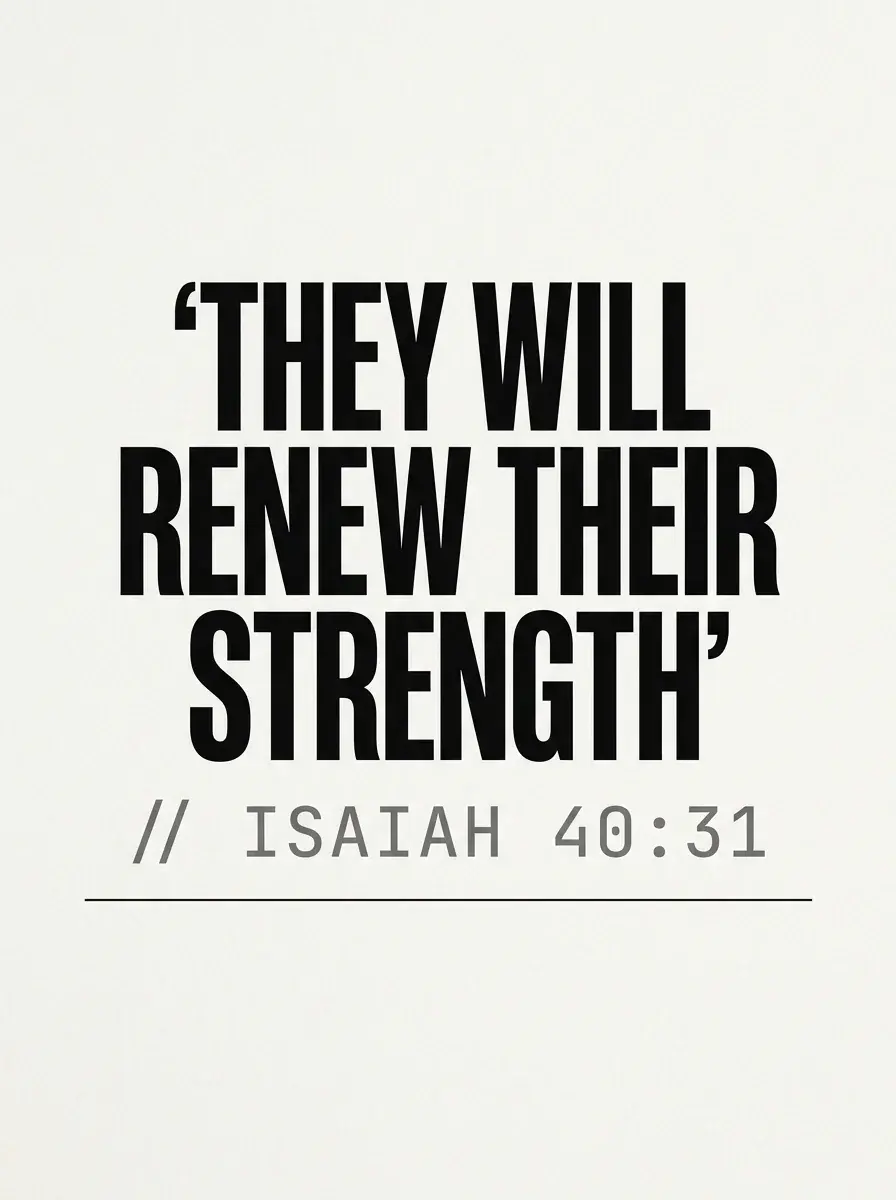
If you want the promise that carries a man through all four phases, it is the one on the infographic above. “Those who hope in the LORD will renew their strength. They will soar on wings like eagles; they will run and not grow weary, they will walk and not be faint” (Isaiah 40:31 NIV). Renewed strength is promised to the one who hopes and waits - not to the one who forces it. That is the whole theology of a comeback in a single verse.
Why Faith Outlasts a Setback
Motivation is useless in a comeback. It shows up on the good days, when the injury feels fine and the loads move, and it vanishes on the days you need it - the flare-up, the plateau, the week you feel further from your old self than ever. What carries a man through those weeks is not feeling. It is conviction that faithful, unglamorous work is worth doing whether or not today rewarded it. That conviction is the backbone of Alpha Omega Strength Team: beginning and end, the whole return held under the lordship of Christ, without the noise.
Getting the Most Out of Your Return
- Get cleared first and, if you can, keep your physical therapist in the loop as you climb through the phases
- Start lighter than your ego wants; the entire return fails if Phase 1 is already an effort
- Track pain, not just weight, and let the next-morning number - never your mood - decide when you advance
- Stop chasing the number you lost; rebuild the base and the number comes back on its own, usually stronger
Frequently Asked Questions About Returning to Lifting After Injury
How long before I can lift heavy again after an injury?
For most cleared lifters, a full return to heavy work takes somewhere in the range of eight to twelve weeks of structured reloading, but the honest answer is that your body sets the clock, not your calendar. The four phases above are guidelines with green-light rules; if the injury stays quiet you move up on schedule, and if it does not you hold. Chasing a fixed date is exactly how men get hurt a second time.
Should I train around the injury or rest completely?
Once you are cleared, training the rest of your body around the injured area is almost always better than sitting still. Complete rest lets strength and conditioning drain away everywhere, which makes the whole return longer. Keep training what is healthy - the other lifts, the other side, conditioning that does not aggravate the site - while you reload the injured pattern by the phases. Ask your physical therapist where the line is for your specific injury.
How do I stop being afraid of the movement that hurt me?
Fear of a movement fades through successful, controlled reps at loads you trust - not through avoiding it or forcing it. That is the quiet genius of starting at an empty bar: every clean, pain-free session is evidence that rebuilds confidence alongside strength. Give the fear a track record to argue with. And name it honestly before God rather than pretending it is not there; courage in Scripture is almost never the absence of fear but obedience carried out in spite of it.
Conclusion
An injury is not the end of your training, and the man you were under the bar is not gone - he is being rebuilt, and if you do this right he comes back more durable than before. The four-phase return asks for the one thing most lifters find harder than heavy weight: the patience to start light, advance on a rule, and trust that renewed strength is coming at the proper time. Get cleared, start with the empty bar, track the signal, and take the phases in order. Those who hope in the LORD will renew their strength - and the man who waits on it is the one who gets it back.
// FREQUENTLY ASKED
Questions, answered.
How long before I can lift heavy again after an injury?
For most cleared lifters, a full return to heavy work takes somewhere in the range of eight to twelve weeks of structured reloading, but the honest answer is that your body sets the clock, not your calendar. The four phases above are guidelines with green-light rules; if the injury stays quiet you move up on schedule, and if it does not you hold. Chasing a fixed date is exactly how men get hurt a second time.
Should I train around the injury or rest completely?
Once you are cleared, training the rest of your body around the injured area is almost always better than sitting still. Complete rest lets strength and conditioning drain away everywhere, which makes the whole return longer. Keep training what is healthy - the other lifts, the other side, conditioning that does not aggravate the site - while you reload the injured pattern by the phases. Ask your physical therapist where the line is for your specific injury.
How do I stop being afraid of the movement that hurt me?
Fear of a movement fades through successful, controlled reps at loads you trust - not through avoiding it or forcing it. That is the quiet genius of starting at an empty bar: every clean, pain-free session is evidence that rebuilds confidence alongside strength. Give the fear a track record to argue with. And name it honestly before God rather than pretending it is not there; courage in Scripture is almost never the absence of fear but obedience carried out in spite of it.
// GEAR WORN IN THIS TRAINING


PUBLISHED JULY 9, 2026