
// FAITH
Alpha and Omega: What Revelation 22:13 Means for the Man Under the Bar

Revelation 22:13 is the last self-introduction Christ gives in the canon - Alpha and Omega, the first and the last. This is the theological frame behind it, the three-part identity framework it gives a lifter, and what changes when you carry it under a barbell.
Pete Fluriach, founder of Alpha Omega Strength Team. The first time I sat with Revelation 22:13 in a hotel gym at 5 AM, I almost laughed at how unexpected it was. The final self-introduction Christ gives in the whole Bible is not a parable, not a beatitude, not a command to his disciples - it is a title. Twelve words. Two Greek letters. ‘I am the Alpha and the Omega, the first and the last, the beginning and the end.’ And every man who has spent a year under a barbell knows what it feels like to need exactly that kind of frame.
This is the title behind the name of the brand and behind a lot of what gets written here. It is not a slogan. It is a christological claim that, taken seriously, changes how a serious lifter relates to every part of his training - the day he starts, the months he stalls, the day he stops.
What Every Faith-Driven Lifter Needs to Know About ‘Alpha and Omega’
The phrase ‘Alpha and Omega’ appears three times in the book of Revelation. It is Christ’s self-description, spoken in the first person, at three load-bearing moments of the book - once near the beginning (1:8), once in the middle (21:6), and once near the end (22:13). The placement is deliberate. The God who claims to be the first and the last names himself that way at the first, middle, and last of the final book.
Most lifters approach the verse from one of three angles:
- As a theological statement about Christ’s divinity - the most common reading
- As a frame for personal identity - useful, but only when grounded in the first
- As a practical lens for hard seasons - what the verse actually does for a man under the bar
Before any of those land, four things about the verse have to be true. The whole weight of the rest of this post sits on these:
- Christ is making a claim only Yahweh ever made (Isaiah 41:4, 44:6, 48:12) - the title is borrowed from the Old Testament’s God
- The claim is comprehensive - beginning, end, and everything between sits under his lordship
- It is spoken at the close of the canon as if to seal everything before it - the last word, on purpose
- It is a personal address - not just abstract theology, but a Christ who introduces himself this way to lifters, fathers, and men who train
After this guide, you will have a working theological frame for the title, a three-part identity framework you can carry under the bar, and a clear sense of why ‘Alpha and Omega’ is more useful in the gym than the verse-decoration culture has trained you to expect.
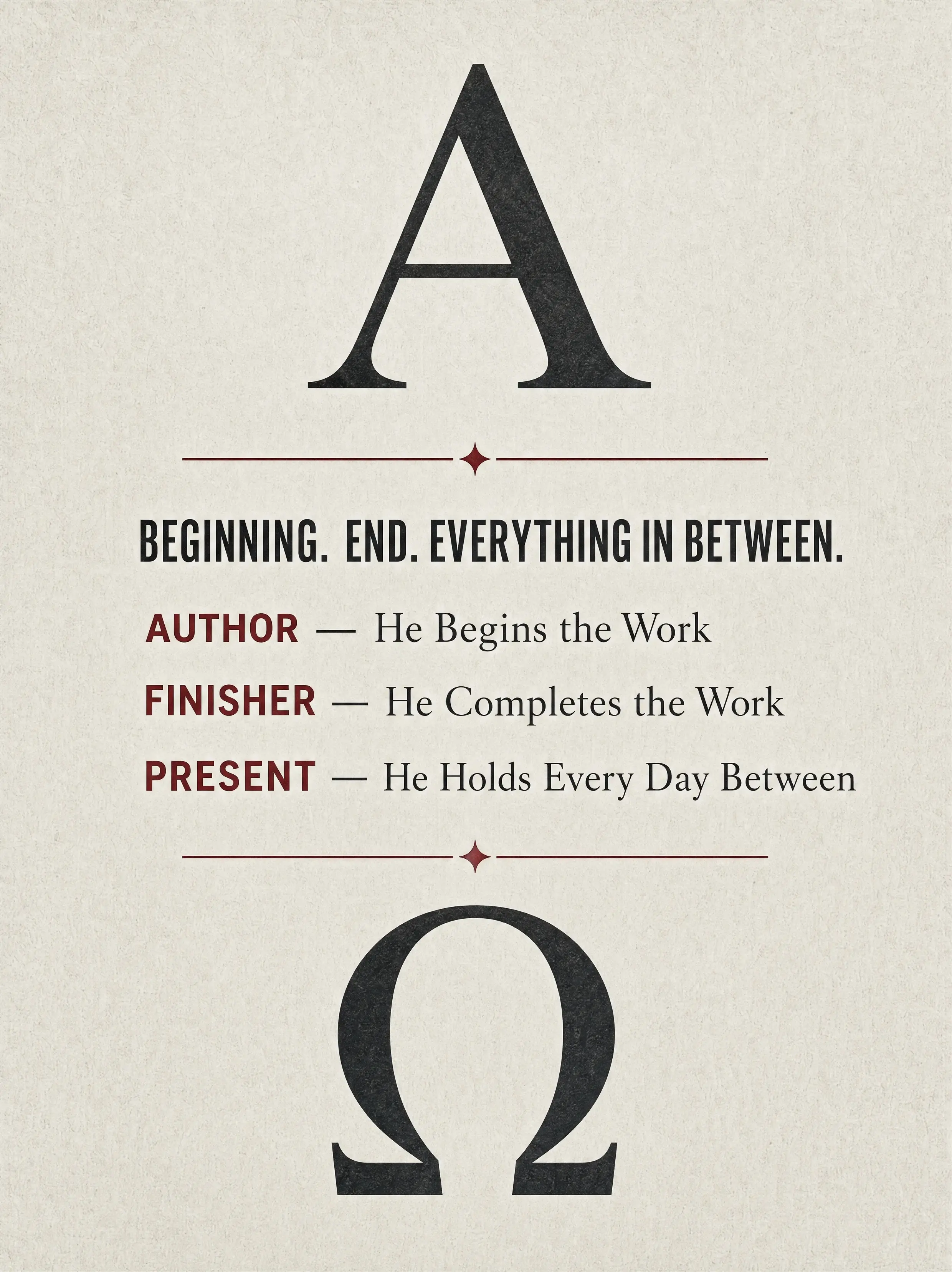
The Theology Behind ‘Alpha and Omega’: Why It Is Not Just a Cool Name
Most Christian content treats ‘Alpha and Omega’ as a poetic flourish - Greek letters that sound nice, look great in serif type, and gesture vaguely at God being big. That reading misses the whole weight of what is happening in the text. The phrase is not poetry. It is a borrowed title. It belongs to Yahweh in the Old Testament, and Christ takes it for himself in the New.
In Isaiah 44:6, the LORD speaks: ‘I am the first and I am the last; besides me there is no god.’ Isaiah 48:12 repeats it: ‘I am he; I am the first, and I am the last.’ These are claims of exclusive divinity. The first and the last is a category of one. When the resurrected Christ steps into John’s vision in Revelation and uses the same self-description - translated into the Greek alphabet so the audience hears it in their own letters - he is doing what no created being can do without blasphemy. He is occupying Yahweh’s seat.

A Claim Only One Person in History Has Ever Made
Most religious founders make moral claims. Some make prophetic claims. A handful claim direct contact with God. None of them, in any other tradition, claim to be the beginning and the end of all things. The Buddha did not. Muhammad did not. Confucius did not. Joseph Smith did not. Christ does - and the book that records the claim treats it as the most natural thing in the world for him to say.
For a lifter, this is the difference between training under the eye of a powerful coach and training under the eye of the one who made the body itself. The first asks you to do better. The second knows what better is, because he wrote the design.
The Witness of the Whole Canon
The title shows up three times in Revelation and reaches back into Isaiah, but its theology runs the whole canon. Genesis 1 opens with God speaking matter into existence. John 1 opens with Christ as the Word through whom that matter was spoken. Colossians 1:16-17 makes the claim explicit: all things were created through him and for him, and in him all things hold together. Hebrews 12:2 calls him ‘the founder and perfecter of our faith’ - author and finisher, alpha and omega in different language.
When Revelation 22:13 lands as the third Alpha-and-Omega statement in the book - and as one of the last sentences in the Bible - it is sealing what the whole canon has been saying. He is the start. He is the end. He owns the middle.
How to Read the Alpha-Omega Claim: A Three-Part Framework for the Lifter
Three claims sit inside the title, and each one maps onto a category of the lifter’s real life. Hold these three in order. They are how the title becomes useful instead of decorative.
Alpha - Christ as Author
- Function: he begins the work - the training program, the season, the call to discipline all have their source in him, not in your willpower
- Implication for the lifter: you did not invent your desire to train - he stirred it, and that changes how you treat it
- Where it shows up: first reps of a new program, the first day after a long layoff, the decision to start at all
- Failure mode: treating training as self-made - a project of self-improvement disconnected from the one who designed the body being improved
The Alpha claim disarms a quiet idolatry every lifter eventually meets: the idea that discipline is the man’s possession and not a gift. A serious training life is not something you wring out of yourself. It is something you receive, steward, and return.
Omega - Christ as Finisher
- Function: he completes the work - sanctification, formation, and the long arc of a training life land where he puts them, not where you force them
- Implication for the lifter: you are not the closer of your own life - he is, and that should both relax you and steady you
- Where it shows up: PRs that do not come, plateaus that do not break on your timeline, the day you decide a season is over
- Failure mode: treating training as something you have to finish before death proves you serious - the Omega claim says the finishing is not your job
Most lifters under 30 train as if the program needs to climax this year. Most lifters over 40 train as if the program is closing whether they like it or not. The Omega claim corrects both. The finishing is not yours. The faithful showing up is.
The Center - Sovereign Over Everything Between
- Function: he holds the middle - the unphotographed Tuesday session, the set you almost skipped, the week your numbers did not move
- Implication for the lifter: the middle of a training life - by far the longest part - is not abandoned space, it is owned space
- Where it shows up: years two through ten, the seasons no one watches, the quiet decade between getting strong and getting old
- Failure mode: training the start hard, training the end hard, and treating the middle as a holding pattern
The middle is where most men lose their training. Not at the start, when motivation is fresh. Not at the end, when stakes are clear. In the middle, when nothing is on fire and no one is looking. The Center claim is the part of Revelation 22:13 that decides whether the training life lasts.
What ‘Alpha and Omega’ Changes When You Step Under the Bar
Doctrine that does not change behavior is decoration. The Alpha-Omega claim only matters here if it does work in the gym. Three concrete situations show how it does.
When You Are Starting - Alpha Frames the Call
The first day of a new program is the easiest day to over-spiritualize. Most beginners want their training to mean something cosmic on day one. The Alpha claim works in the other direction - it grounds the start. He began the work. Your job is not to manufacture significance; it is to show up to the work he started in you. That puts a quiet floor under the first week, when nothing about your performance is impressive and you are still figuring out the squat rack.
When You Are Plateauing - the Center Holds the Middle
Plateaus are the spiritual problem most lifters mistake for a programming problem. The numbers stop moving. The body stops looking different in the mirror. The training, externally, looks the same as last month. The temptation in the middle is to quit, switch programs every week, or start performing for an audience that is not there. The Center claim says the middle is not abandoned by Christ. He owns the unphotographed Tuesday at the same level he owns the meet-day PR. That changes what you do with a stalled month - you keep going, because the value of the work is not set by the trajectory.
When You Are Finishing - Omega Frames the End
Every season of training ends. Most end because of injury, life change, or a quiet drift you did not notice. Some end well - clean cycles closed out, a program completed, a deload taken. The Omega claim is most useful at the seams between seasons. He finishes the work. That gives a man permission to actually close a chapter - to let the bench cycle end, to take the deload, to stop a program that ran its course - without treating every transition as a failure of will.
Why ‘Alpha and Omega’ Is the Foundation of a Faith-Driven Training Identity
Most training identities are too small to last. Performance identities collapse the first time the body refuses to perform. Vanity identities collapse the first time the mirror stops cooperating. Tribal identities collapse the first time the tribe disappoints you. The Alpha-and-Omega identity is the only frame I have found that holds when each of those others breaks.
It is not a slogan. It is a confession. Christ is the first and the last. He started the work in me. He will close it on his timeline, not mine. He owns the years between. That is a training identity a man can build a decade on - not on the strength of a self-image, but on the strength of a fact about who Christ is.
The Alpha-Omega frame also reorders what training is for. Performance still matters - the numbers should move, the body should change, the program should be progressive. But performance becomes downstream of stewardship rather than upstream. You train because the body is owned, the time is owned, and the season is owned. None of that is yours to fail at. It is yours to steward.
That is the title behind the work we publish here. Not because two Greek letters look strong in a logo. Because the One underneath them is the only one large enough to hold a training life that lasts longer than a motivational phase.
Frequently Asked Questions About ‘Alpha and Omega’ as a Lifter
Where exactly does the phrase ‘Alpha and Omega’ appear in the Bible?
Three times, all in Revelation. Revelation 1:8 - ‘I am the Alpha and the Omega, says the Lord God, who is and who was and who is to come, the Almighty.’ Revelation 21:6 - ‘I am the Alpha and the Omega, the beginning and the end.’ Revelation 22:13 - ‘I am the Alpha and the Omega, the first and the last, the beginning and the end.’ The Old Testament background sits in Isaiah 41:4, 44:6, and 48:12, where Yahweh uses ‘first and last’ language to make the same claim.
Is ‘Alpha and Omega’ only about Christ, or about the Father too?
In Revelation 1:8 the speaker is the Lord God; in 22:13 the speaker is Christ. Trinitarian theology has historically read this as a title belonging to the one God - Father, Son, and Spirit - with Christ explicitly claiming it for himself in 22:13. For the lifter, the practical takeaway is that the title points to a unified divine claim of sovereignty, not a contested attribute.
Is it heavy-handed to bring this verse into a workout?
It would be heavy-handed if the verse were doing the work for you - as if reciting ‘Alpha and Omega’ before a deadlift would unlock something extra. That is superstition, not theology. The verse works in the gym the way it works anywhere else: as a frame that orders the soul before the work begins. You do not need to say it out loud. You need to remember who began the work and who will finish it.
How is the Alpha-and-Omega claim different from the Hebrew names of God?
The Hebrew names - Yahweh, Elohim, El Shaddai - describe God’s nature: existence, power, sufficiency. The Alpha-and-Omega title describes God’s relation to time and creation: he stands at the beginning of all things and at the end. They are not in conflict. The Hebrew names tell you who he is. The Greek title tells you where he stands in the story. For a man training for the long haul, the Greek title is the one that locates him most clearly inside the timeline of the work.
How does the cross fit with the Alpha-and-Omega claim?
The cross is the proof that the Alpha-and-Omega claim is not abstract. The one who claims to be the beginning and the end is also the one who allowed himself to be killed by his own creatures. The claim of sovereignty over everything is made by the one who voluntarily entered the worst that everything had to offer. That asymmetry is the whole force of the gospel. The man under the bar is being trained by a sovereign who has personally suffered.
Conclusion
Strength training is one of the most patient teachers a man can sit under. It punishes haste, rewards faithfulness in small things, and exposes everything you tried to hide. The Alpha-and-Omega claim is the only frame I have found that survives a decade of that kind of teaching. Christ is the beginning of the work in you. He is the end of it. He owns the years between. None of those facts depend on your numbers or your mood - which is exactly why they can hold a training life that lasts.
Revelation 22:13 is the seal on the whole canon. Twelve words. Two Greek letters. Enough to ground a man under any bar, in any season, for as long as the work is given to him. To go deeper on the practical frame underneath this, read the Lifter’s Devotional Guide to Training as Worship.
// FREQUENTLY ASKED
Questions, answered.
Where exactly does the phrase ‘Alpha and Omega’ appear in the Bible?
Three times, all in Revelation. Revelation 1:8 - ‘I am the Alpha and the Omega, says the Lord God, who is and who was and who is to come, the Almighty.’ Revelation 21:6 - ‘I am the Alpha and the Omega, the beginning and the end.’ Revelation 22:13 - ‘I am the Alpha and the Omega, the first and the last, the beginning and the end.’ The Old Testament background sits in Isaiah 41:4, 44:6, and 48:12, where Yahweh uses ‘first and last’ language to make the same claim.
Is ‘Alpha and Omega’ only about Christ, or about the Father too?
In Revelation 1:8 the speaker is the Lord God; in 22:13 the speaker is Christ. Trinitarian theology has historically read this as a title belonging to the one God - Father, Son, and Spirit - with Christ explicitly claiming it for himself in 22:13. For the lifter, the practical takeaway is that the title points to a unified divine claim of sovereignty, not a contested attribute.
Is it heavy-handed to bring this verse into a workout?
It would be heavy-handed if the verse were doing the work for you - as if reciting ‘Alpha and Omega’ before a deadlift would unlock something extra. That is superstition, not theology. The verse works in the gym the way it works anywhere else: as a frame that orders the soul before the work begins. You do not need to say it out loud. You need to remember who began the work and who will finish it.
How is the Alpha-and-Omega claim different from the Hebrew names of God?
The Hebrew names - Yahweh, Elohim, El Shaddai - describe God’s nature: existence, power, sufficiency. The Alpha-and-Omega title describes God’s relation to time and creation: he stands at the beginning of all things and at the end. They are not in conflict. The Hebrew names tell you who he is. The Greek title tells you where he stands in the story. For a man training for the long haul, the Greek title is the one that locates him most clearly inside the timeline of the work.
How does the cross fit with the Alpha-and-Omega claim?
The cross is the proof that the Alpha-and-Omega claim is not abstract. The one who claims to be the beginning and the end is also the one who allowed himself to be killed by his own creatures. The claim of sovereignty over everything is made by the one who voluntarily entered the worst that everything had to offer. That asymmetry is the whole force of the gospel. The man under the bar is being trained by a sovereign who has personally suffered.
// GEAR WORN IN THIS TRAINING

PUBLISHED MAY 27, 2026