// FAITH
The Faith-Driven Man's Guide to Staying in the Gym When Life Falls Apart: Training Through Hard Seasons

Job loss, grief, divorce, the long collapse. The gym is the last place most men go when life breaks. It should be the first. Here is the case for training through hard seasons, and the five-anchor framework that keeps you under the bar without faking it.
Pete Fluriach, founder of Alpha Omega Strength Team. I have trained through a job loss, a grief, and one season I would not put a clean word on. The gym is the last place most men go when life breaks; I am convinced it should be the first. This is the case for training through hard seasons - and the five-anchor framework that lets you stay under the bar without faking the season you are in.
A hard season is not a setback in your program. It is a different program entirely. You do not train through it the same way you trained when sleep was solid and the rent was paid. But you do train. The cost of quitting is almost always higher than the cost of showing up to a half-version, and most men do not learn that until they have paid it.
What Every Faith-Driven Man Needs to Know About Training Through Hard Seasons
Training through a hard season is the practice of keeping a baseline of physical work in your week when the rest of your life is in some stage of collapse, repair, or grief. It is not about progress. It is about preservation - keeping the body capable and the man oriented while everything else gets rebuilt around him.
There are five hard seasons most men will train through at some point:
- Job loss or sudden financial pressure
- Grief - the death of a parent, a child, a friend
- A separation, divorce, or the slow end of a long relationship
- Chronic illness - your own, or someone you care for
- Spiritual dryness - the season where prayer goes flat and faith goes quiet
Before you build a plan, hold the four variables that decide whether your training survives the season:
- Time - hard seasons cut free time in half; design the program for the smaller window
- Energy - assume 40-60% of baseline; do not write checks the body cannot cash
- Sleep - usually the first casualty; build training around what your sleep actually is, not what you wish it were
- Frame - the goal is presence and preservation, not personal records
After this guide, you will have a working framework you can pick up in week one of any hard season - without quitting the gym, without lying to yourself about the load you can actually handle, and without bolting cheap motivation onto a season that needs something heavier.
Why Most Men Quit the Gym in a Hard Season - and Why That Is Almost Always the Wrong Move
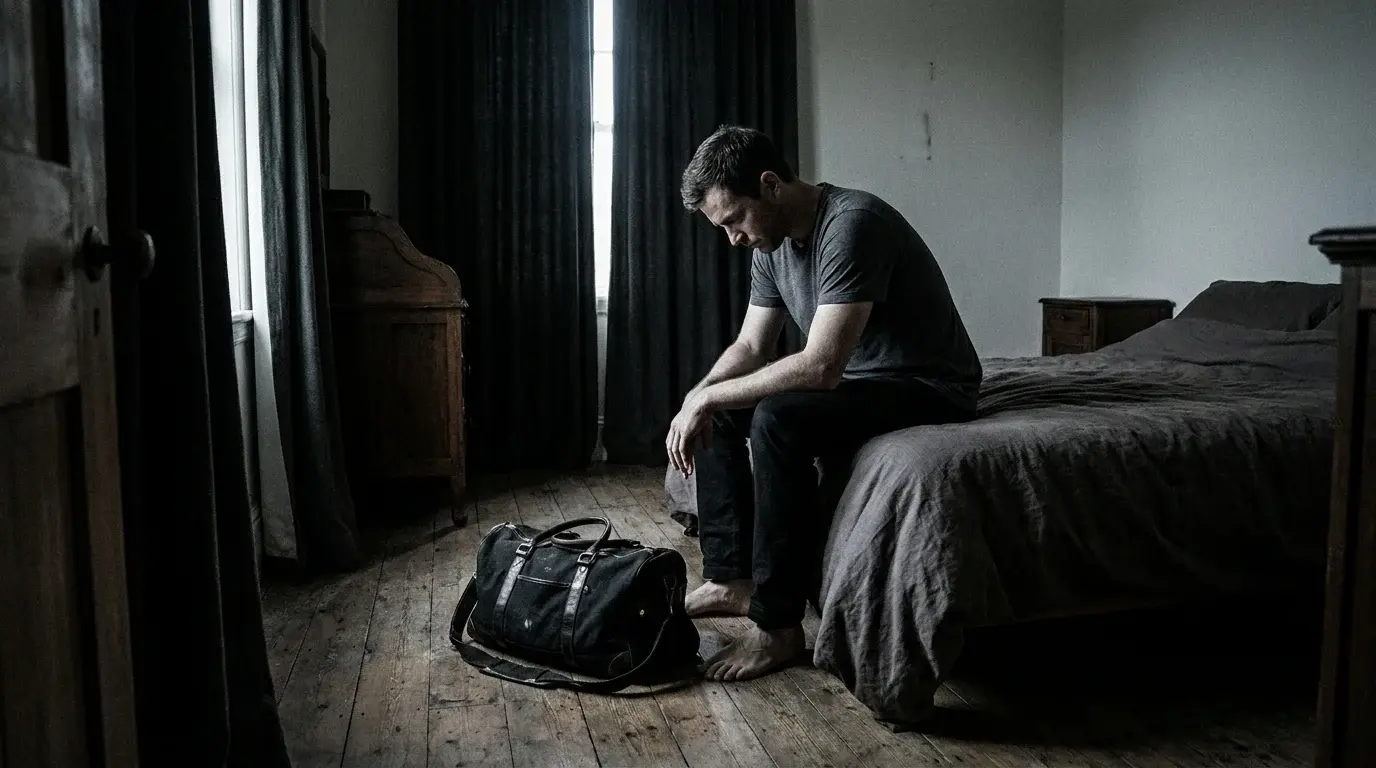
When life breaks, the first thing most men cut is training. The logic feels obvious. You are tired, your schedule is in pieces, you do not feel like a man who deserves to be in the gym. So you skip a week, then a month, then six. By the time you look up, the body that was a fixed point in your life has become one more thing that needs fixing - exactly when you have the least bandwidth to fix anything.
The cost of quitting in a hard season compounds. According to the CDC's most recent National Health Interview Survey work, only about one in four U.S. adults meet the combined aerobic and muscle-strengthening recommendation in any given year; the rate drops further inside high-stress life events. By 2026, the gap between men who train and men who do not is no longer a gap of vanity - it is a gap of nervous-system resilience, sleep quality, and basic capacity to absorb hard news without breaking.

Training as a Fixed Point When Everything Else Moves
In a hard season, most of your life stops being predictable. Income shifts. Family rhythms collapse. Prayer goes quiet. Sleep falls apart. In that environment, the bar is one of the few things that still behaves consistently. 225 still weighs 225. The squat still goes down before it goes up. That predictability is medicine when the rest of your life is no longer predictable - one of the cleanest mercies God built into having a body.
- Function - gives a man one block of his week that still operates by clear rules
- Length - short enough to survive a hard schedule, long enough to actually count as work
- Content - the simplest lifts you already know, run at 50% to 70% of normal load
- Result - a body that still works, a mind that still has a place to go, and a man who has not added 'lost my health' to the list of things that broke this year
Training does not fix grief, pay your bills, or undo a divorce. What it does is keep you from compounding the damage. A man who keeps training through a hard season comes out with the same hard problems - but with his body, his discipline, and his sense of agency intact. That is most of the recovery.
The Biblical Case for Hard-Season Work
The Bible is not gentle with grief. Job sits in ashes; David writes from a cave; Elijah collapses under a juniper tree and asks to die. In every scene, the response from God is not a sermon - it is structure. Eat. Drink. Sleep. Walk. Show up to the next thing. The faith that survives a hard season is not the faith that escapes the body. It is the faith that keeps using the body God gave you while the soul does the slower work of healing.
1 Corinthians 6:19-20 still applies in a bad year. Romans 12:1 does not get suspended because life is hard. Stewardship of the body is not a fair-weather discipline. The hard season is precisely when the practice has to keep going - quieter, lighter, less ambitious, but real.
How to Choose the Right Hard-Season Training Approach
There is no single right way to train through a hard season. There are four broad approaches, and three of them are real options. Use the comparison below to pick the one most likely to survive contact with the season you are actually in - not the season you wish you were having.
Maintain Mode - for the Steady Operator
- Best for: men with a deep training base; a hard season that is intense but time-limited
- Strength: keeps the same lift selection, drops volume and intensity by 30% to 40%; preserves identity as a trainee
- Weakness: still asks for 3 to 4 sessions a week; falls apart if the season takes more bandwidth than expected
Minimalist Mode - for the Survivor
- Best for: most men in most hard seasons; the default unless you have a clear reason to choose something else
- Strength: 2 short sessions per week, 30-45 minutes, full-body, light to moderate load; easy to defend on a hard schedule
- Weakness: requires you to make peace with not making visible progress; the ego will fight it
Walking-and-Mobility Mode - for the Truly Wrecked Season
- Best for: the worst weeks - the first 30 days of grief, an acute health crisis, an unexpected collapse
- Strength: a 30-minute outdoor walk and 10 minutes of mobility, daily; nearly impossible to fail to do
- Weakness: not technically lifting; meant as a bridge for two to six weeks, not a long-term plan
Quit Mode - the One Wrong Option
- Best for: nobody - listed here because it is the default most men slide into without naming the decision
- Strength: none; feels easier in week one; compounds against you in month three
- Weakness: adds a body in decline to a life in decline; nothing about the hard season gets easier when you also lose physical capacity
Expert tip: if you cannot tell which mode is honest, start with Minimalist Mode. Two 30-minute sessions a week is the floor below which the practice is not real training - and the ceiling below which almost no schedule can claim no room.
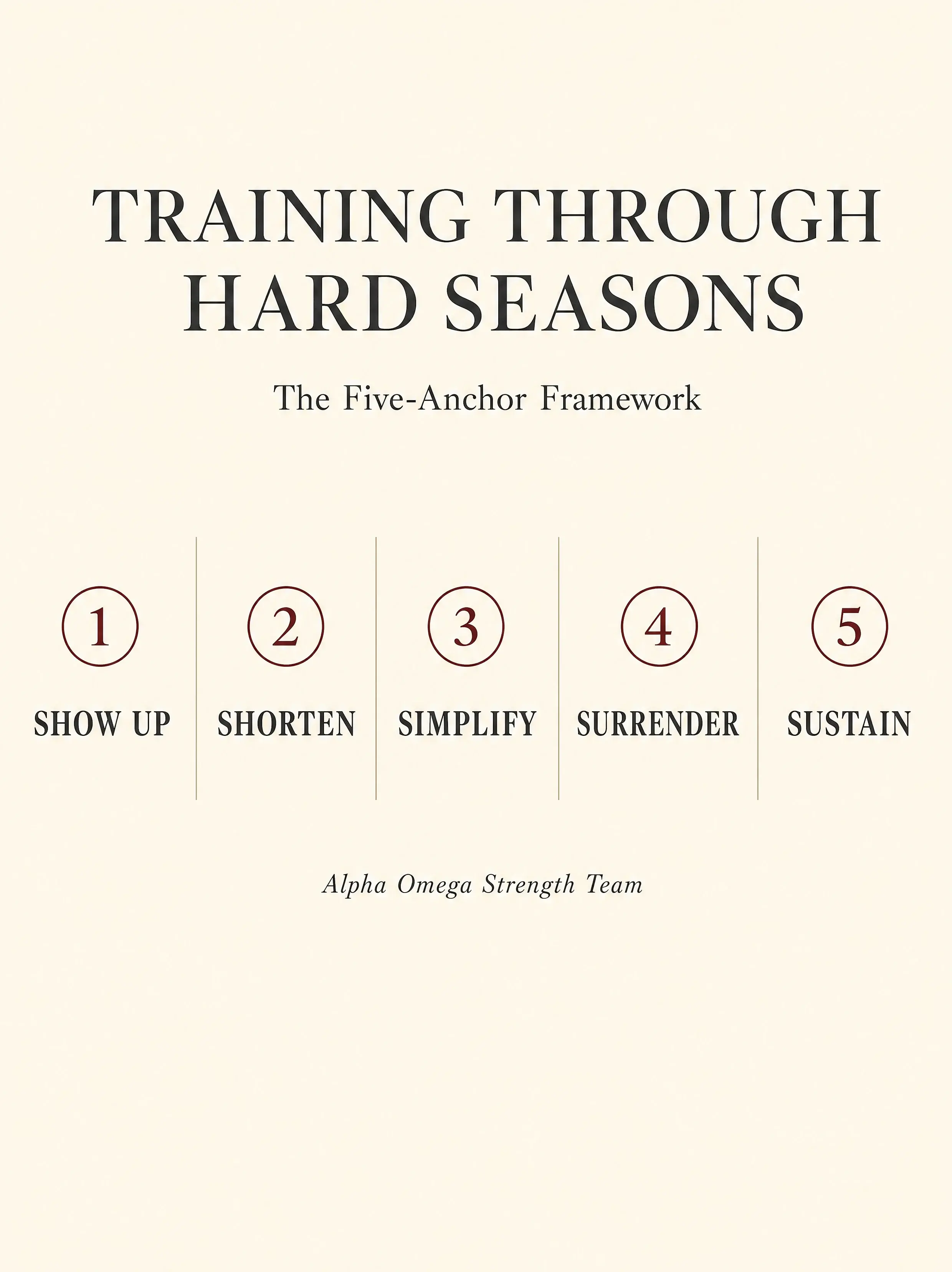
Practical Steps - The Five-Anchor Framework
Whichever mode you pick, the same five anchors hold underneath:
- Show Up - pick two non-negotiable days a week and put them on the calendar before anything else claims the slot
- Shorten - cut the sessions to 30 to 45 minutes; long sessions die first in a hard week
- Simplify - three to five compound lifts per session, no accessories, no fancy programming, light to moderate load
- Surrender - name what you are not chasing this season (PRs, body composition, vanity goals); pray it off before the first warm-up set
- Sustain - accept this as a 90-day to 18-month program, not a six-week cut; the goal is to be still training when the season ends
Maintenance vs. Progress - The Honest Comparison
Progress-mode training assumes excess capacity. Maintenance-mode assumes a deficit. Most men try to run a progress program inside a maintenance season, fail inside three weeks, and read the failure as evidence to quit altogether. The correct read is that the program was wrong for the season, not that training was wrong for the man. For more on the theology of stewardship that frames this, see the Lifter's Devotional Guide to Training as Worship.
Training Through Hard Seasons at Every Stage of Life

The framework reads differently at different life stages. A 22-year-old man losing his first real job is not running the same playbook as a 47-year-old man walking through a divorce. Below is how the same five-anchor framework applies at three real stages of a man's life:
- Early-career man (20-30): emphasis on Anchor 1 - Show Up. You do not yet have a long training identity to fall back on, so consistency is the entire game. Two short sessions a week build the pattern that carries you through every harder season after.
- Mid-career man (30-45): emphasis on Anchor 3 - Simplify. This is the bracket with the deepest training base and the most complicated lives. Cut the programming to compound lifts and refuse to add anything until the season is over. Complexity is what kills training in this decade.
- Late-career man (45+): emphasis on Anchor 5 - Sustain. Recovery is slower, injury risk is higher, the season may last longer than you want to admit. The goal is to still be moving real weight two years from now, not to push through a quarter you do not have.
Grief Season vs. Job-Loss Season vs. Divorce Season
The same framework, recalibrated by the kind of hard season you are actually in:
- Grief season - walking-and-mobility mode for the first 30 days, then minimalist mode; the body grieves on its own clock and will tell you when it is ready for load
- Job-loss season - minimalist mode from day one; the schedule is open but the nervous system is fried, and a heavy program will not survive two weeks of job searching
- Divorce season - maintain mode if possible; one of the few seasons where the discipline of the gym becomes load-bearing for sanity, and an under-stimulated body is its own problem
Adapting the Framework to Your Gym and Your Week
As of 2026, most men are operating on schedules tighter and more fragmented than they were five years ago. The framework adapts. In a commercial gym, run minimalist mode at off-peak hours; minimizing the audience minimizes the friction of being seen training light. In a garage gym the same program is easier - run it at 5 AM if that is what gets it done. In a hotel gym on a work trip, body-weight versions of the five anchor lifts are enough to keep the practice alive. The location does not matter. The orientation does.
Why a Faith-Driven Training Identity Holds in the Hard Seasons
Most men who lose their training in a hard season did not lose it because the program was wrong. They lost it because the framing around the program was thin. Performance-oriented training collapses the moment performance is no longer possible. Vanity-oriented training collapses the moment a man is too tired to care how he looks. What survives is training framed larger than the season - work done as worship, stewardship of a body the lifter does not own.
- Work as worship - Romans 12:1 framing turns a 30-minute minimalist session into a real act, not a placeholder
- Stewardship - 1 Corinthians 6:19-20: maintaining the body in a hard season is not optional, it is the assignment
- Endurance - Hebrews 12:1 was written to people who are tired; the call is not to run faster, it is to keep running
- Quiet messaging - Alpha and Omega (Revelation 22:13) - without the bro-Christian aesthetic; faith-grounded through values in action
Getting the Most Out of Training Through a Hard Season
- Pick two fixed days, name them out loud, put them on the calendar before anything else competes
- Cap sessions at 45 minutes; if you cannot get it done in 45, the program is wrong for the season, not the man
- Track only one variable - did you show up - and refuse any other metric until the hard season is clearly over
- Re-read the framework every 90 days; the season shifts under you, and the right anchor to lean on shifts with it
Frequently Asked Questions About Training Through Hard Seasons
How do I start training again after I have already been out for weeks or months?
Start with one 30-minute session this week. Not three, not the old program. Pick a day, walk into the gym, run three compound lifts at 50% of your last working load, and walk out. Add the second session next week. The mistake nearly every man makes after a long lay-off is coming back at the volume he left at. The body and the schedule will both reject it inside ten days. Build the floor before you rebuild the ceiling.
What scripture should I be reading when I am training through grief?
Pick one passage from each category and rotate them through the week:
- Lament - Psalm 13, Psalm 42, Psalm 88
- Endurance - Hebrews 12:1-2, James 1:2-4, Romans 5:3-5
- Stewardship - 1 Corinthians 6:19-20, Romans 12:1
- Sustaining presence - Psalm 23, Isaiah 43:1-3, Lamentations 3:22-23
Is it okay to train at all when I feel like a hypocrite for being in the gym?
Yes. The man who shows up to the gym while his life is breaking is not faking - he is preserving. There is a difference between performative training (heavy programs to prove something while everything else is on fire) and preservation training (refusing to let one more good thing collapse). Preservation training is not hypocrisy. It is, in most cases, an act of faith.
How long should I stay in maintenance mode before I try to progress again?
Wait until two conditions are true at once: the hard season is clearly over (income stable, grief past the acute stage, marriage settled one way or the other), and you have run minimalist mode without missing sessions for 30 days. Then add load slowly. Pushing into progress before either condition is met is how the framework breaks.
Conclusion
Hard seasons are not the time to find out if you are a serious trainee. They are the time you prove it. The bar does not care that your life is on fire - that is the mercy. The man who keeps training through the worst year of his life does not come out with a fixed life. He comes out with a body that still works, a discipline that holds, and a faith that has stopped being theoretical. That is the win.
Two sessions. Forty-five minutes. Five anchors. Start this week. For the theology behind training that does not collapse under pressure, read the Lifter's Devotional Guide to Training as Worship.
// FREQUENTLY ASKED
Questions, answered.
How do I start training again after I have already been out for weeks or months?
Start with one 30-minute session this week. Not three, not the old program. Pick a day, walk into the gym, run three compound lifts at 50% of your last working load, and walk out. Add the second session next week. The mistake nearly every man makes after a long lay-off is coming back at the volume he left at. The body and the schedule will both reject it inside ten days. Build the floor before you rebuild the ceiling.
What scripture should I be reading when I am training through grief?
Pick one passage from each category and rotate them through the week: Lament - Psalm 13, Psalm 42, Psalm 88 Endurance - Hebrews 12:1-2, James 1:2-4, Romans 5:3-5 Stewardship - 1 Corinthians 6:19-20, Romans 12:1 Sustaining presence - Psalm 23, Isaiah 43:1-3, Lamentations 3:22-23
Is it okay to train at all when I feel like a hypocrite for being in the gym?
Yes. The man who shows up to the gym while his life is breaking is not faking - he is preserving. There is a difference between performative training (heavy programs to prove something while everything else is on fire) and preservation training (refusing to let one more good thing collapse). Preservation training is not hypocrisy. It is, in most cases, an act of faith.
How long should I stay in maintenance mode before I try to progress again?
Wait until two conditions are true at once: the hard season is clearly over (income stable, grief past the acute stage, marriage settled one way or the other), and you have run minimalist mode without missing sessions for 30 days. Then add load slowly. Pushing into progress before either condition is met is how the framework breaks.
// GEAR WORN IN THIS TRAINING


PUBLISHED MAY 26, 2026