
// TRAINING
The Faith-Driven Training Split for Busy Men: A 4-Day Program That Fits a Real Life

If you have 3-4 hours of training time per week, a family to lead, and a God to honor, this 4-day upper/lower split is built for you - with a Sabbath rest day baked in from the start.
Pete Fluriach, founder of Alpha Omega Strength Team. I have trained on and off since my twenties, but the program that finally stuck was not the most sophisticated one I found - it was the one that fit inside my actual life. I have a business, a family, and obligations that do not move for the gym. So the question was never what is the optimal split - the question was what is the best program I will actually run for the next six months. This is that program.
Most online programming is built for men with unlimited time, no children, and no theological convictions about how a week should be structured. This guide is different. It is built for working men who want to get stronger, honor the body God gave them, and still be present for everything else that matters.
What Every Busy Man Needs to Know About Building a Sustainable Training Split
A training split is simply how you divide your training volume across the days of the week. The upper/lower split is the most time-efficient and physiologically sound option for men with limited weekly training time. It trains each major muscle group twice per week - which 2025 research continues to confirm is the minimum stimulus for meaningful hypertrophy and strength gain - while leaving adequate recovery between sessions.
The four main splits most busy men consider:
- Full-body 3x per week - high frequency, short sessions, excellent for beginners
- Upper/lower 4x per week - balanced frequency and volume, best fit for intermediate lifters with 3 to 4 hours available
- Push/pull/legs 6x per week - high volume, requires significant weekly time, prone to collapse under real-life stress
- Bro split (body part per day) - low frequency per muscle, suboptimal for time-limited lifters, survives on gym culture nostalgia
What the busy, faith-driven man needs to consider before picking a split:
- Realistic weekly training time, not aspirational
- Whether a Sabbath rest day is a fixed commitment (it should be)
- Current training level - beginner, intermediate, or advanced
- Recovery demands outside the gym: stress load, sleep quality, physical labor at work
- Whether the program can be sustained for 12 or more weeks without restructuring
The program below passes every one of those tests. It is not the flashiest approach. It is the most reliable one.
Why the Upper/Lower Split Is the Right Choice for Working Men
The upper/lower split has been a staple of serious programming since at least the 1970s, and the research has never stopped validating it. A landmark 2016 meta-analysis by Schoenfeld, Ogborn, and Krieger in Sports Medicine found that twice-weekly training frequency per muscle group produces hypertrophy outcomes statistically equivalent to higher frequency training for intermediate lifters, while requiring less total weekly volume - a finding replicated across multiple subsequent reviews through 2024. That is good news for men with jobs, children, and lives. You do not need to live in the gym. You need to train hard twice on each half of your body every week.
The upper/lower structure also lends itself naturally to the kind of week a faith-driven man is already trying to build. Four training days fit cleanly around a Sunday Sabbath and a family schedule. The split does not ask you to be in the gym on the Lord's day. It does not ask you to miss Friday night with your wife because legs are programmed. It asks you to train hard four times, rest on Sunday, and be a complete person the rest of the time.
The Frequency Argument
Muscle protein synthesis (MPS) - the biological process of building new muscle tissue - peaks within 24 to 36 hours of a training stimulus and returns to baseline by roughly 48 to 72 hours in trained individuals. A bro split that trains each muscle once per week leaves a five-day window where the muscle receives no growth signal. An upper/lower split at 4 days per week hits each muscle group every 72 to 96 hours, keeping MPS elevated across the week in a way that one-session-per-muscle programming cannot match.
The Stewardship Argument
Christian stewardship theology applies to time just as much as it applies to money. A 6-day program that you run for three weeks and then abandon because life happened is not good stewardship - it is wishful thinking dressed up as dedication. The 4-day upper/lower is honest about what a working man can sustain. It builds the discipline of showing up consistently, which is worth more over a five-year horizon than any program optimization.

The 4-Day Upper/Lower Split: Full Program Layout
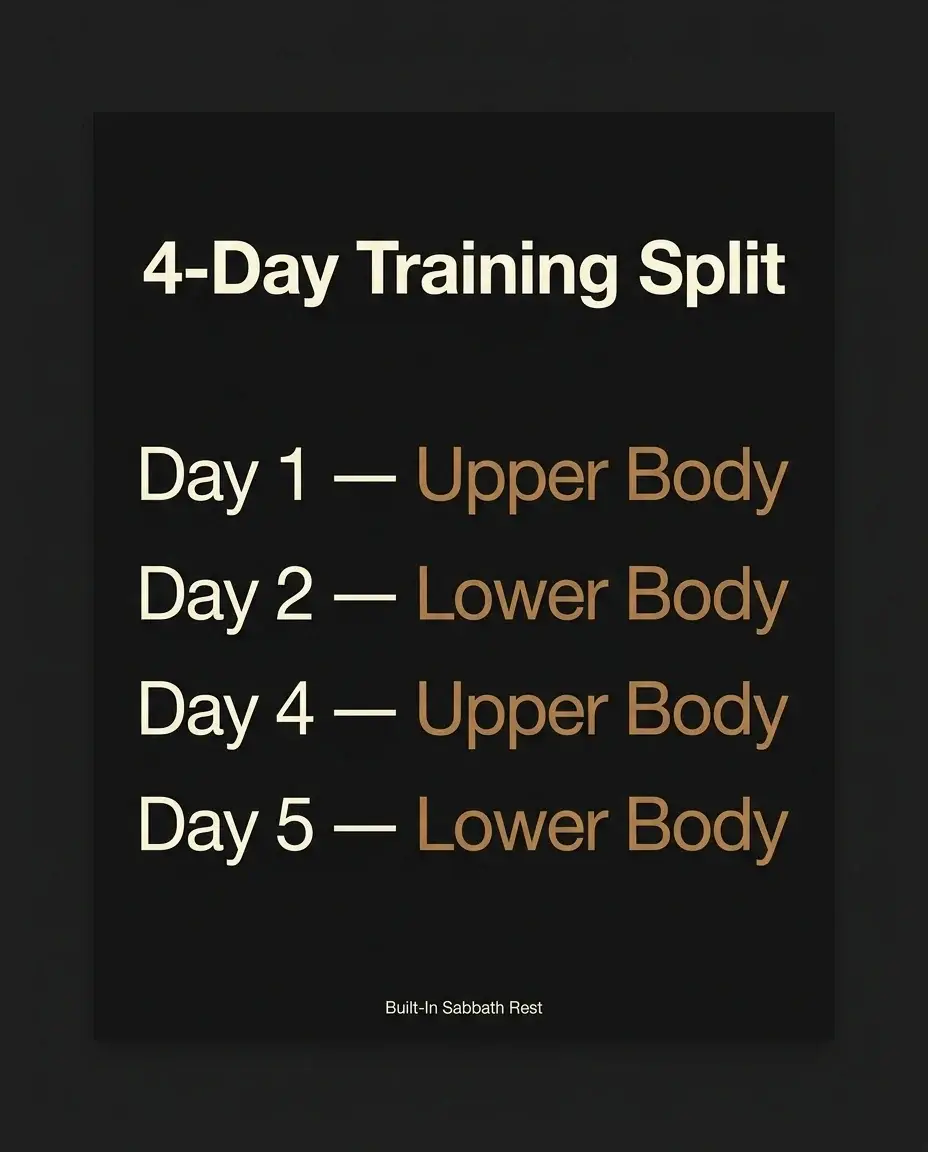
Here is the weekly structure. Days can shift based on your calendar - the pattern matters more than the specific day of the week. The one non-negotiable is the Sabbath rest on Sunday.
- Monday: Upper A - strength focus, horizontal push and pull emphasis (bench press, barbell row)
- Tuesday: Lower A - strength focus, squat pattern emphasis (back squat, Romanian deadlift)
- Wednesday: Rest
- Thursday: Upper B - volume focus, vertical push and pull emphasis (overhead press, weighted pull-ups or lat pulldown)
- Friday: Lower B - volume focus, hinge pattern emphasis (conventional deadlift, Bulgarian split squat)
- Saturday: Rest or light activity - walk, mobility work, family time
- Sunday: Sabbath - full rest, no training
The man who trains four days consistently for a year will outgrow the man who trains six days for three months and then collapses back to two. Consistency is not a virtue - it is the mechanism. - Pete Fluriach, Alpha Omega Strength Team
Four Principles for Building Each Session
Four principles that separate men who progress on this program from men who plateau:
- Lead each session with the heaviest compound movement while the CNS is fresh. Bench and row on Upper A. Squat on Lower A. Overhead press and weighted pull-up on Upper B. Deadlift on Lower B.
- Follow with 2 to 3 accessory lifts targeting weak points or accumulating volume in supporting muscles. Three sets of 8 to 12 reps with controlled tempo.
- Keep sessions to 45 to 60 minutes. If you are regularly going 90 minutes, you are resting too long or have too many exercises. Cut, do not extend.
- Use progressive overload as the primary driver: add 2.5 to 5 lb on main lifts whenever you complete all prescribed sets and reps with good form. No program works without this discipline.
If you are unsure which compound lifts to anchor each session around, see The 5 Compound Lifts Every Christian Man Should Know - it covers the foundational movements in detail.
How to Fit This Split Into the Three Real-Life Seasons of a Working Man
A training program does not exist in a vacuum. It has to survive the three recurring seasons that derail most working men's training: the heavy work season, the family intensive season, and the normal season. The 4-day upper/lower handles all three because it can flex without breaking.
- Normal season: run the full 4-day split as written, Mon/Tue/Thu/Fri, Sabbath on Sunday
- Heavy work season: compress to 3 days (Upper A, Lower A, Upper B); drop Lower B temporarily rather than skipping random sessions
- Family intensive season (new baby, illness, travel): run 2 days (Upper A and Lower A only, full compound movements, 30 minutes max)
Progression by Training Level
This split adapts as you advance:
- Beginner (0 to 12 months): Linear progression on main lifts, add weight every session. Keep accessories minimal. Do not complicate it.
- Intermediate (1 to 3 years): Weekly progression using RPE-based approach. Add weight when all sets complete at RPE 7 or below. Rotate accessory lifts every 6 to 8 weeks.
- Advanced (3 or more years): Block periodization - alternate 4 to 6 week strength blocks (3 to 5 rep range) with 4 to 6 week hypertrophy blocks (6 to 10 rep range). Schedule a deload week every 6 to 8 weeks.
Session Length by Time Available
Not every training day looks the same. Here is how to scale session length without abandoning the program:
- 30 minutes: Compound movement only - warm-up sets plus 3 working sets, then out. No accessories.
- 45 minutes: Compound plus 1 to 2 accessories. Choose the ones that address your weakest link.
- 60 minutes: Full session. Compound plus 3 accessories plus 5 minutes of mobility at the end.

Why the Sabbath Rest Day Makes You a Better Lifter, Not a Weaker One
The most common pushback on this program is the Sabbath rest day. Not the Wednesday rest day - that one makes obvious physiological sense. The Sunday rest day. The men asking the question are usually the most motivated ones, which is exactly why they need the answer. The Sabbath is not a weakness accommodation. It is a theological statement about who is in charge of your progress. You are not. You train hard six days and rest on the seventh because the rhythm of creation demands it, because your body requires it physiologically, and because the man who cannot stop training for 24 hours has made training his god, not his discipline.
What Alpha Omega Strength Team is built around is this conviction: strength is worth building, but it is not worth building at the cost of the rhythms God designed for the human body and the human soul. You do not need seven days. You need four hard days, two recovery days, and one day of genuine rest. That is the architecture of a sustainable life.
- The program structure respects your obligations - to God, to your family, and to your work - without treating the gym as a competitor to any of them
- Four days is enough if each day is trained with genuine intensity and progressive overload - nothing is wasted, nothing is coasted through
- The theological frame transforms training from ego-driven performance into purposeful stewardship - a more sustainable fuel source than motivation
- The built-in flexibility allows you to survive every season of life without abandoning the program, keeping long-run compounding working in your favor
Getting the Most Out of the 4-Day Upper/Lower Split
Four things that separate the men who progress on this program from the men who plateau:
- Track every session in a log. If you do not record the weight and reps, you will not know when you are stagnant, and stagnation will masquerade as normal variation. Write it down.
- Prioritize sleep over everything else in the recovery window. Eight hours is the threshold for full hormonal recovery. Seven is acceptable. Six is where gains go to die.
- Eat enough protein. For a man weighing 180 lb, the target is 144 to 180 g per day. If you are not hitting that, the program will underdeliver regardless of how well you train.
- Do not change the program every 4 weeks. Every time you restart a different program you reset the adaptation clock. Run this split for a minimum of 12 weeks before evaluating.
Pair the physical discipline of this split with a mental and spiritual frame before each session. The Faith-Driven Lifter's Guide to Pre-Workout Prayer walks through the 5-minute routine that sets the right frame for every training day.
Frequently Asked Questions
Can I shift the training days if Monday and Tuesday do not work for my schedule?
Yes. The pattern matters more than the specific days. The non-negotiables are: Upper and Lower sessions should not land on consecutive days if possible (Wednesday rest solves this in the default layout), and you need at least 48 hours between sessions training the same muscle groups. If your schedule runs better on Tue/Wed/Fri/Sat with Sunday as the Sabbath, that works. Build the program around your real life, not an ideal life that does not exist.
I only have time for 3 sessions per week right now. Should I wait to start this program?
No. Start the 3-day compressed version now: Upper A, Lower A, Upper B - rest days between each. When your schedule opens up to four days, add Lower B back in. The goal is to build the habit of training consistently with a Sabbath rest. The specific day count is secondary to that habit being in place.
How long before I see real results from this program?
Expect visible strength gains within 4 to 6 weeks if you are training with progressive overload and eating enough protein. Expect visible body composition changes within 8 to 12 weeks. The 12-week minimum before evaluating is the professional standard, not an arbitrary number. Adaptations compound slowly. The men who quit at week 6 do not get to see what week 12 looks like.
Conclusion
There is no shortage of complex, high-volume programs online written by men who have nothing else to do but train. This is not that. The 4-day upper/lower split described here is built for men who carry real weight outside the gym - in their jobs, their families, and their faith commitments - and who want to honor God with the body they have been given without sacrificing everything else to do it. Four days is enough. Progressive overload is the mechanism. A Sabbath rest day is the discipline. Run it for 12 weeks and see what consistent, theologically grounded training actually produces.
If you are new to the five core compound movements that anchor each session in this program, start with The 5 Compound Lifts Every Christian Man Should Know - then come back here and build your week around them. Alpha Omega is the beginning and the end. Train accordingly.
Sources
- Schoenfeld, B.J., Ogborn, D., & Krieger, J.W. (2016). Effects of Resistance Training Frequency on Measures of Muscle Hypertrophy: A Systematic Review and Meta-Analysis. Sports Medicine, 46(11), 1689-1697.
- Phillips, S.M., Tipton, K.D., Aarsland, A., Wolf, S.E., & Wolfe, R.R. (1997). Mixed muscle protein synthesis and breakdown after resistance exercise in humans. American Journal of Physiology - Endocrinology and Metabolism, 273(1), E99-E107.
- Morton, R.W., Murphy, K.T., McKellar, S.R., Schoenfeld, B.J., Henselmans, M., Helms, E., ... & Phillips, S.M. (2018). A systematic review, meta-analysis, and meta-regression of the effect of protein supplementation on gains in muscle mass and strength in healthy adults. British Journal of Sports Medicine, 52(6), 376-384.
- Krieger, J.W. (2010). Single vs. Multiple Sets of Resistance Exercise for Muscle Hypertrophy: A Meta-Analysis. Journal of Strength and Conditioning Research, 24(4), 1150-1159.
// FREQUENTLY ASKED
Questions, answered.
Can I shift the training days if Monday and Tuesday do not work for my schedule?
Yes. The pattern matters more than the specific days. The non-negotiables are: Upper and Lower sessions should not land on consecutive days if possible (Wednesday rest solves this in the default layout), and you need at least 48 hours between sessions training the same muscle groups. If your schedule runs better on Tue/Wed/Fri/Sat with Sunday as the Sabbath, that works. Build the program around your real life, not an ideal life that does not exist.
I only have time for 3 sessions per week right now. Should I wait to start this program?
No. Start the 3-day compressed version now: Upper A, Lower A, Upper B - rest days between each. When your schedule opens up to four days, add Lower B back in. The goal is to build the habit of training consistently with a Sabbath rest. The specific day count is secondary to that habit being in place.
How long before I see real results from this program?
Expect visible strength gains within 4 to 6 weeks if you are training with progressive overload and eating enough protein. Expect visible body composition changes within 8 to 12 weeks. The 12-week minimum before evaluating is the professional standard, not an arbitrary number. Adaptations compound slowly. The men who quit at week 6 do not get to see what week 12 looks like.
// GEAR WORN IN THIS TRAINING


PUBLISHED MAY 17, 2026