
// RECOVERY
The 10-Minute Mobility Routine for Faith-Driven Lifters Over 30

After 30, the warm-up stops being optional. Here is the 10-minute daily mobility routine that keeps your hips, T-spine, and shoulders working under the bar - and the stewardship case for why a man trains for the next thirty years, not just the next session.
Pete Fluriach, founder of Alpha Omega Strength Team. Somewhere around my thirty-third birthday, the warm-up that used to take two minutes started taking ten. For a while I treated that as a problem. Then I realized it was information. The body was telling me what it needed, and I had spent a decade not listening. This guide is the 10-minute daily mobility routine I built in response, the physiology behind it, and the reason a faith-driven lifter should care about staying mobile for the next thirty years and not just the next session.
Mobility for lifters over 30 is not about touching your toes or impressing anyone with a deep squat. It is about keeping the joints that let you squat, press, and pull doing their job for the long haul. Ten focused minutes a day is enough. It costs nothing, it fits before any session, and it is the cheapest insurance a training life has.
What Every Lifter Over 30 Needs to Know About Mobility
Mobility is the ability to move a joint actively through its full range with control. It is not the same as flexibility, and it is not the same as a static stretch held while you scroll your phone. For the lifter past 30, mobility is the quality that decides whether the strength you have built stays usable - or slowly locks itself away behind stiff hips and a rigid upper back.
Three zones go first, and they go in roughly this order:
- Hips - the first to tighten from sitting all day and squatting heavy
- Thoracic spine - the mid-back that rounds at a desk and steals your overhead position
- Shoulders - the joint with the most range to lose and the most to protect
Before you start, hold the four variables that decide whether a mobility routine actually works:
- Time - short enough you will never skip it (target: 10 minutes)
- Consistency - daily beats long; the joint responds to frequency, not heroics
- Specificity - train the ranges your lifts actually demand, not random stretches
- Control - own the end range under your own power; passive flopping does little
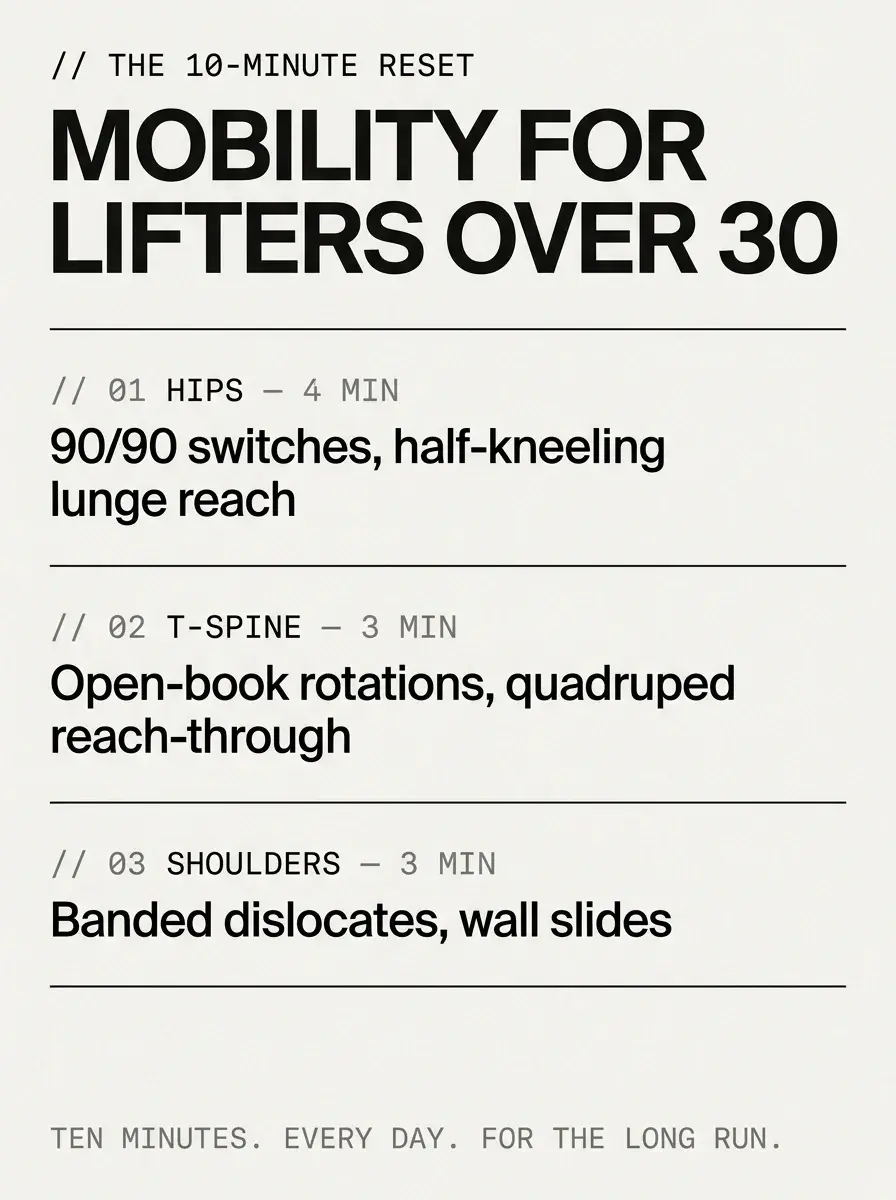
Here is the full routine on one card - three zones, ten minutes, every day:
Why Mobility Is the First Thing to Go After 30
Nothing dramatic happens at 30. There is no cliff. What there is, is the quiet compounding of two trends that finally cross. The first is a slow decline in tissue quality - connective tissue holds a little less water, recovers a little slower, and adapts a little less eagerly than it did at 22. The second is a lifestyle that has spent a decade teaching your hips to be short and your upper back to be round: a desk, a commute, a couch, and a training program that loads those same positions under a bar.
The result is not weakness. A man can keep adding weight to the bar well into his forties. The result is range. The squat gets shallower, the overhead press starts arching the lower back to find a line the shoulders no longer offer, and the deadlift setup begins from a rounder position than it used to. Mobility work is how you hold the line on range while the strength keeps coming.
Mobility as Stewardship, Not Vanity
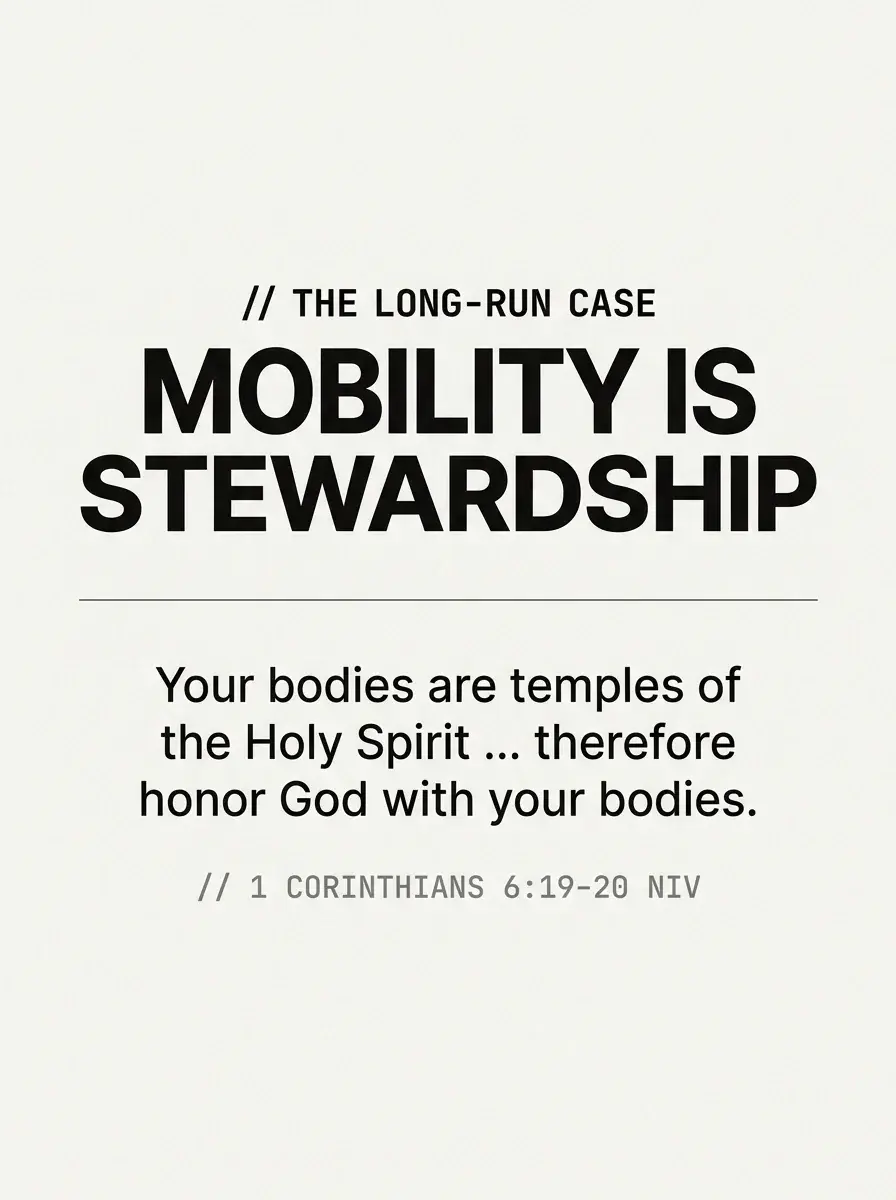
It is easy to file mobility under vanity - one more thing to optimize, one more box in the routine. The faith-driven frame reads it differently. Paul writes, 'Do you not know that your bodies are temples of the Holy Spirit, who is in you, whom you have received from God? You are not your own; you were bought at a price. Therefore honor God with your bodies' (1 Corinthians 6:19-20 NIV). A temple is maintained. Maintenance is not glamorous, and it is not optional. Ten minutes of joint care is one of the most ordinary, honest ways a lifter lives that verse out.
- Function - restores active range so the big lifts keep their full positions
- Length - short enough to never be skipped, frequent enough to actually change tissue
- Content - active drills through end range, not passive stretches held in place
- Result - a body that still trains in ten years, not one rebuilt after an avoidable injury
Scripture is not naive about the body's limits. 'For physical training is of some value, but godliness has value for all things, holding promise for both the present life and the life to come' (1 Timothy 4:8 NIV). Mobility work sits inside that 'some value' honestly - it is not salvation, and it is not the point of your life. It is simply good stewardship of a tool you will want to keep using for decades.
How to Choose Where to Spend Your 10 Minutes
Most men who try mobility abandon it inside two weeks. The reason is almost always the same: they spread ten minutes across fifteen random drills and feel nothing change. The fix is to spend the time where the stiffness actually lives. Use the table below to see why each zone tightens after 30, the daily dose that holds it, and the single drill worth starting with.
| Zone | Why It Stiffens After 30 | Daily Dose | Go-To Drill |
|---|---|---|---|
| Hips | Desk sitting plus heavy squatting | 4 min | 90/90 switches |
| Thoracic spine | Rounded posture at a desk | 3 min | Open-book rotations |
| Shoulders | Pressing volume, little overhead range | 3 min | Banded dislocates |
| Ankles (as needed) | Old sprains, stiff calves | Add 2 min | Wall knee-to-wall |
The ankle row is optional. If your squat depth and balance are fine, leave it out and keep the routine to ten minutes. If you have an old sprain that never fully came back, borrow two minutes from a rest day and add it in.
Hips - the 4-Minute Anchor
- Best for: anyone who sits more than four hours a day and squats or deadlifts
- Drills: 90/90 switches, half-kneeling lunge reach, controlled deep-squat holds
- Payoff: a deeper, more honest squat and a deadlift that starts from a stronger position
Thoracic Spine - the 3-Minute Game-Changer
- Best for: desk workers, anyone whose overhead press has stalled or started to arch
- Drills: open-book rotations, quadruped reach-through, foam-roller extensions
- Payoff: a real overhead position and a cleaner front rack without bullying the lower back
Shoulders - the 3-Minute Insurance Policy
- Best for: high-volume pressers, anyone with cranky shoulders on bench day
- Drills: banded dislocates, wall slides, slow controlled circles to end range
- Payoff: pressing that stays pain-free across years, not just across one good month
Expert tip: if you are starting from zero, do not chase all three zones on day one. Run the 4-minute hip block alone for two weeks until it is automatic, then layer in the T-spine and shoulder work. A routine that survives is worth more than a perfect one you quit.
Mobility for Every Stage and Every Training Day

The same ten minutes reads differently depending on where you are. A lifter newly into his thirties needs a different emphasis than a man closing in on fifty. Below is how the routine shifts across a training life:
- Early 30s: emphasis on consistency. The range is mostly still there - the job is to keep it before you lose it. Run the full ten minutes daily and treat it like brushing your teeth.
- Late 30s: emphasis on the T-spine and shoulders. This is when the overhead position usually starts to complain. Give the upper back its full three minutes and resist the urge to arch around the problem under the bar.
- 40 and up: emphasis on hips and ankles. Add the optional ankle block, lengthen the deep-squat holds, and accept that the warm-up is now part of the workout, not a preamble to it.
Heavy Day vs. Volume Day vs. Rest Day
The same routine, recalibrated by what the day asks of you:
- Heavy day - run the full ten minutes as your warm-up; prioritize the zone the main lift loads most
- Volume day - keep it to the standard ten; let the higher rep work do some of the mobility job for you
- Rest day - this is the day to add the ankle block and hold positions longer; the body has time to absorb it
Adapting the Routine to Your Space
The routine needs almost nothing - a patch of floor and one resistance band. In a commercial gym, claim a corner of the stretching area before you touch a weight. In a garage gym, you have all the room and privacy you need. On the road, the whole sequence works in a hotel room with the band you packed. The location does not matter. Showing up to the ten minutes does. For more on why a full day of rest belongs in the same long-run plan, see the Sabbath Rest for Lifters guide.
Why Training for the Long Run Is a Faith-Driven Discipline
Most men quit mobility for the same reason they quit anything slow: there is no immediate scoreboard. The bar does not go up because you did your open-book rotations. The reward shows up years later, in the squat you still own at 45 and the shoulder that never needed surgery. That is exactly the kind of unseen, patient work a faith-driven lifter is built for. Patience here is not passivity - it is obedience to a long horizon.
- Quiet, unflinching identity - Alpha and Omega, the beginning and the end (Revelation 22:13) - a man training for the whole race, not the next month.
Getting the Most Out of a Daily Mobility Practice
- Attach it to a trigger you already have - your warm-up, your coffee, the same corner every session - so the habit runs itself
- Move slowly and own the end range; a controlled drill beats a bounced stretch every time
- Track it like a lift - if you skip it for two weeks, expect your positions to slip, and adjust
- Reassess every season; the zone that needed the most work last year may not be the one that needs it now
Frequently Asked Questions About Mobility for Lifters Over 30
How long until I see results from a mobility routine?
Most lifters feel a difference in their warm-up within a week and see it in their lifts - a deeper squat, a cleaner overhead position - inside four to six weeks of daily work. Tissue change is real but slow. Judge the routine on a month, not a session.
Should I do mobility before or after lifting?
Before, as your warm-up, is the highest-value slot - it primes the positions the session is about to demand. If you only have time after, that still works for long-term range. The one option that fails is doing it never. Pick the slot you will actually keep.
Is stretching the same as mobility?
No, and the difference matters most after 30:
- Static stretching lengthens a muscle passively while you hold still
- Mobility trains active control through a joint's full range under your own power
- The lifter over 30 needs usable, controlled range - which is mobility, not just length
Can mobility work fix pain I already have?
Mobility work can reduce the stiffness that contributes to nagging aches, and many lifters find their minor complaints quiet down with consistent daily range work. But sharp, persistent, or worsening pain is a signal, not a mobility problem to push through. See a physical therapist or physician before you self-treat it. Stewardship of the body includes knowing when to get help.
Conclusion
Strength built over years deserves a body that can still use it. After 30, ten minutes of daily mobility is how you protect the lifts you have already earned - hips, thoracic spine, shoulders, in that order, every day. It will not make the bar lighter. It will keep the man under the bar moving well into the seasons most lifters quietly stop training. That is not vanity. It is stewardship of a body that was never fully your own to begin with.
Ten minutes. Three zones. Run it tomorrow. And remember that range is only half of recovery - to go deeper on the rest that rebuilds you, read the faith-driven guide to sleep and recovery.
// FREQUENTLY ASKED
Questions, answered.
How long until I see results from a mobility routine?
Most lifters feel a difference in their warm-up within a week and see it in their lifts - a deeper squat, a cleaner overhead position - inside four to six weeks of daily work. Tissue change is real but slow. Judge the routine on a month, not a session.
Should I do mobility before or after lifting?
Before, as your warm-up, is the highest-value slot - it primes the positions the session is about to demand. If you only have time after, that still works for long-term range. The one option that fails is doing it never. Pick the slot you will actually keep.
Is stretching the same as mobility?
No, and the difference matters most after 30: Static stretching lengthens a muscle passively while you hold still Mobility trains active control through a joint's full range under your own power The lifter over 30 needs usable, controlled range - which is mobility, not just length
Can mobility work fix pain I already have?
Mobility work can reduce the stiffness that contributes to nagging aches, and many lifters find their minor complaints quiet down with consistent daily range work. But sharp, persistent, or worsening pain is a signal, not a mobility problem to push through. See a physical therapist or physician before you self-treat it. Stewardship of the body includes knowing when to get help.
// GEAR WORN IN THIS TRAINING


PUBLISHED JUNE 23, 2026