// RECOVERY
The Sabbath Rest for Lifters: Why a Real Day Off Makes You Stronger
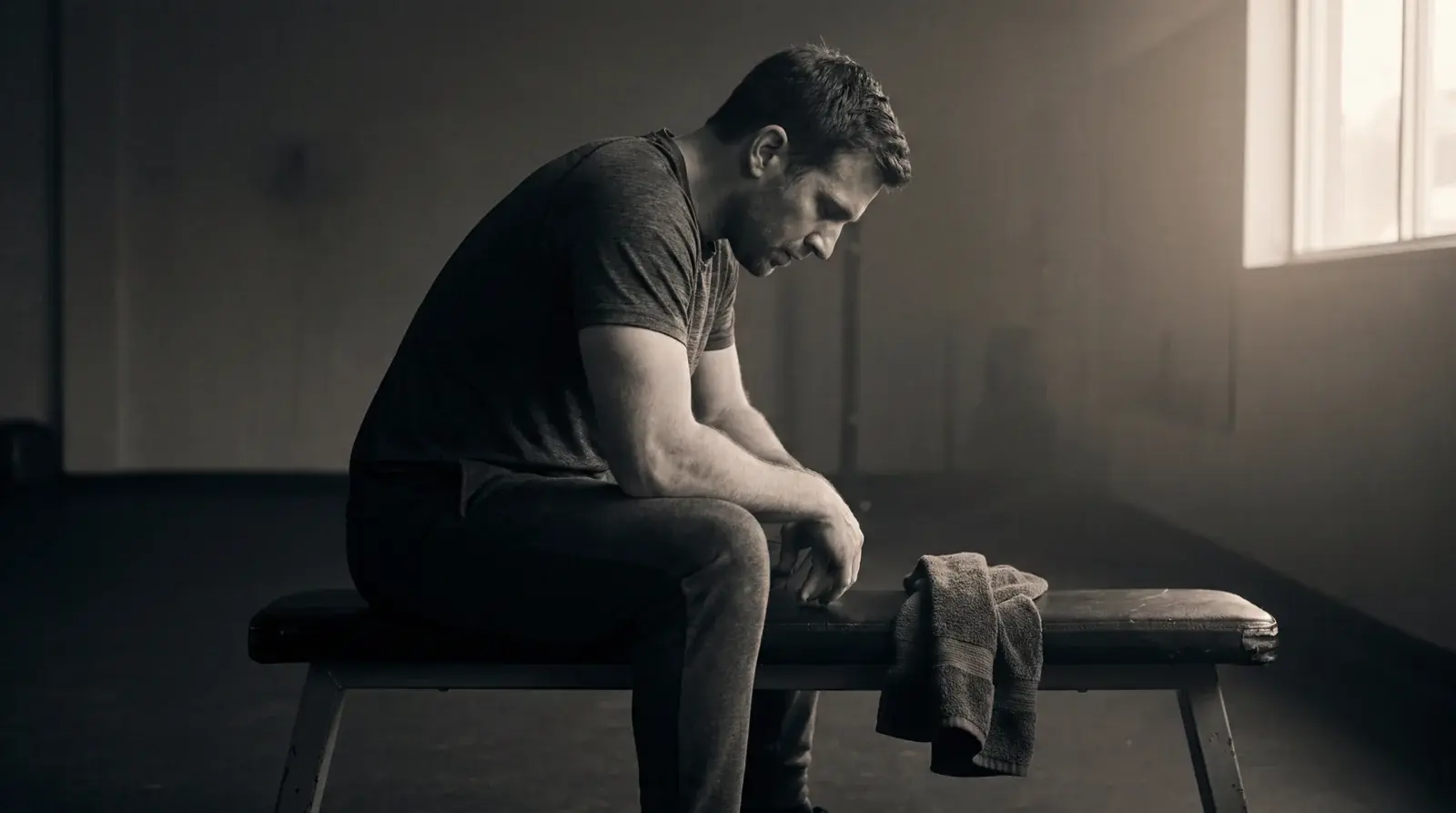
Most lifters treat the rest day as a problem to manage with active recovery and step counts. Scripture and physiology agree on something harder: one true day off — a full Sabbath — is where the strength actually gets built.
Pete Fluriach, founder of Alpha Omega Strength Team. For years I treated the rest day as a problem to be optimized. If I was not lifting, I was walking for step count, stretching for mobility, or doing 'active recovery' that was really just training with the intensity turned down. I called it discipline. It was actually an inability to stop. This guide is the correction I needed — the theology of a real day off, the physiology that backs it up, and how to take a full Sabbath rest without feeling like you are falling behind.
A Sabbath rest is not a deload week or a lighter training day. It is one true day off, every week, where you do no programmed training at all. For the faith-driven lifter, it is also the one day that most directly connects the way you train to the way the world was made. Rest is not the absence of the work. It is part of the design of the work.
What Every Faith-Driven Lifter Needs to Know About Sabbath Rest
Sabbath rest for athletes is the practice of taking one full, unprogrammed day off training each week — treated not as a gap in the plan but as part of the plan. It belongs to every lifter, beginner or advanced, who wants to still be training in twenty years instead of burning out in two.
There are four kinds of 'rest' most lifters confuse with each other:
- The deload — a planned light week, still training, lower load and volume
- Active recovery — easy movement on an off day: a walk, a swim, light mobility
- Passive recovery — sleep, food, and doing genuinely nothing strenuous
- Sabbath rest — a whole day set apart, no training agenda at all, by design
Before you build a rest day that actually holds, hold the four variables that decide whether it works:
- Frequency — one full day every seven, not one whenever you feel wrecked
- Type — genuine rest, not training relabeled as recovery
- Mindset — rest received as a gift, not earned as a reward for hard weeks
- Rhythm — the same day each week, so the body and the calendar both expect it
After this guide you will have a clear definition of what a real day off is, the biblical and physiological case for taking one, and a practical way to install it into a serious training week without losing your progress or your nerve.
The Theology of the Seventh Day: Rest Was Commanded Before It Was Earned
The Sabbath is the first thing in the Bible that God calls holy. Not a mountain, not a temple, not a person — a day of rest. Genesis 2:2-3 reads: 'By the seventh day God had finished the work he had been doing; so on the seventh day he rested from all his work. Then God blessed the seventh day and made it holy, because on it he rested from all the work of creating that he had done' (Genesis 2:2-3 NIV). God was not tired. The rest was not recovery for him. It was a pattern set into the structure of the week on purpose, for the people who would later live inside it.
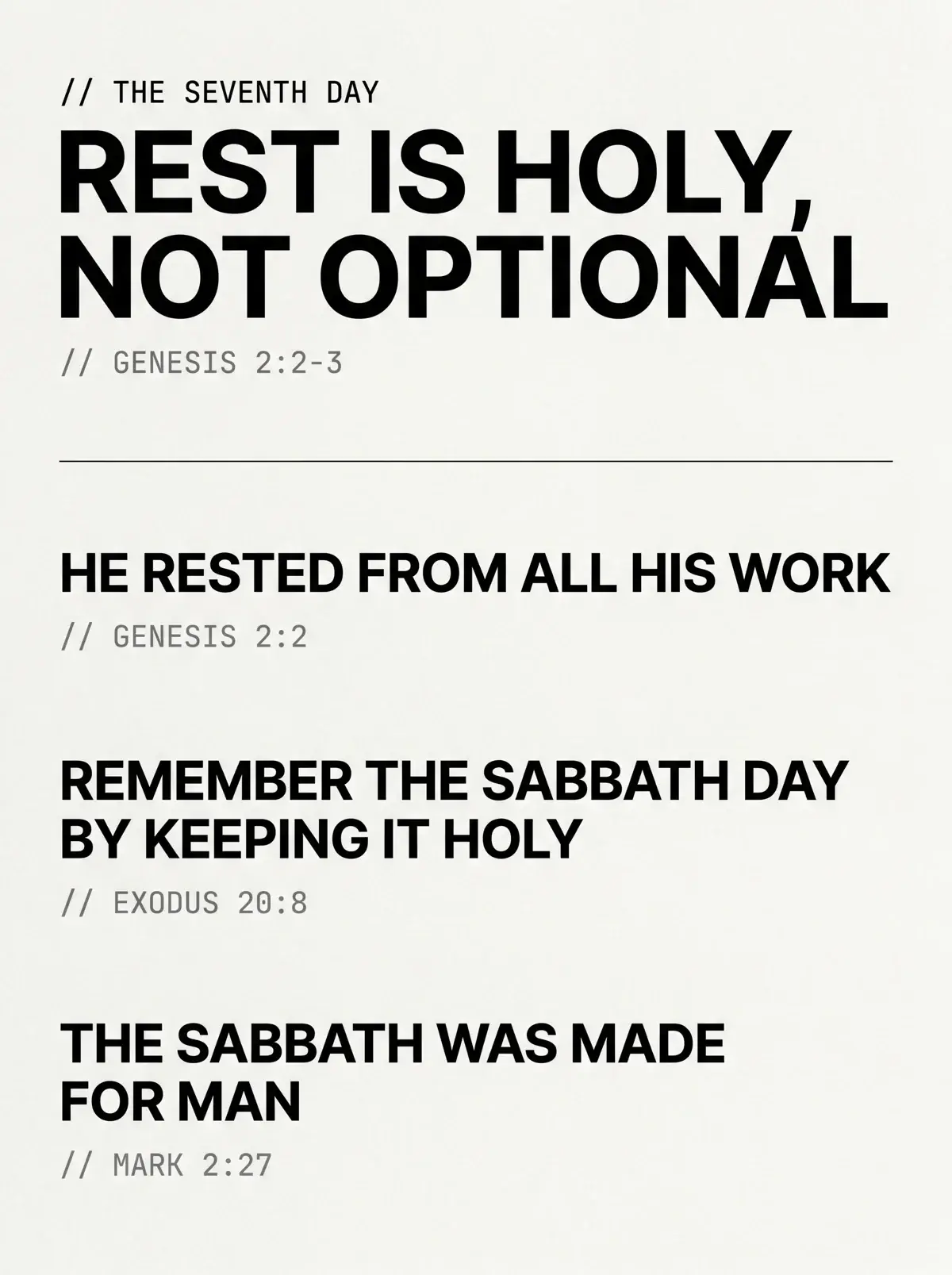
By the time the command is formalized in Exodus 20:8 — 'Remember the Sabbath day by keeping it holy' (Exodus 20:8 NIV) — rest is not presented as a luxury for the productive. It is an obligation for everyone, including servants, animals, and the land itself. The point is hard for a driven man to swallow: the rest is not the reward you earn for a hard week of work. It is built in before the work, ahead of the work, as a limit the work is supposed to respect.
The Sabbath Was Made for Man, Not Man for the Sabbath
When the religious leaders of his day had turned the Sabbath into a cage of rules, Jesus corrected the framing: 'The Sabbath was made for man, not man for the Sabbath' (Mark 2:27 NIV). Rest is for your good. It was given to serve the man, not to trap him. For a lifter, that reframes the whole thing. A day off is not a concession to weakness — it is a gift designed to keep you whole. Jesus himself, in the middle of relentless demand, told his disciples: 'Come with me by yourselves to a quiet place and get some rest' (Mark 6:31 NIV).
The book of Hebrews carries the idea forward: 'There remains, then, a Sabbath-rest for the people of God' (Hebrews 4:9 NIV). Rest is not a footnote in the Christian life. It is woven into the way God made time and into the hope at the end of it. The man who cannot stop is not more faithful than the man who rests — he is quietly insisting that the work depends on him alone.
The Physiology: What a True Day Off Does to a Trained Body
The theology and the physiology end up at the same place. Training is a stress applied to the body. Strength is not the stress itself — it is the body's adaptation to the stress, and that adaptation happens during recovery, not during the session. Lift hard enough and you leave the gym slightly weaker than you walked in. The gains show up later, in the rest.
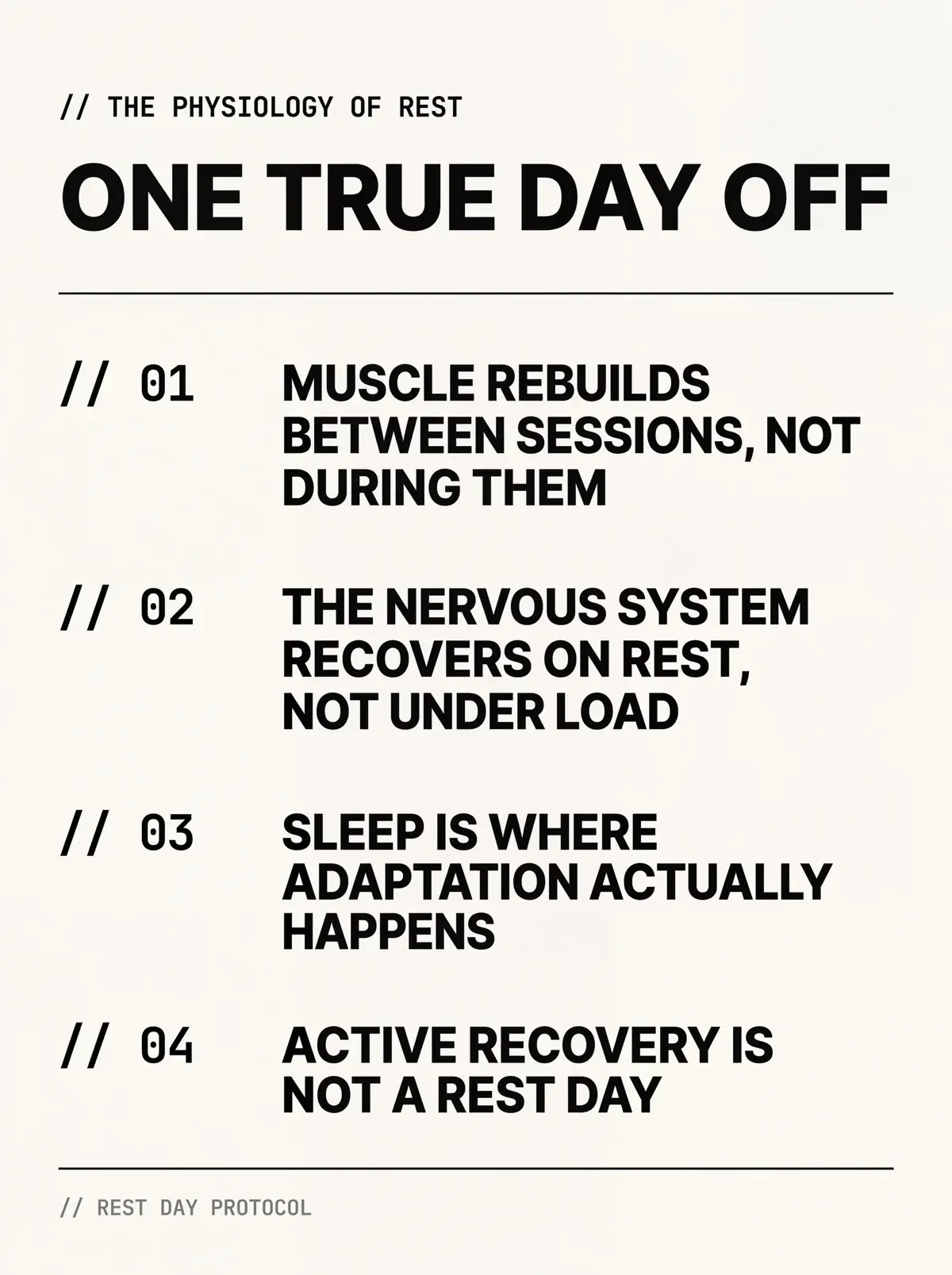
Two systems in particular do their real repair on the days you do nothing. Muscle protein synthesis — the process that actually rebuilds the tissue you broke down — runs for roughly 24 to 48 hours after a hard session, and it competes for resources with any new training you stack on top of it. And the central nervous system, which is what truly limits a heavy strength program, recovers far more slowly than muscle does. You can feel physically fine and still be neurologically flat. A full day off lets both systems finish their work.
Active Recovery Is a Tool — Not a Rest Day
Active recovery has its place. Easy movement can increase blood flow and help you feel less stiff. But for the driven lifter, 'active recovery' is usually a loophole — a way to keep training while telling yourself you rested. A long ruck with a weighted pack is not a rest day. An hour of hard mobility work is not a rest day. If it has a target, a metric, or a number you are trying to beat, it is training. A real Sabbath rest has none of those things.
For the deeper case on why recovery is not the opposite of discipline, read Rest Is Not Weakness — The Case for Recovery.
Expert tip: pick your Sabbath rest day before the training week starts and write it into the program like any other session — 'OFF' in capital letters. A rest day you schedule is a rest day you take. A rest day you leave to feel like it never comes.
Sabbath Rest for Every Stage of Training

The principle is fixed — one full day off a week — but how it lands changes with where you are in a training life:
- The new lifter (0–12 months): the danger is doing too much, too soon. Your enthusiasm is high and your recovery capacity is low. One hard Sabbath rest protects you from the early burnout that ends most lifting careers before they start.
- The intermediate lifter (1–4 years): the danger is the loophole. You now know enough to design endless 'recovery' work that is really just more training. This is the stage where a true day off is hardest to take and matters the most.
- The advanced lifter (5+ years): the danger is identity. Training has become who you are, and a day off feels like losing yourself. The Sabbath rest reminds you that you are a man who trains, not a training program that happens to be a man.
Heavy Training Block vs. Deload vs. Sabbath
These three serve different jobs and should never be collapsed into one:
- Heavy block — six training days carry the load; the weekly Sabbath rest is what makes six hard days survivable
- Deload — a planned lighter week every four to eight weeks; it still contains training and still contains your weekly day off
- Sabbath — the weekly full stop; it is not a deload and not active recovery; it is the day the program asks nothing of you
What to Actually Do With the Day
A Sabbath rest is not an empty day to be endured — it is a day to be filled with the things training crowds out. Worship. A long unhurried meal with your family. Time outdoors with no metric attached. Sleep you do not apologize for. The goal is not to do nothing in the clinical sense; it is to do nothing that demands performance from your body or your will. You are not recovering so you can train. You are resting because rest is good in itself.
Why a Faith-Driven Identity Makes the Day Off Stick
Most men who try to take a real rest day quit inside a month — not because they stop believing it works, but because the culture around them treats stopping as falling behind. The fix is not more willpower. The fix is identity. If your worth is tied to your output, a day off will always feel like a threat. If your worth is settled somewhere outside the gym, a day off is just obedience to a good design.
- Quiet, unflinching frame — Alpha and Omega, the beginning and the end (Revelation 22:13) — the One who finished his work and rested is the One who holds yours together when you stop.
Making the Sabbath Rest Stick
- Fix the day — the same day every week, so neither your body nor your calendar has to negotiate it
- Write it into the program — 'OFF' is a prescription, not an absence of one
- Guard it from the loophole — if it has a target or a number, it is training; move it to another day
- Track your six — if your hard days start sliding, the problem is usually the seventh day you stopped taking
Frequently Asked Questions About Sabbath Rest for Lifters
Does the rest day have to be Sunday?
No. The principle is one full day in seven, set apart and consistent — not a specific square on the calendar. Many men line their rest day up with their day of worship because the two reinforce each other, but the physiological benefit comes from the rhythm and the completeness of the day off, not from which day it lands on. Pick the day your real life can actually protect.
Will I lose strength or muscle from a full day off?
No — the opposite. Detraining does not begin to set in until roughly two to three weeks of no training at all. A single day off does not erode anything; it is when the adaptation from the previous days actually completes. The lifters who fear losing progress on a rest day are almost always the ones whose progress has stalled from never taking one.
Is a walk or light mobility allowed on the Sabbath rest day?
A short, unstructured walk for the sake of being outside is fine — it is rest, not training. The line is intent. The moment you add a distance to hit, a pace to hold, or a step count to beat, you have turned the day back into work. Keep the day free of targets and you keep it a true Sabbath.
Conclusion
Strength is a long game, and the long game is won by the man who knows how to stop. A real Sabbath rest is not the part of the week where nothing happens — it is the part where the work of the other six days is finally allowed to finish. God rested on the seventh day and called it holy before anyone had earned it. The lifter who learns to do the same trains harder, recovers deeper, gets hurt less, and lasts.
Take one full day off this week. Write it into the program. For more on why recovery is part of the discipline and not a break from it, read Rest Is Not Weakness — The Case for Recovery.
// FREQUENTLY ASKED
Questions, answered.
Does the rest day have to be Sunday?
No. The principle is one full day in seven, set apart and consistent — not a specific square on the calendar. Many men line their rest day up with their day of worship because the two reinforce each other, but the physiological benefit comes from the rhythm and the completeness of the day off, not from which day it lands on. Pick the day your real life can actually protect.
Will I lose strength or muscle from a full day off?
No — the opposite. Detraining does not begin to set in until roughly two to three weeks of no training at all. A single day off does not erode anything; it is when the adaptation from the previous days actually completes. The lifters who fear losing progress on a rest day are almost always the ones whose progress has stalled from never taking one.
Is a walk or light mobility allowed on the Sabbath rest day?
A short, unstructured walk for the sake of being outside is fine — it is rest, not training. The line is intent. The moment you add a distance to hit, a pace to hold, or a step count to beat, you have turned the day back into work. Keep the day free of targets and you keep it a true Sabbath.
// GEAR WORN IN THIS TRAINING


PUBLISHED JUNE 1, 2026