
// NUTRITION
Protein Targets for the Faith-Driven Athlete: How Much You Actually Need

The gym sells you on a gram of protein per pound, and the supplement aisle is happy to charge you for it. The evidence says you need less - and spending on protein you cannot use is a stewardship problem, not a strength one.
Pete Fluriach, founder of Alpha Omega Strength Team. Protein is the one nutrition topic every lifter thinks they have figured out, and the one most of them quietly overspend on. The standard advice - a gram per pound of bodyweight, more if you are serious - is not dangerous, but it is wrong often enough to cost you money you did not need to spend. This guide is the number the research actually supports, how to hit it with food instead of marketing, and why a faith-driven lifter should treat the question as one of stewardship and not just gains.
Protein targets are not complicated. They have been made complicated by an industry that profits when you believe you always need more. Strip the marketing away and what is left is a steady, achievable number you can build a year of eating around.
What Every Faith-Driven Lifter Needs to Know About Protein Targets
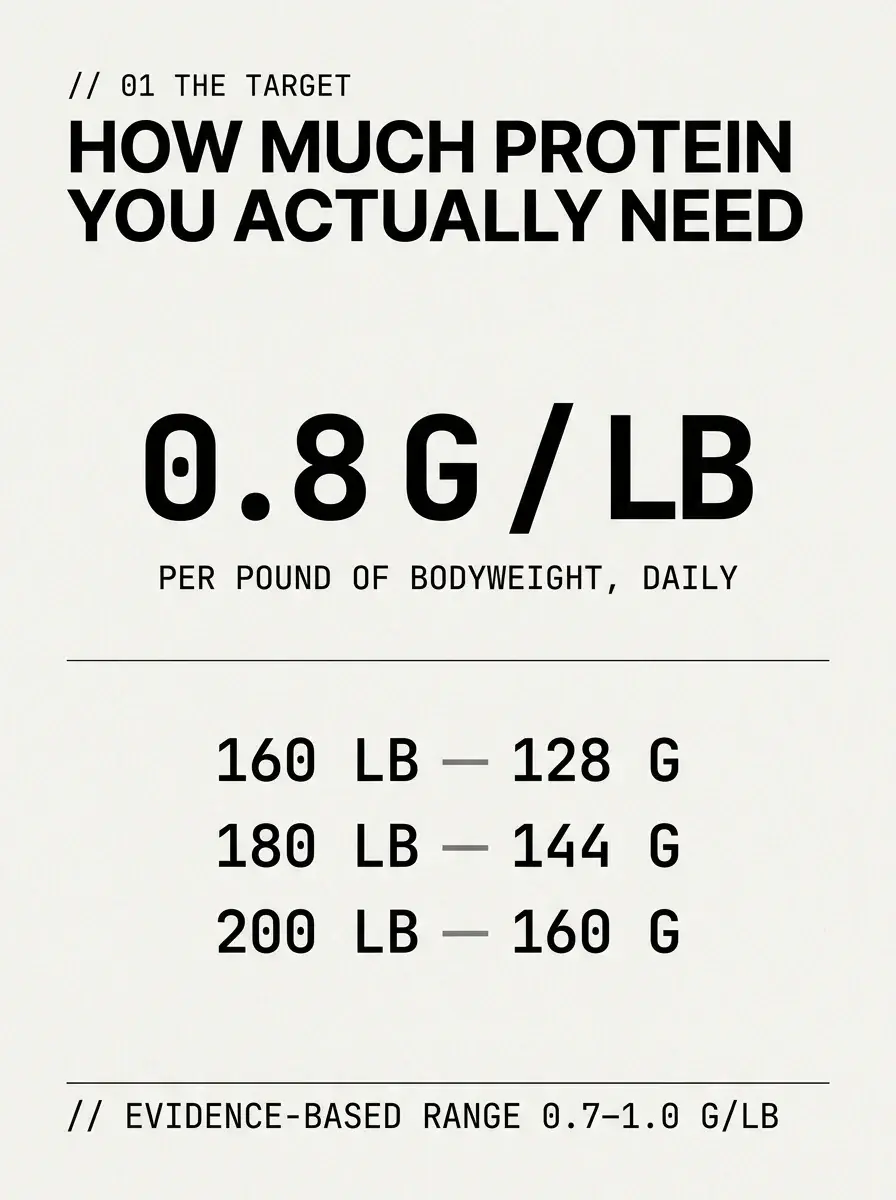
A protein target is the amount of protein you eat per day to build muscle, hold the muscle you have, and recover from training. For nearly every lifter who is not a competitive bodybuilder in a hard cut, that number lands around 0.8g per pound of bodyweight - roughly 1.6g per kilogram. That is the figure the strongest body of research keeps returning to.
Before you chase a higher number, hold the four variables that actually decide whether your protein intake is working:
- Total - the daily amount across all meals, which matters far more than any single serving
- Consistency - hitting the target most days for months, not nailing it once and drifting
- Source - whole food first, powder only where food is impractical
- Distribution - spread across three or four meals so each one carries real protein, not loaded into one
Get those four right and the exact gram count stops mattering much. Get them wrong and no amount of powder will fix it. After this guide, you will have a target you can calculate in ten seconds and a way to hit it that does not depend on a single supplement.
The Real Number: What the Research Actually Says About Protein
The most cited work on this question is a large 2018 review that pooled dozens of resistance-training studies. The finding was consistent: muscle and strength gains climbed as protein rose, then flattened at roughly 1.6g per kilogram of bodyweight - about 0.73g per pound. Eating more than that did not produce more muscle. The researchers set a practical ceiling near 2.2g per kilogram, or roughly 1g per pound, to give a margin for taller, leaner, or hard-dieting athletes. Past that line, the extra protein is simply fuel or waste.
That is the whole science, and it is why 0.8g per pound is the honest recommendation. It sits comfortably inside the range where gains are maximized, it leaves room for error, and it does not pretend that a 185-pound man needs 370 grams of protein a day. The 2g-per-pound figure that floats around training forums has no support in the literature. It survives because it sells protein and because eating that much makes a lifter feel serious. Feeling serious is not the same as building muscle.
Why Overspending on Protein Is a Stewardship Problem
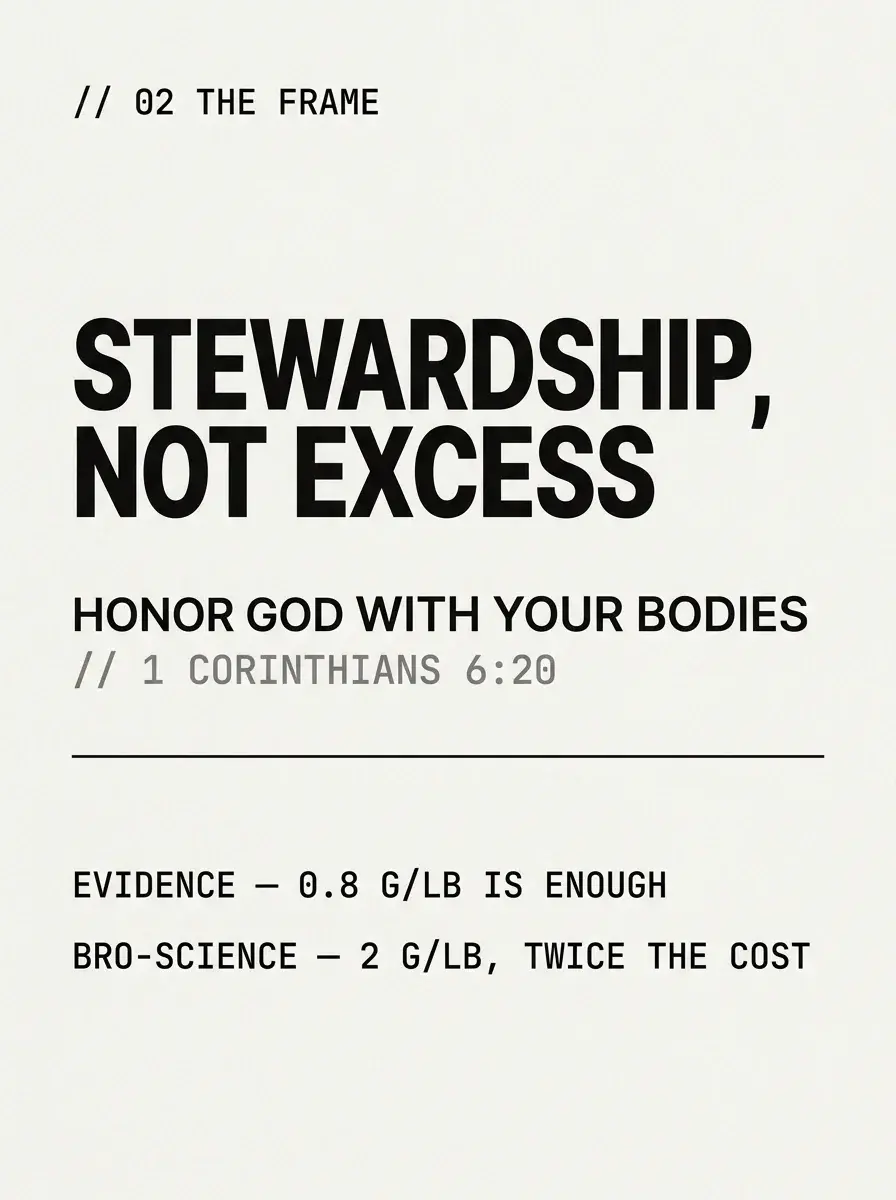
The body has a ceiling on how much protein it will turn into muscle in a day. Past that ceiling, the surplus is oxidized for energy or processed and passed - useful, but no more useful than cheaper carbohydrate or fat would have been. A lifter eating 2g per pound is paying roughly double for the protein above his actual need and getting nothing for it. Over a year, that is hundreds of dollars converted into expensive calories.
For the faith-driven lifter, that is not a small thing. Paul puts it plainly in 1 Corinthians 6:19-20: 'Do you not know that your bodies are temples of the Holy Spirit, who is in you, whom you have received from God? You are not your own; you were bought at a price. Therefore honor God with your bodies.' Honoring the body includes feeding it what it needs - and it also includes not pouring money into what it cannot use while calling it discipline. Stewardship runs in both directions. Underfeeding muscle is poor care of the body. Overspending on protein you will never assimilate is poor care of the resources entrusted to you.
- Floor - below about 0.7g/lb, muscle growth is compromised even with hard training
- Target - 0.8g/lb hits the range where gains are maximized for nearly every lifter
- Ceiling - 1g/lb is the upper end worth eating, useful in a hard cut or for very lean athletes
- Waste - past 1g/lb, you are buying calories at a protein price for no added muscle
How to Hit Your Protein Target Without Living on Powder
Most lifters who miss their protein target do not miss it by a little. They miss it because they treat protein as something they add with a shake instead of something they build their meals around. The fix is to anchor three or four meals with a real protein source and let powder fill only the gap that food cannot reasonably close.
Whole Food First - for the Lifter Who Wants Value
- Best for: nearly everyone; whole food carries micronutrients, satiety, and a lower cost per gram
- Strength: eggs, chicken thighs, ground beef, Greek yogurt, milk, and canned fish hit the target cheaply
- Weakness: requires cooking and planning, which is exactly where most lifters quit
Whey Powder - for the One or Two Meals Food Cannot Cover
- Best for: a fast post-training meal or a busy morning, not as the backbone of the diet
- Strength: cheap per gram, digests fast, and removes the excuse of having no time to eat
- Weakness: easy to over-rely on; a tub does not feed you the way a cooked meal does
Expert tip: build a default plate that carries 40 grams of protein - say, six ounces of chicken or a can of tuna with two eggs - and repeat it. A lifter who has one reliable high-protein meal he can make without thinking will out-eat the lifter chasing a different macro-perfect recipe every day.
The 10-Second Calculation
Take your bodyweight in pounds, multiply by 0.8, and divide across your meals. Three steps, no app required:
- Multiply bodyweight by 0.8 - a 180-pound lifter lands at 144 grams per day
- Divide by your meal count - four meals means roughly 36 grams each
- If you carry extra bodyfat, calculate from a realistic goal weight instead, so you do not inflate the number
For how to feed a strength program without overspending in the first place, see the Faith-Driven Lifter's Grocery Guide to fueling on a budget.
Protein Targets for Every Goal and Stage

The target flexes with the goal. The same 0.8g-per-pound baseline reads a little differently depending on whether you are gaining, holding, or cutting, and on how long you have been training:
- Building muscle (slight surplus): 0.8g/lb is plenty. The extra calories, not extra protein, drive the growth. Adding more protein here just crowds out the carbs that fuel the work.
- Maintaining: 0.7 to 0.8g/lb holds muscle comfortably. This is the easiest phase to under-eat protein because the urgency is gone, so keep the habit anyway.
- Cutting (calorie deficit): push to 0.9 or 1g/lb. This is the one situation where the higher end earns its keep - more protein protects muscle and blunts hunger while you lose fat.
Younger Lifter vs. Lifter Over 40
Age shifts the emphasis more than the total:
- Under 40 - hitting the daily total is most of the battle; timing barely matters as long as the total lands
- Over 40 - the body resists building muscle from small servings, so aim for at least 35 to 40 grams per meal to clear that threshold
- Any age - a meaningful dose of protein at breakfast is the most commonly skipped and most quietly costly meal of the day
None of this requires perfection. A lifter who lands within ten grams of his target most days, year after year, will out-build the one who tracks to the gram for three weeks and then abandons it. Protein is a long game, and the long game rewards the steady more than the precise.
Why Treating Food as Stewardship Changes How You Eat
Most men who try to dial in their nutrition burn out, not because the plan was wrong, but because the motivation underneath it was thin. Eating for vanity runs out of fuel the moment the mirror stops cooperating. Eating because the body was given to you, bought at a price, and entrusted to your care is a reason that holds when the novelty is gone. 1 Corinthians 10:31 makes the frame universal: 'So whether you eat or drink or whatever you do, do it all for the glory of God.' That includes the unglamorous work of hitting a protein target on a Tuesday.
- Quiet, unflinching conviction - the body is worth feeding well and worth not wasting money on - without the bro-science aesthetic that treats more as automatically holier.
Getting the Most Out of Your Protein Plan
- Set the daily total once, in grams, and stop renegotiating it every week
- Build two or three default high-protein meals you can make on autopilot, so a tired day does not become a missed day
- Buy protein at the cost per gram, not the label - whole cuts and eggs usually beat anything in a tub or a bar
- Reassess only when your bodyweight or goal actually changes, not when a new product tells you the old number was too low
Frequently Asked Questions About Protein Targets
Is more protein ever better than 0.8g per pound?
In one situation: a hard calorie cut. When you are eating in a deficit to lose fat, pushing protein to 0.9 or 1g per pound helps protect muscle and keeps you fuller. Outside of a cut, eating past roughly 1g per pound does not add muscle - it just adds cost. The ceiling is real, and the research is clear that crossing it does not pay.
What are the cheapest ways to hit my protein target?
Per gram of protein, the best value usually comes from:
- Eggs and whole milk - cheap, complete, and easy to eat in volume
- Chicken thighs and ground beef - cheaper per gram than lean breast and more satisfying
- Canned tuna and dried lentils - shelf-stable protein for almost nothing
- Plain whey powder - the cheapest convenience option, best kept to one meal a day
Does it matter if I get all my protein in one or two meals?
The daily total is the main driver, so two large protein meals will still build muscle. That said, spreading protein across three or four meals gives a small edge, especially as you age, because each meal triggers its own muscle-building response. If you are already hitting your total, do not stress over distribution. If you are over 40, lean toward more meals with at least 35 grams each.
Conclusion
Protein is not the place to prove how serious you are. The number is settled: roughly 0.8g per pound of bodyweight, a little higher in a cut, built mostly from food you can afford and repeat. The lifter who hits that target quietly for a year will be stronger than the one who chased a bigger number and a fuller cupboard of supplements. Feed the body well, do not waste what you have been given, and let the steadiness do the work.
Calculate your number today and build two meals around it. To stretch your food budget further without cutting protein, read the Faith-Driven Lifter's Grocery Guide to fueling on a budget.
// FREQUENTLY ASKED
Questions, answered.
Is more protein ever better than 0.8g per pound?
In one situation: a hard calorie cut. When you are eating in a deficit to lose fat, pushing protein to 0.9 or 1g per pound helps protect muscle and keeps you fuller. Outside of a cut, eating past roughly 1g per pound does not add muscle - it just adds cost. The ceiling is real, and the research is clear that crossing it does not pay.
What are the cheapest ways to hit my protein target?
Per gram of protein, the best value usually comes from: Eggs and whole milk - cheap, complete, and easy to eat in volume Chicken thighs and ground beef - cheaper per gram than lean breast and more satisfying Canned tuna and dried lentils - shelf-stable protein for almost nothing Plain whey powder - the cheapest convenience option, best kept to one meal a day
Does it matter if I get all my protein in one or two meals?
The daily total is the main driver, so two large protein meals will still build muscle. That said, spreading protein across three or four meals gives a small edge, especially as you age, because each meal triggers its own muscle-building response. If you are already hitting your total, do not stress over distribution. If you are over 40, lean toward more meals with at least 35 grams each.
// GEAR WORN IN THIS TRAINING
PUBLISHED JUNE 5, 2026