
// NUTRITION
The Only 4 Supplements Worth the Money for Faith-Driven Lifters

Creatine, whey, vitamin D, fish oil. That is the list. Here is the evidence behind the four supplements that earn their place, the five that waste your money, and the stewardship argument for spending less than you think you need to.
Pete Fluriach, founder of Alpha Omega Strength Team. There was a stretch where the shelf in my garage held eleven different tubs, and I could not have told you what six of them were supposed to do. I had been sold a category, not a plan. Somewhere in year three I threw most of it out, kept four things, and my training did not get worse. It got cheaper.
This guide is the short list and the reasoning behind it. Four supplements have enough evidence to justify a line in your budget. The rest of the industry is built on the hope that you will keep buying things you cannot feel working. Knowing the difference is a training skill and a stewardship skill at the same time.
What Every Faith-Driven Lifter Needs to Know About Supplements
A supplement supplements. The word is doing honest work: it fills a gap left by something more important. It is the last few percent of a result that training, food, and sleep have already built. Sold correctly, that is a modest and useful claim. Sold the way the industry sells it, it becomes a substitute for the work, which is the one thing it can never be.
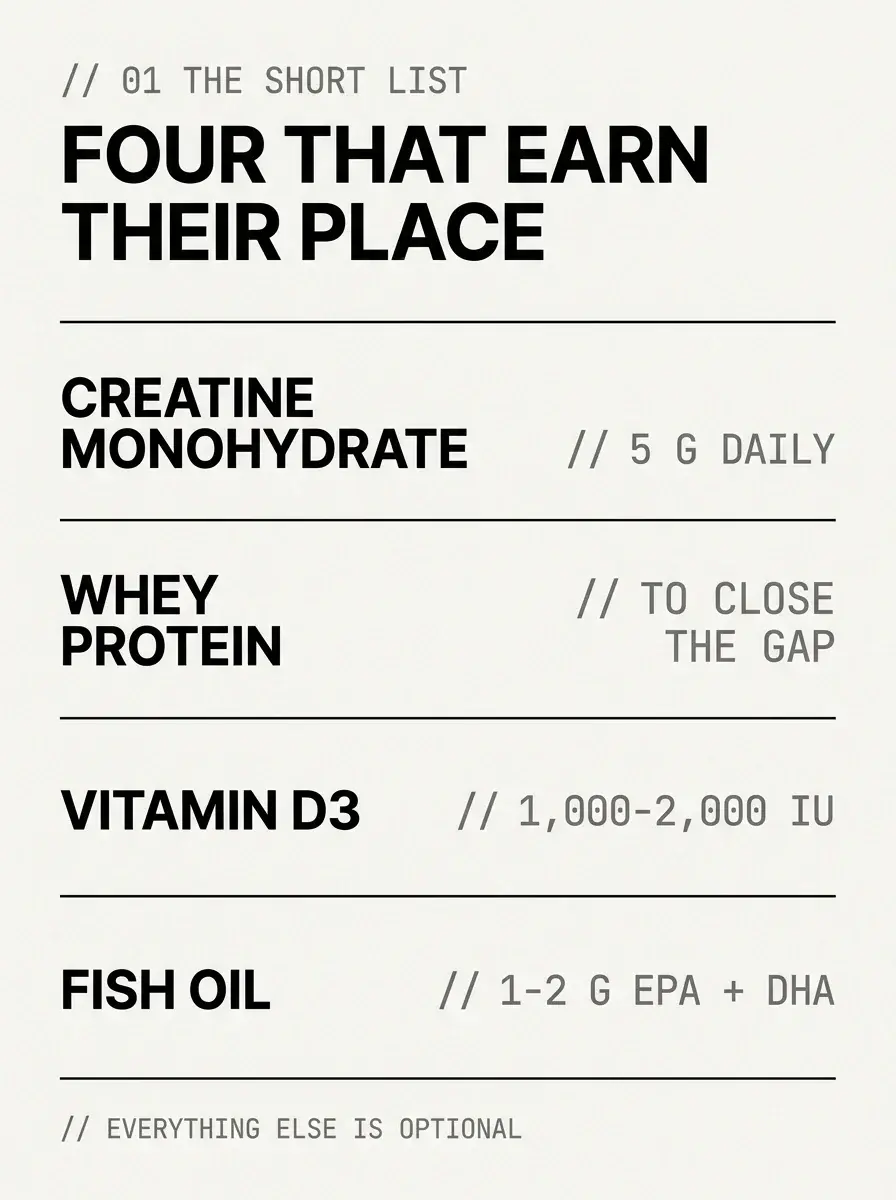
Four earn their place on the shelf:
- Creatine monohydrate - five grams daily, the most studied ergogenic aid in sport
- Whey protein - a convenience tool for closing a real protein gap, nothing more
- Vitamin D3 - worth it if your blood level is low, which for most indoor men it is
- Fish oil - worth it if you rarely eat fatty fish, for joints and general health more than performance
Together those four cost less per month than a single tub of most branded pre-workout blends. That is the entire argument of this guide in one sentence.
The Foundation: What a Supplement Can and Cannot Do
Put the inputs in order of how much they decide. A program you actually run, week after week, with load going up over months. Enough total food, and enough protein inside that food. Seven to nine hours of sleep. Those three settle nearly all of it. Supplements arrive after that list is handled, and they operate on what is left over.
This is why the man taking six products while sleeping five hours is getting nothing for his money. There is no gap being filled. There is a foundation being ignored while the roof gets decorated.
Scripture is careful with proportion in a way the supplement aisle is not. Paul writes to Timothy: “For physical training is of some value, but godliness has value for all things, holding promise for both the present life and the life to come” (1 Timothy 4:8 NIV). Read the qualifier rather than skipping it. Physical training is of some value - real, limited, worth doing. If the training itself carries some value, then a powder that assists the training carries some fraction of some value. That is not an argument against supplements. It is an argument for keeping them the size they actually are.
A lifter who gets the proportion right buys four things and stops thinking about it. A lifter who gets it wrong spends years hoping the next purchase is the one that finally works.
The Decision Framework: Where the Money Actually Goes
Before anything goes in the cart, three questions. Is there a real gap in my training or my diet? Is there human evidence that this product closes that gap? Is this the cheapest honest way to close it? A product has to clear all three. Most clear none.
Run the common purchases through that filter and the picture gets clear fast. Costs below are typical monthly figures for unflavored, single-ingredient products bought in bulk rather than in branded blends.
| Product | Cost / Month | Human Evidence | What It Actually Does | Verdict |
|---|---|---|---|---|
| Creatine monohydrate | $8-12 | Strongest in all of sport | A few more reps at the same load | Buy this first |
| Whey protein | $30-45 | Strong, but it is only food | Closes a daily protein gap | Buy only if the gap is real |
| Vitamin D3 | $5-8 | Strong when you are deficient | Restores a low blood level | Test first, then buy |
| Fish oil | $12-20 | Moderate | Joint comfort and general health | Buy if you rarely eat fish |
| Pre-workout blend | $35-55 | Caffeine works, the rest is filler | Wakes you up at a markup | Buy coffee instead |
The bottom row is the one that stings. Caffeine is a genuine performance aid, well studied, and it costs almost nothing in coffee form. Sold as a proprietary blend with eleven other ingredients at clinically meaningless doses, the same caffeine costs forty dollars a month and arrives with a name that sounds like a weather event.
Notice also that the cheapest item on the list has the strongest evidence behind it. That relationship holds across the whole category, and it is the opposite of what the marketing implies.
The Four That Earn Their Place
1. Creatine monohydrate - five grams daily
Creatine is the one supplement I would tell a new lifter to buy on day one. It has hundreds of human trials behind it, a clean safety record spanning decades, and a mechanism that is not mysterious: it helps your muscles regenerate energy between hard efforts. In practice that shows up as one or two extra reps at a given load, which compounds into meaningful strength over a training year.
Buy plain monohydrate. Skip the patented forms, the buffered versions, and anything with a trademark symbol - none of them have beaten monohydrate in a head-to-head study, and all of them cost more. Five grams a day, any time of day, every day including rest days. Loading phases are optional; skipping one just means it takes three or four weeks to saturate instead of one.
2. Whey protein - only if the gap is real
Whey is not a supplement in the pharmacological sense. It is a dairy protein that has been filtered and dried, which makes it food that happens to be convenient. That framing matters, because it tells you exactly when to buy it: when you have counted your protein for a week, found yourself thirty or forty grams short most days, and decided that a shake is easier than another meal.
If you are already hitting your target with meat, eggs, dairy, and legumes, whey adds nothing but expense. Timing is close to irrelevant - the anabolic window is far wider than it was sold to us as, and total daily protein is what carries the result.

3. Vitamin D3 - test, then dose
Vitamin D behaves less like a performance aid and more like a repair to a deficiency. If your blood level is low - common for men who train indoors, work indoors, and live above roughly the thirty-fifth parallel - correcting it tends to improve mood, immune resilience, and bone health. If your level is already adequate, adding more does close to nothing.
Which is why this one starts with a blood test rather than a purchase. Ask for 25-hydroxyvitamin D at your next physical. If you come back low, one to two thousand IU daily with a meal containing fat is a reasonable, cheap correction. Talk to your doctor before going higher; this is a fat-soluble vitamin and more is not automatically better.
4. Fish oil - a gap-filler, not a performance aid
The evidence here is more modest than the label copy suggests, and it is mostly about health rather than lifting: cardiovascular markers, joint comfort, inflammation. If you eat fatty fish two or three times a week, you can skip it entirely. If you almost never do, one to two grams of combined EPA and DHA daily is a sensible, inexpensive way to close a genuine dietary gap.
Read the back of the bottle rather than the front. A capsule advertised as one thousand milligrams of fish oil often contains only three hundred milligrams of actual EPA and DHA, which is the number that matters.
The Five Purchases That Waste the Most Money
These are the categories I see most often on other men's shelves, in rough order of how much money they consume for how little return.
- Pre-workout blends - you are paying a large markup for caffeine surrounded by ingredients at doses too small to do anything. Coffee and a plan cost less.
- BCAAs - largely redundant if you are eating enough total protein, which covers those amino acids already.
- Testosterone boosters - the herbal blends sold over the counter do not meaningfully move hormone levels in healthy men. If you suspect a real problem, that is a blood panel and a physician, not a tub.
- Fat burners - a stimulant with a small appetite effect, priced as though it were a metabolic intervention. Nothing in the bottle creates a calorie deficit.
- Mass gainers - expensive sugar. If you need more calories, rice, oats, whole milk, and peanut butter deliver them for a fraction of the price.
There is a pattern underneath all five. Each one sells the feeling of doing something about a problem that is actually solved by consistency you have not built yet. That is a comfortable trade in the moment and an expensive one over years.
Stewardship: Why the Cheapest Honest Answer Is Usually the Right One
Sixty dollars a month is seven hundred and twenty dollars a year. For most households that is not a rounding error - it is a real number that could have gone toward a debt, a giving commitment, or a family that did not need another tub of powder in the pantry. Money spent on supplements is money not spent somewhere else, and a man who takes stewardship seriously has to be able to say what he bought and why.
That does not make supplements suspect. Creatine at ten dollars a month is a defensible line item, easy to explain to your wife and easy to justify to yourself. The problem is never the four things on the short list. It is the eleven tubs that accumulate when a lifter is buying reassurance instead of nutrition.
Paul takes the ordinary business of eating and drinking and gives it a direction: “So whether you eat or drink or whatever you do, do it all for the glory of God” (1 Corinthians 10:31 NIV). He is not ranking foods. He is saying that the small, repeated, unglamorous decisions - what goes in the cart, what goes in the shaker, what you can afford without pretending - are already spiritual decisions. The shelf in your garage is a small ledger of what you actually believe about restraint.

Buy the four. Skip the rest. Put the difference somewhere it will still matter in ten years.
Frequently Asked Questions
Do I need to load creatine or cycle off it?
No to both. A loading phase of twenty grams a day for five days saturates your muscles faster, but five grams daily gets you to the same place in three or four weeks with less stomach discomfort. Cycling off has no demonstrated benefit - the research on continuous use runs years long with no signal of harm in healthy people. Take five grams a day and stop thinking about it.
Is whey protein necessary if I already eat a lot of meat?
Probably not. Whey is a convenience, not a requirement. Track your intake honestly for one week; if you are consistently hitting roughly one gram of protein per pound of bodyweight from food, a shake adds cost and nothing else. If you are landing short most days because of your schedule, whey is the cheapest fix available.
Are expensive supplements better than cheap ones?
Usually the opposite. The best-supported supplement in existence, creatine monohydrate, is also nearly the cheapest thing on the shelf. Price in this category tracks marketing spend and proprietary blends, not evidence. What you should pay for is third-party testing - a certification mark from an independent lab tells you the tub contains what the label claims, which is worth more than any patented formulation.
Is spending money on supplements poor stewardship?
Not inherently. Ten dollars a month for creatine, spent deliberately, is a small and defensible investment in a body you are responsible for maintaining. Sixty dollars a month spread across products you cannot explain is a different question, and the honest answer is usually no. The test is not whether you spend, but whether you could account for each item if someone asked.
The Bottom Line
Creatine, whey if you need it, vitamin D if you are low, fish oil if you rarely eat fish. That is the whole list, and it will cost you less than most lifters spend on a single branded tub. Everything else in the aisle is competing for money that belongs somewhere more useful.
None of it substitutes for the parts that actually decide your results. If your protein number is the gap, start with the protein targets guide for faith-driven athletes. If the budget is the constraint, read how to fuel a strength program on a budget and build the foundation before you buy anything to sit on top of it.
// FREQUENTLY ASKED
Questions, answered.
Do I need to load creatine or cycle off it?
No to both. A loading phase of twenty grams a day for five days saturates your muscles faster, but five grams daily gets you to the same place in three or four weeks with less stomach discomfort. Cycling off has no demonstrated benefit - the research on continuous use runs years long with no signal of harm in healthy people. Take five grams a day and stop thinking about it.
Is whey protein necessary if I already eat a lot of meat?
Probably not. Whey is a convenience, not a requirement. Track your intake honestly for one week; if you are consistently hitting roughly one gram of protein per pound of bodyweight from food, a shake adds cost and nothing else. If you are landing short most days because of your schedule, whey is the cheapest fix available.
Are expensive supplements better than cheap ones?
Usually the opposite. The best-supported supplement in existence, creatine monohydrate, is also nearly the cheapest thing on the shelf. Price in this category tracks marketing spend and proprietary blends, not evidence. What you should pay for is third-party testing - a certification mark from an independent lab tells you the tub contains what the label claims, which is worth more than any patented formulation.
Is spending money on supplements poor stewardship?
Not inherently. Ten dollars a month for creatine, spent deliberately, is a small and defensible investment in a body you are responsible for maintaining. Sixty dollars a month spread across products you cannot explain is a different question, and the honest answer is usually no. The test is not whether you spend, but whether you could account for each item if someone asked.
// GEAR WORN IN THIS TRAINING

PUBLISHED JULY 28, 2026