
// DISCIPLINE
Training When You Don't Feel Like It: The Faith-Driven Discipline of Showing Up
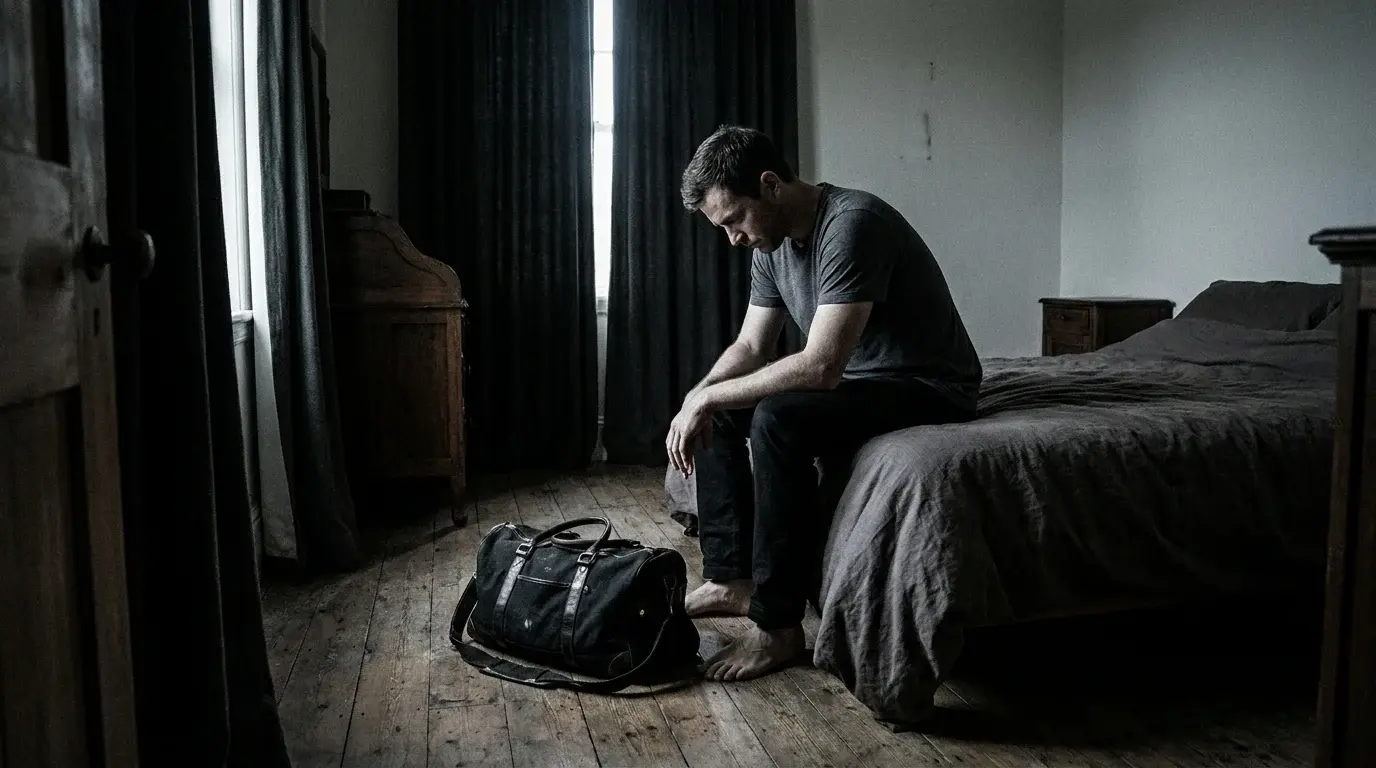
Motivation shows up about one session in four, and never on the days that need it. Here is how to diagnose a real recovery signal from a soft excuse, how to scale a session instead of cancelling it, and why Scripture cares far more about your continuing than your enthusiasm.
Pete Fluriach, founder of Alpha Omega Strength Team. I have never once in eight years of training walked into a gym on a Tuesday in February and felt like it. Not once. What I have done is walk in anyway, most of the time, and the difference between the men who make progress and the men who talk about progress turns out to sit almost entirely in that one gap.
This is not a piece about finding motivation. Motivation is a feeling, and feelings are lousy employees. This is about what to do with your body and your will on the days the feeling does not show up, how to tell a real recovery signal from a soft excuse, and why God appears to care a great deal more about your showing up than about your enthusiasm when you do.
What Every Faith-Driven Lifter Needs to Know About Training Motivation
Training motivation is the emotional willingness to start a session. It arrives unpredictably, it is heavily influenced by sleep and blood sugar and whatever happened at work, and it cannot be scheduled. Discipline is the structure you build so that the session happens whether or not motivation arrives. One is weather. The other is architecture.
Every serious lifter eventually discovers the same four facts:
- Motivation shows up roughly one session in four, and never on the sessions that need it most.
- The decision to train is made before you get to the gym, usually the night before.
- Most unwillingness is a fuel, sleep, or fatigue problem wearing a motivation costume.
- The sessions you do not want to do are the ones that build the most character, and often the most strength.
Paul was blunt about the gap between wanting and doing. "I do not understand what I do. For what I want to do I do not do, but what I hate I do" (Romans 7:15 NIV). If the apostle who wrote most of the New Testament had a compliance problem with his own intentions, you are not going to fix yours with a better playlist.
The Foundation: Motivation Is a Feeling, Discipline Is a Structure
Here is the mistake almost every man makes in his first two years under the bar. He treats the feeling of wanting to train as the permission slip for training. On the days it shows up, he trains hard. On the days it does not, he tells himself he will go tomorrow. Over a year that produces maybe ninety sessions out of a possible two hundred, spread unevenly, with no block long enough to drive an adaptation.
The man who runs on structure instead gets a hundred and eighty sessions. Some of them are excellent. A lot of them are ordinary. A handful are genuinely bad. And he is dramatically stronger at the end of the year than the man who only trained when inspired, because strength is a response to accumulated, repeated stress and nothing else. The body does not audit your attitude. It audits your tonnage.
Structure means a fixed schedule, a written program you did not invent that morning, a bag packed the night before, and a rule about what happens when you do not feel like it. Not a hope. A rule. Mine is simple: I go, I warm up, and I am allowed to reconsider after the first working set. In eight years that reconsideration has ended the session maybe six times.
That is the whole trick, and it works because unwillingness is almost always front-loaded. The resistance lives in the ten minutes before you start. It rarely survives contact with the first set.
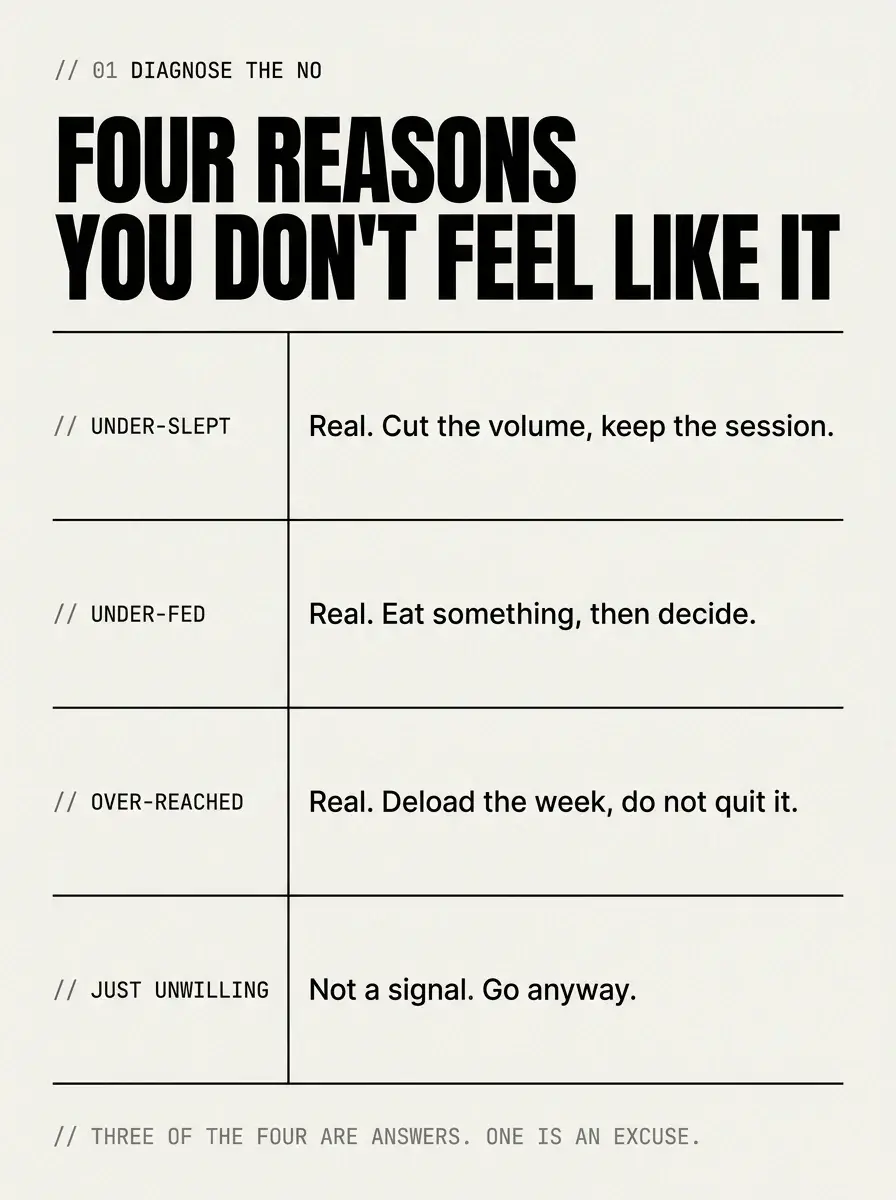
The Decision Framework: Diagnose the No Before You Obey It
Not every no is an excuse. Some of them are your body filing a legitimate report, and a man who trains straight through every warning signal for a year will spend the following year in physical therapy. The skill is not blanket defiance. It is diagnosis.
Before you skip, name the reason out loud in one sentence. Then run it through the table below. Four of these five signals are real and have a scaled answer that keeps the session on the calendar. Only one of them is a genuine stop, and only one of them is nothing at all.
| The No Sounds Like | What It Actually Is | The Move | Skip or Show Up? |
|---|---|---|---|
| Under five hours of sleep | Real recovery debt | Keep the session, cut volume 40 percent | Show up, scaled |
| Have not eaten since lunch | Real fuel gap | Eat, wait 45 minutes, then lift | Show up, delayed |
| Third hard week in a row | Accumulated fatigue | Deload the week at 60 percent load | Show up, deloaded |
| Fever, chest, or gut illness | A genuine medical stop | Rest fully, return at 60 percent | Skip |
| Body is fine, mind is unwilling | Not a signal at all | Warm up, then decide | Show up |
Notice what the table does. It removes the question from the realm of feeling and puts it in the realm of fact. You either slept or you did not. You either ate or you did not. You are either three weeks into a hard block or you are not. Those are checkable. "I am not feeling it" is not checkable, which is exactly why it is the reason men reach for most.
The bottom row is the one that decides your training career. If your body is functional and your mind is simply unwilling, that is not information about whether you should train. It is information about how you feel, which is a different subject entirely.
What This Looks Like on Four Kinds of Bad Day
1. The tired day
Six hours or less of sleep, heavy limbs, short fuse. Go. Keep the exercise selection and drop the volume by roughly forty percent, so four sets becomes two or three and the accessory work gets trimmed to one movement. Hold the load if it feels fine and pull it back ten percent if it does not. You are protecting the habit and the movement pattern, not chasing a personal record.
2. The busy day
Ninety minutes of work that will not fit in the forty you have. Cut the session, not the week. Two compound lifts, three sets each, in and out in twenty-five minutes. A short session that happened beats a full session that did not by a margin so wide it is not worth discussing.
3. The discouraged day
The bar has not moved in five weeks and you are starting to wonder what the point is. This one is not a physical problem and cutting volume will not touch it. Go, run the session as written, and stop evaluating your progress on a weekly timescale. Strength is measured in quarters. Five flat weeks inside a good program is a normal shape, not a verdict.
4. The heavy-heart day
Something real happened. A diagnosis, a job loss, a hard conversation. Here the honest answer is sometimes to go and sometimes to sit with it, and I would not hand anyone a rule for that. What I will say is that in my experience the gym is one of the few places where a man can put his hands on something solid when nothing else is, and that has value beyond the training effect.

There is a specific moment I have come to think of as the whole battle in miniature. You are in the parking lot. The engine is off. The door is forty feet away and lit. Nothing is stopping you except that you would rather not. Every man who trains for a decade wins that moment several hundred times, and no single instance of it feels significant while it is happening.
Five Mistakes Men Make on the Days They Do Not Want To
The failure modes are predictable, which makes them easy to guard against.
- Making the decision in the moment. If the choice to train is live every single day, you will lose it often. Decide the schedule once a week, on paper, and then stop deciding.
- Treating every session as all-or-nothing. Men skip a full workout because they cannot do a full workout. A scaled session keeps the streak, the pattern, and the identity intact.
- Waiting for the feeling. It is not coming, and organizing your training around its arrival puts your progress in the hands of your mood.
- Confusing intensity with consistency. A man who annihilates himself twice a month is not training. He is having episodes.
- Skipping rest and calling it discipline. Refusing a deload is not toughness, it is poor programming, and the body collects on that debt eventually.
That last one deserves emphasis. Discipline includes the discipline to stop. A planned day off is part of the program, and a real day of rest is not a failure of will. Under-recovery and unwillingness look identical from the inside, which is why sleep is the first thing to audit when the no starts arriving every day instead of once a week.
The Long View: Why Showing Up Is a Spiritual Practice
Scripture has almost nothing to say about feeling motivated and a great deal to say about continuing. That asymmetry is worth sitting with, because it suggests the thing being formed in you is not enthusiasm.
"No discipline seems pleasant at the time, but painful. Later on, however, it produces a harvest of righteousness and peace for those who have been trained by it." - Hebrews 12:11 NIV
The writer of Hebrews concedes the whole emotional case up front. Discipline is unpleasant. There is no promise that it will start to feel good, and no suggestion that the unpleasantness means you have chosen wrong. The promise attaches to what comes later, and to the person who stayed in it long enough to be trained by it.
Paul used the same frame when he described his own body as something to be governed rather than consulted. "Therefore I do not run like someone running aimlessly; I do not fight like a boxer beating the air. No, I strike a blow to my body and make it my slave so that after I have preached to others, I myself will not be disqualified for the prize" (1 Corinthians 9:26-27 NIV). He is not describing an athlete who felt like training. He is describing an athlete who had decided in advance who was in charge.
None of this makes the barbell holy. Lifting is not a sacrament and your squat is not a spiritual metric. But the habit of doing a hard, unglamorous, useful thing on the days you would rather not is directly transferable to prayer, to work, to marriage, and to every other place where showing up matters more than feeling ready. The gym is simply the cheapest place to practice it, four times a week, with immediate feedback.
Paul's line to the Galatians is the one I come back to most: "Let us not become weary in doing good, for at the proper time we will reap a harvest if we do not give up" (Galatians 6:9 NIV). Note the conditions. The harvest is real, the timing is not yours to set, and the only variable under your control is whether you are still in the field when it arrives.
Frequently Asked Questions
How do I know if I am being lazy or genuinely need rest?
Check the facts before you check the feeling. Sleep under five hours, three or more consecutive hard weeks, a resting heart rate well above your normal, joints that ache at rest, or worsening sleep despite fatigue all point to real recovery debt. A functional body paired with an unwilling mind points to the other thing. When it is genuinely unclear, go and warm up. Ten minutes of general work makes the answer obvious.
Should I ever skip a session entirely?
Yes. Fever, chest or gut illness, an acute injury, and a scheduled deload are all legitimate reasons to stay home, and training through them costs you more than it earns. The distinction that matters is between a planned or medically indicated day off and an unplanned skip driven by mood. The first is programming. The second is drift.
Does a short, scaled session actually do anything?
A good deal, yes. Two compound lifts for three sets each preserves the movement pattern, provides a real if reduced training stimulus, and keeps the habit unbroken, which is the part that compounds. Across a year the men who scale on bad days out-train the men who skip on bad days by a wide margin, because they simply accumulate far more work.
Is it wrong to train when my heart is not in it?
No. Faithfulness in the absence of feeling is the ordinary shape of the Christian life, not a lesser version of it. Most of prayer, most of work, and most of love operate the same way. Showing up without enthusiasm is not hypocrisy. It is obedience with the emotions running late.
The Bottom Line
You are not going to feel like it, and that was never the requirement. Build the structure, pack the bag the night before, diagnose the no honestly instead of obeying it reflexively, and give yourself permission to scale the session rather than cancel it. Then go win the parking lot, forty feet at a time, for the next ten years.
If the reason you cannot get to the gym is heavier than mood, that is a different piece of work entirely and worth reading separately: training when life falls apart. And if you want a way to frame the session before you start it, the five-minute morning prayer routine is where I would begin.
// FREQUENTLY ASKED
Questions, answered.
How do I know if I am being lazy or genuinely need rest?
Check the facts before you check the feeling. Sleep under five hours, three or more consecutive hard weeks, a resting heart rate well above your normal, joints that ache at rest, or worsening sleep despite fatigue all point to real recovery debt. A functional body paired with an unwilling mind points to the other thing. When it is genuinely unclear, go and warm up. Ten minutes of general work makes the answer obvious.
Should I ever skip a session entirely?
Yes. Fever, chest or gut illness, an acute injury, and a scheduled deload are all legitimate reasons to stay home, and training through them costs you more than it earns. The distinction that matters is between a planned or medically indicated day off and an unplanned skip driven by mood. The first is programming. The second is drift.
Does a short, scaled session actually do anything?
A good deal, yes. Two compound lifts for three sets each preserves the movement pattern, provides a real if reduced training stimulus, and keeps the habit unbroken, which is the part that compounds. Across a year the men who scale on bad days out-train the men who skip on bad days by a wide margin, because they simply accumulate far more work.
Is it wrong to train when my heart is not in it?
No. Faithfulness in the absence of feeling is the ordinary shape of the Christian life, not a lesser version of it. Most of prayer, most of work, and most of love operate the same way. Showing up without enthusiasm is not hypocrisy. It is obedience with the emotions running late.
// GEAR WORN IN THIS TRAINING


PUBLISHED JULY 30, 2026