
// FAITH
What the Bible Actually Says About Physical Strength: A Lifter's Theological Primer

Most Christian fitness content recycles three or four verses. This is the survey you actually need - Old Testament and New, from Genesis to Revelation - on what Scripture says about the body, physical strength, and the stewardship owed to both.
Pete Fluriach, founder of Alpha Omega Strength Team. I've been reading the text seriously for long enough to know that most Christian fitness content operates on a small handful of verses, repeated without context, stamped on apparel, and handed to men who deserve better. This is not that. What follows is a structured theological survey - Old Testament, Psalms and Wisdom literature, Gospels, Epistles - of what the Bible actually says when it talks about the body, physical strength, and the stewardship both require.
This is not a devotional. It is a primer. You can read it straight through or use it as a reference the next time someone hands you a verse without its context and expects it to settle something.
What Every Faith-Driven Lifter Needs to Know About Scripture and the Body
The Bible is not ambivalent about the body. From Genesis 1 - where God creates a physical world, declares it good, and places man inside it with a physical body - to Revelation 21 - where the redemption of creation includes a new earth, not an escape from earth - the text holds a consistently high view of embodied human existence. Physical strength, in this framework, is not a vanity. It is a stewardship.
There are six categories of text worth knowing:
- Creation theology - the body as gift, not prison
- Warrior texts - God arming, training, and strengthening specific men
- Psalms on strength - praise and petition language around physical capacity
- Wisdom literature - physical strength as a moral category
- Paul's body theology - temple, sacrifice, discipline, and the athlete metaphor
- The misread verses - what they actually say and what to do with them
Before diving in, hold these four interpretive realities that shape every passage below:
- Context - every verse has one; ignoring it produces bad theology and worse training decisions
- Genre - warrior poetry reads differently than epistle instruction; both matter
- Trajectory - Scripture's arc moves toward embodied redemption, not escape from the physical
- Application - what the text demands is stewardship, not optimization; the goal is faithfulness, not a PR
After this primer, you'll have a working theological framework for your training - one you can defend from the text, not just quote from a wall decal.
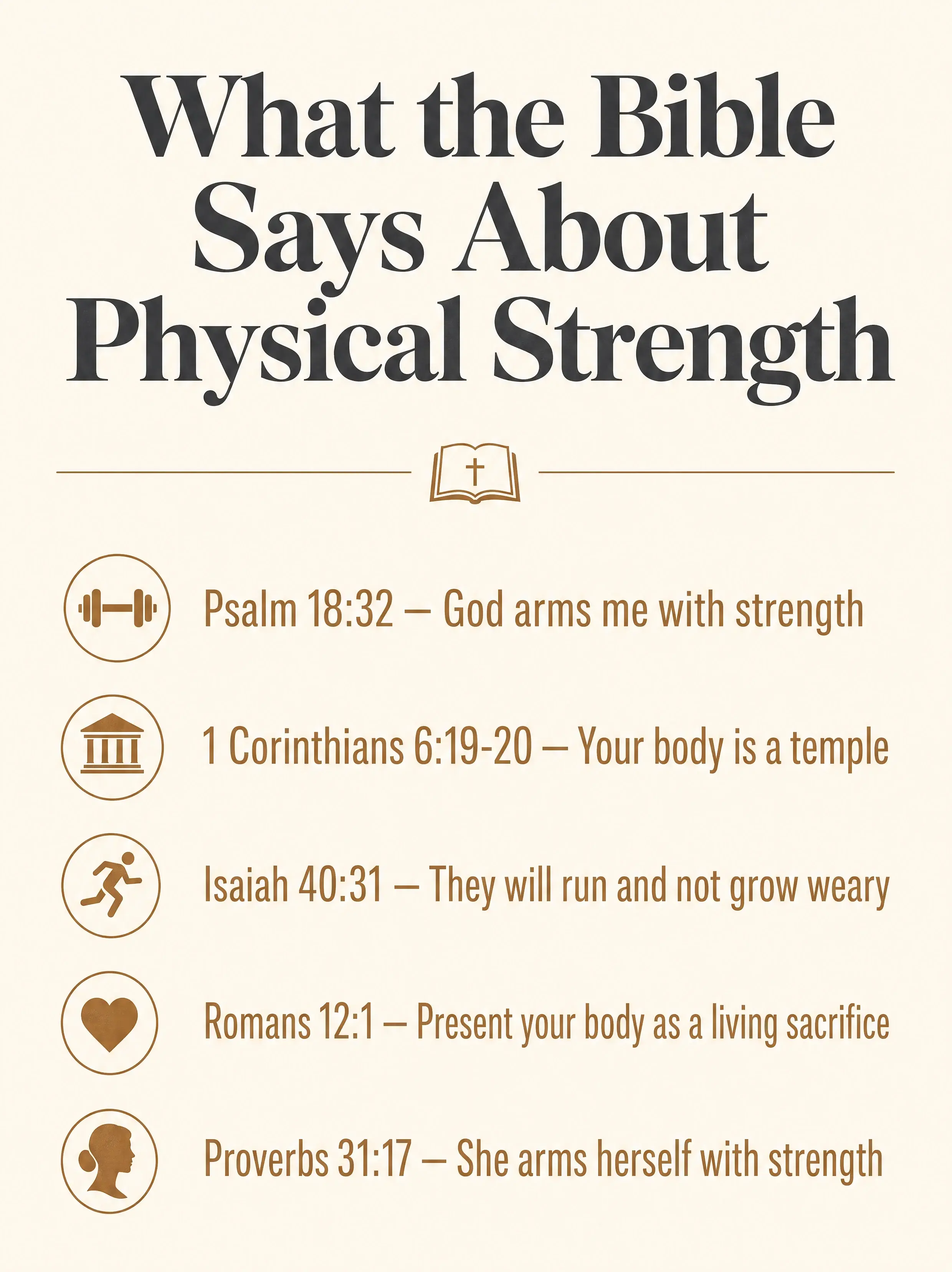
The Old Testament on Strength: Warriors, Psalms, and the God Who Trains Hands for Battle
The Old Testament has no category crisis about physical strength. It does not spiritualize it, minimize it, or treat it as a lower-order concern. The God of the Old Testament is presented repeatedly as the direct source of his people's strength - and that strength is often explicitly physical. Psalm 18:32 states it plainly: 'It is God who arms me with strength and keeps my way secure.' The Hebrew word translated 'arms' (azor) carries a concrete, martial sense - to gird, to equip for battle. This is not metaphor for inner resolve. It is military language for a warrior being fitted for war.
The same psalm continues in verse 34: 'He trains my hands for battle; my arms can bend a bow of bronze.' The verb is lamad - to teach, to train, to accustom. God is described here not as someone who grants magical strength apart from effort, but as a trainer who develops capacity in a man's actual hands and arms. A 2026 reader bringing any serious barbell experience to this verse will feel the precision of the language. Strength developed under load, through repeated difficult work - that is the model the text is describing.

The Creation Premise: Why the Body Is Not the Problem
Before any warrior text, Genesis 1-2 establishes the premise: God creates a physical world, inspects it, and calls it good. Man is formed from the earth - not trapped in matter, but made from it by a creator who is not embarrassed by the material. The fall in Genesis 3 introduces death and decay into the body, but it does not revoke the body's goodness or strip it of purpose. It corrupts the design; it does not invalidate the category. Every serious theology of physical training starts here. The body being good does not mean the body being easy - the fall ensures otherwise. But it does mean the body being worth something. Worth training. Worth stewarding. Worth presenting, as Paul will later say, as an offering.
- Genesis 1:31 - 'God saw all that he had made, and it was very good' - includes the physical body
- Psalm 139:14 - 'I am fearfully and wonderfully made' - the body as crafted, not accidental
- Proverbs 31:17 - 'She sets about her work vigorously; her arms are strong for her tasks' - physical capacity as virtue, not vanity
- Isaiah 40:31 - 'They will run and not grow weary, they will walk and not be faint' - physical endurance as a marker of those who wait on God
The Old Testament reading of strength is not gnostic - it does not divide the spiritual man from the physical man and declare the former superior. The warrior, the farmer, the woman of Proverbs 31 with her strong arms - these are not lesser figures in the text. They are examples of human beings functioning as designed.
Samson, David, and the Moral Weight of Physical Strength
Not every strong man in the Old Testament is a model. Samson had extraordinary physical strength and catastrophic character failure. David was a skilled warrior who killed tens of thousands and also committed adultery and ordered a man's death to cover it. The text does not pretend otherwise. What this means for the reader is important: physical strength in Scripture is consistently treated as morally neutral capacity - what matters is what it serves. Samson's strength served his appetites. David's strength, at its best, served the covenant people. The same weight can be picked up for different reasons, and the text cares about which reason.
This is the stewardship frame the Old Testament builds. Physical capacity is not praised merely because it exists. It is praised when it is directed rightly - toward protection, provision, service, and the work God has given the man to do.
Paul's Body Theology: Temple, Sacrifice, Discipline, and the Misread Verses
Paul writes more directly about the body than any other New Testament author. His letters contain the verses most often used in Christian fitness content - and the verses most often stripped of their context. A serious reading of Paul produces a high view of the body, a demanding ethic of bodily stewardship, and a sharp correction on at least one widely misquoted passage.
1 Corinthians 6:19-20 - The Temple Argument
- The verse: 'Do you not know that your bodies are temples of the Holy Spirit, who is in you, whom you have received from God? You are not your own; you were bought at a price. Therefore honor God with your bodies.'
- Context: Paul is addressing sexual immorality in Corinth - bodies joined to prostitutes. The temple language is a rebuke of specific physical sin, not a general wellness instruction.
- What it actually establishes: the body is the dwelling place of God - which means what you do with your body has theological weight. Neglect and abuse both fall under this judgment.
- For the lifter: the temple argument does not say 'go train.' It says your body is not yours to treat carelessly - which logically includes intentional physical development and care.
Romans 12:1 - The Living Sacrifice
- The verse: 'Therefore, I urge you, brothers and sisters, in view of God's mercy, to offer your bodies as a living sacrifice, holy and pleasing to God - this is your true and proper worship.'
- What the sacrifice language means: the Old Testament sacrifice was a real, physical thing given to God - an animal killed, a grain offering burned. Paul's point is that the New Testament equivalent is not less physical; it is more demanding. A living sacrifice stays on the altar. It keeps showing up.
- For the lifter: this is the strongest biblical case for treating your training as worship - not as a metaphor, but as a literal act of presenting the body to God for his purposes.
Expert note: the phrase 'your true and proper worship' (logike latreia in Greek) has been translated 'reasonable service' in older versions. The word logike means rational, fitting, appropriate. Paul is not being poetic. He is saying: given what God has done, offering your body is the rational response. There is nothing mystical or over-spiritual about this. It is logic applied to grace.
Philippians 4:13 - The Misread Verse
'I can do all things through Christ who strengthens me.' This is the most cited verse in Christian fitness culture and one of the most consistently misread in the entire New Testament. Reading Philippians 4:10-13 in full makes Paul's actual point unavoidable: he is describing contentment in suffering - being abased, going hungry, facing need. The 'all things' he can do through Christ is not a performance promise about PRs or athletic achievement. It is a statement about endurance under deprivation. Christ strengthens Paul to survive hardship without losing his footing. That is a profound truth. It is just not what the tank top says.
The correct use of Philippians 4:13 in a training context is not 'I will hit this lift because Christ.' It is 'I will train through this hard season - the injury, the plateau, the year the numbers did not move - because my contentment is not contingent on the outcome.' That is a harder and more useful verse than what most men are carrying into the gym.
Four Practical Implications from Paul's Body Theology
- Your body is not yours - train it accordingly, which means neither neglect nor obsession is a faithful option
- Physical training offered to God is worship - the Romans 12:1 frame makes this explicit
- Contentment in hardship is the muscle Philippians 4:13 trains - not peak performance
- Whatever you do - including every set, every rep, every programming decision - falls under Colossians 3:17's scope: do it in the name of the Lord Jesus
To see how this theology applies to the daily training decision - specifically, what it means to bring your body under the bar as an act of devotion - see the Lifter's Devotional Guide to Training as Worship.
Strength at Three Stages of a Man's Life: What the Text Emphasizes

The biblical picture of physical strength is not static. The text speaks differently to men at different stages of life - and those differences matter for how a man should train and what he should expect from his body at each season.
- Young men (teens through early 30s): Proverbs 20:29 - 'The glory of young men is their strength.' Scripture acknowledges and celebrates the physical peak season of a man's life. This is the season to build the foundation - heavy compound work, serious volume, the discipline of the long program. It is also the season where strength most easily becomes its own idol without a theological frame.
- Men in their prime (30s through 50s): Psalm 18:32-34 - the warrior frame. Strength in this season is for purpose - family protection, productive work, modeling for sons. Isaiah 40:31 promises sustained physical capacity to those who wait on God. This is the season of training that serves, not training that performs.
- Older men (60+): Psalm 71:9 - 'Do not cast me away when I am old; do not forsake me when my strength is gone.' The text does not pretend physical decline is not real. It acknowledges it and calls on God in the middle of it. Strength in this season is stewardship of what remains - maintenance, mobility, presence, longevity of service.
Three Types of Strength the Bible Addresses
The biblical vocabulary of strength maps onto distinct categories:
- Physical-military: strength to fight, protect, and prevail under physical threat - Psalm 18, Judges, 1-2 Samuel. Relevant for today's man as protection of home and family.
- Physical-productive: strength for labor and provision - Proverbs 31, Nehemiah's builders who worked with one hand and held a weapon with the other. Relevant for the man whose body is the instrument of his livelihood.
- Endurance-under-hardship: the capacity to continue when the body is under duress - Isaiah 40:31, Hebrews 12:1, Philippians 4:13 in its correct context. Relevant for every man who has had a hard training season or a hard life season.
What 1 Timothy 4:8 Actually Means
The verse that causes the most trouble in Christian fitness culture is 1 Timothy 4:8 - 'for physical training is of some value, but godliness has value for all things.' The word translated 'some' is the Greek oligos - small, little, few. Anti-gym readers use this verse as a biblical case against prioritizing physical training. That reading is too fast. Paul does not say physical training is worthless. He says it is limited in scope - its value is present-tense and body-bound. Godliness has value in this life and the next. The correct application is not 'skip the gym'; it is 'don't let the gym become your primary investment account.' Physical training is valuable and finite. Godliness is valuable and eternal. Hold both, in that order.
Why Theology Changes the Way You Train
A man who trains without a theological frame is always at risk of the same failure: when the training stops paying off in the way he expects, he quits. The numbers plateau. The body gets injured. Life crowds out the schedule. Without a reason for the work that survives the bad seasons, the work itself doesn't survive. A man who has built his training on a serious reading of Scripture has a reason that is not contingent on the return. He trains because the body is a temple. Because the work is a living sacrifice. Because God trains hands for battle, and the man owes the training back to the one who made the hands.
- A biblical theology of the body produces men who train for longer - not because they are more motivated, but because their reason for training is outside themselves.
- It produces men who are slower to ego-spiral on bad days - the Philippians 4:13 corrective means the outcome is not the point; showing up is.
- It produces men who are clearer about stewardship - the temple argument applies to sleep, nutrition, and recovery as much as it applies to the training itself.
- Alpha Omega Strength Team is built for this man - the one who takes the text seriously and takes the work seriously, and refuses the bro-Christian version of both.
Getting the Most Out of a Theologically Grounded Training Life
- Read the texts in context - buy a study Bible, read the surrounding chapters, and do not settle for a verse on a wall
- Build a theology of your own body - what does it mean specifically, at your age and in your season, to steward what you have been given?
- Let the 1 Timothy 4:8 corrective govern your schedule - godliness first, training in its proper place, without apology for either
- Find men who hold the same frame - the Proverbs 27:17 dynamic (iron sharpens iron) applies to theology as much as it applies to training
For the practical side of building a faith-integrated training identity - including how to set the mental frame before every session - see the Faith-Driven Lifter's Guide to Pre-Workout Prayer.
Frequently Asked Questions About the Bible and Physical Strength
Does the Bible actually encourage physical training, or just tolerate it?
It does more than tolerate it. The Old Testament presents a God who directly trains the physical bodies of his people for the work ahead (Psalm 18:34), praises the strong arms of the capable woman (Proverbs 31:17), and describes restored physical vitality as a mark of God's people (Isaiah 40:31). The New Testament frames the body as a temple and its presentation to God as worship (Romans 12:1). None of this is a generic encouragement toward activity. It is a coherent theology of the body as a stewardship. Training is one of the primary ways that stewardship is practiced.
What is the best single verse on physical strength in the Bible?
Psalm 18:32-34 is the most complete single passage - it is specific about God as source, about the body as the thing trained, and about the purpose (battle) the training serves. But the most practically useful single verse for the working man may be Proverbs 31:17 - 'She sets about her work vigorously; her arms are strong for her tasks.' The Hebrew word translated 'strong' (amets) carries the connotation of being resolute, firm, and courageous. Physical strength here is not described as brute force. It is described as the capacity to do the work faithfully, for as long as the work requires. That is a better frame for training than peak performance.
Is it wrong to be proud of being strong?
The text distinguishes between taking satisfaction in good work and boasting in your own capacity as though you produced it without God. Jeremiah 9:23-24 is precise: 'Let not the wise boast of their wisdom or the strong boast of their strength or the rich boast of their riches, but let the one who boasts boast about this: that they have the understanding to know me.' The problem is not being strong. The problem is building your identity on the strength rather than on the one who gave it. A man who works hard, develops significant physical capacity, and is grateful - that is not pride. A man who cannot tolerate being outlifted without it threatening his sense of self - that is the version the text is correcting.
Conclusion
Scripture takes the body seriously. Not as the whole of the man, not as the seat of his worth, but as the instrument through which he lives his actual life - the life of labor, protection, worship, and service. A man who reads these texts carefully will train differently: with a longer time horizon, a steadier emotional baseline under the bar, and a clearer sense of who the work belongs to. The vanity of training-as-identity is not fixed by more motivation. It is fixed by a better reason. The Bible offers one. Several, actually. And none of them require a tank top.
If this primer raised more questions than it answered - good. That is what serious texts do. For the practical next step - how to bring this theology into the gym before your first warm-up set - see the Faith-Driven Lifter's Guide to Pre-Workout Prayer.
// FREQUENTLY ASKED
Questions, answered.
Does the Bible actually encourage physical training, or just tolerate it?
It does more than tolerate it. The Old Testament presents a God who directly trains the physical bodies of his people for the work ahead (Psalm 18:34), praises the strong arms of the capable woman (Proverbs 31:17), and describes restored physical vitality as a mark of God's people (Isaiah 40:31). The New Testament frames the body as a temple and its presentation to God as worship (Romans 12:1). None of this is a generic encouragement toward activity. It is a coherent theology of the body as a stewardship. Training is one of the primary ways that stewardship is practiced.
What is the best single verse on physical strength in the Bible?
Psalm 18:32-34 is the most complete single passage - it is specific about God as source, about the body as the thing trained, and about the purpose (battle) the training serves. But the most practically useful single verse for the working man may be Proverbs 31:17 - 'She sets about her work vigorously; her arms are strong for her tasks.' The Hebrew word translated 'strong' (amets) carries the connotation of being resolute, firm, and courageous. Physical strength here is not described as brute force. It is described as the capacity to do the work faithfully, for as long as the work requires. That is a better frame for training than peak performance.
Is it wrong to be proud of being strong?
The text distinguishes between taking satisfaction in good work and boasting in your own capacity as though you produced it without God. Jeremiah 9:23-24 is precise: 'Let not the wise boast of their wisdom or the strong boast of their strength or the rich boast of their riches, but let the one who boasts boast about this: that they have the understanding to know me.' The problem is not being strong. The problem is building your identity on the strength rather than on the one who gave it. A man who works hard, develops significant physical capacity, and is grateful - that is not pride. A man who cannot tolerate being outlifted without it threatening his sense of self - that is the version the text is correcting.
// GEAR WORN IN THIS TRAINING


PUBLISHED MAY 20, 2026