
// TRAINING
Your First 30 Days of Strength Training: A Faith-Driven Lifter's Survival Guide

Most men quit lifting before week three. This is the 30-day onboarding plan that gets you to day 31 - physically, mentally, and spiritually intact.
Pete Fluriach, founder of Alpha Omega Strength Team. I have onboarded enough beginners - men I trained, men I lifted alongside, men I watched walk out of the gym after two weeks and never come back - to know that the first thirty days are the only thirty days that matter for most people. Get this month right and the next ten years of training are possible. Get this month wrong and you join the seventy-plus percent of new lifters who are gone before the first quarter ends. This guide is the survival plan I would hand any faith-driven man on day one.
The first 30 days of strength training are not about getting strong. They are about installing the habit, learning the foundational lifts, and building the spiritual frame that will keep you under the bar long after the novelty wears off. Done well, the month costs you about three hours per week, makes you almost no measurable gains, and quietly decides whether you become a lifter or remain a man who once tried lifting.
What Every Faith-Driven Beginner Needs to Know About Their First 30 Days
Your first 30 days of strength training is a defined onboarding window with one job: get a body that has never lifted under load three times a week, every week, for four straight weeks. Strength comes later. Aesthetics come later. The window's only output is a man who, on day 31, does not have to relitigate whether he is going to train this week.
There are five things most beginners get wrong in the first month:
- Too many exercises - chasing six-day splits before the body has earned three
- Too much intensity - training to failure on lifts the nervous system has not learned
- Too little patience - expecting visible change inside thirty days
- No written plan - relying on memory and motivation, both of which fail by day 10
- No spiritual frame - training the body without ever asking what the body is for
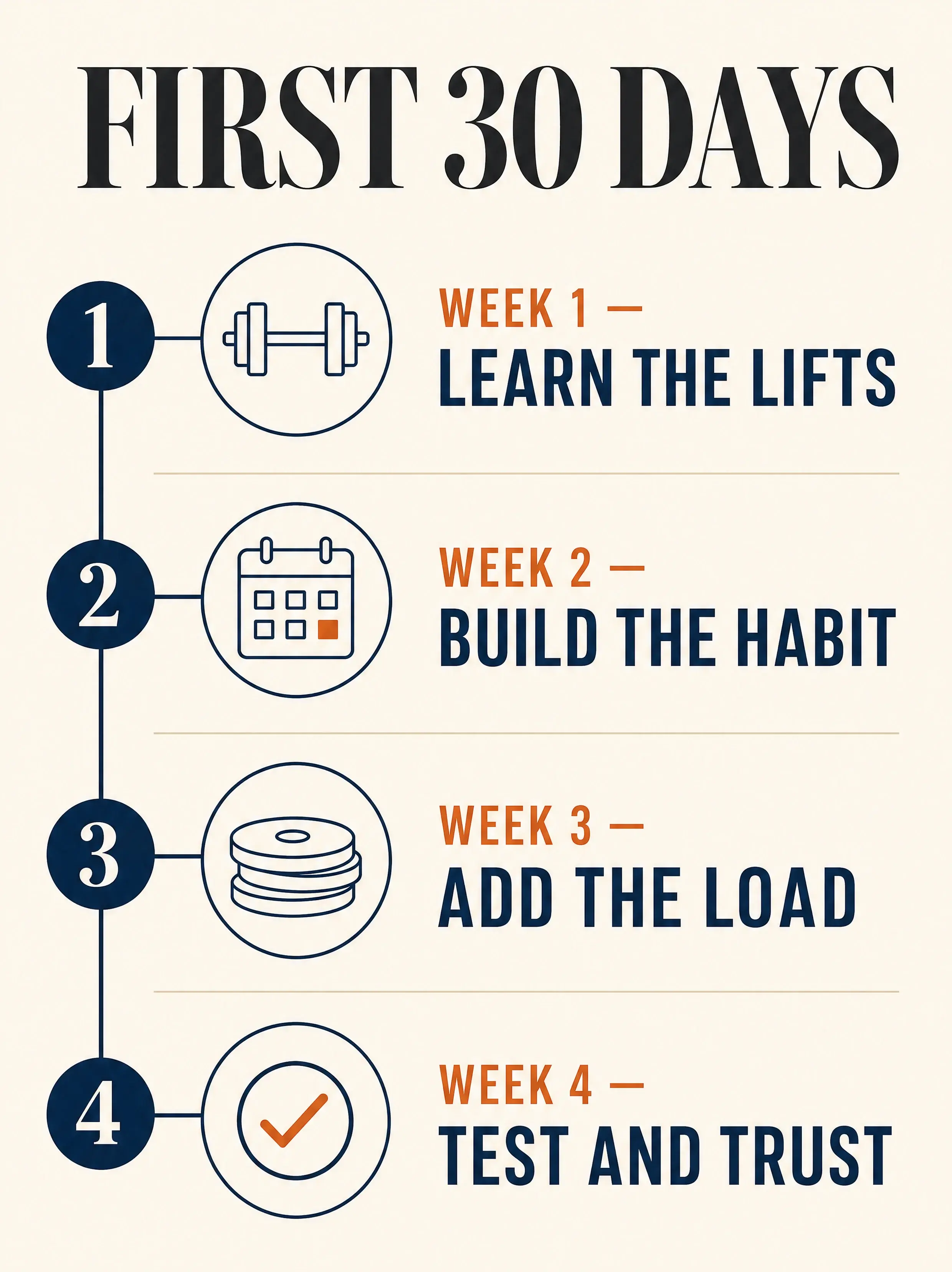
Each of those failures has a single fix. Together they form the four-week structure below - one job per week, no overlap, no negotiation.
Here are the four non-negotiables a faith-driven beginner has to hold for the full thirty days:
- Frequency - three full-body sessions per week, never two, never four
- Movements - squat, hinge, press, pull, carry - every session touches all five
- Intensity - every working set stops two reps shy of failure, no exceptions
- Frame - every session begins with one minute of prayer and one verse held in mind
Hold those four for four weeks and the program has done its job. The payoff is small in pounds on the bar and enormous in identity: by day 31, training is no longer a thing you are trying - it is a thing you do.
The Landscape: Why Most Beginners Don't Make It to Day 31
The fitness industry in 2026 has more onboarding content than at any point in its history - phone apps, free programs, AI coaches, full-length video libraries. None of that has moved the dropout number. Industry attrition data still shows roughly half of new gym members stop showing up inside the first six months, with the steepest drop happening in the first four weeks. The product is not the problem. The structure of the first month is.
What the Dropout Data Actually Says
When researchers track new lifters who quit, two patterns dominate. First, the men who quit almost never quit on a hard day - they quit on a missable day, a Tuesday with light rain and a busy inbox, the kind of day where the program asked for nothing dramatic and they could not produce even the small yes. Second, the men who quit almost always over-built week one. They trained five days, sore for nine, never recovered, and read that as failure of will rather than failure of dose. The program asked too much and they paid for the math.
Why Faith-Driven Lifters Have an Advantage They Rarely Use
A man who already orders his week around worship has a built-in scaffolding most beginners do not. He knows what it looks like to do a thing weekly because it is good and not because it is fun. He has practiced showing up to obligations the body resists. Strength training maps onto that scaffolding cleanly - three sessions a week is well below the cadence of even a casual prayer life. The advantage exists. The problem is that most faith-driven beginners never connect the two practices, so the gym stays in the same mental category as a hobby, and hobbies are the first thing a busy man drops.

The 30-Day Decision Framework: One Job Per Week
The single biggest mistake a beginner makes is treating month one as a smaller version of month six. Month six is about progressive overload, periodization, and chasing a number on the bar. Month one is about something more boring and more important - installing a man who lifts. Use the four-week breakdown below to keep each week pointed at one job and one job only.
Week 1 - Learn the Lifts
- Job: drill movement quality on squat, hinge, press, pull, carry
- Load: empty bar or light dumbbell - three sets of five, slow tempo
- Win condition: leaving every session feeling like you could have done two more sets
Week 2 - Build the Habit
- Job: lock the same three days and the same time slots into the week
- Load: small increase only if last week's bar speed was clean
- Win condition: three sessions completed on the calendar slots you committed to
Week 3 - Add the Load
- Job: introduce real working weight on the main lift of each session
- Load: top set leaves two reps in reserve, never more, never less
- Win condition: a written log of every working set and the reps in reserve
Week 4 - Test and Trust
- Job: confirm the habit by training a low-motivation day and a busy-week day
- Load: hold week 3 numbers - no PR attempts in month one, ever
- Win condition: thirty straight days where you did not have to debate showing up
Expert tip: write the four weeks on a single piece of paper before day one and tape it inside your gym bag. Do not refine the plan during the month. The discipline of running the original plan unmodified is part of what the first 30 days are forming.
Practical Tips: The Five Rules That Carry the Month
- Pack the gym bag the night before - friction kills more sessions than fatigue does
- Eat one real meal in the two hours before training - protein, carbs, water, no novelty supplements
- Log every working set on paper or in one app - memory is not a logging system
- Sleep seven hours minimum during the month - recovery in week one is the load you carry into week two
- Start each session with one minute of silence and one verse held in mind - the spiritual frame is a load-bearing wall, not a decoration
Full-Body Three Days vs. Body-Part Splits: Why It's Not Close
The five-day bro split is the single most over-prescribed program for new lifters. It is engineered for men with three years of training history, not three weeks. In month one, body-part splits give too much recovery to the muscles they hit and too little practice to the movements you have not learned. Full-body three days a week gives the nervous system thirty-six exposures to the main lifts inside a month - six times what a bro split delivers. The man who learns to squat across thirty-six reps a week becomes a squatter. The man who squats once a week on leg day in month one becomes a man who knows what soreness feels like.

Use-Case Mapping: Three Common Beginners, Three Adjustments
The thirty-day framework is the same for every beginner. The application changes based on where the man is starting from. Below are three real-world contexts and the small adjustments each one requires.
The Commercial Gym Beginner
Beginner version: pick the rack in the back corner, use the empty bar for the first two sessions, and let crowded peak hours teach you patience instead of frustration. Advanced version: by week three, train at off-peak times even if it costs you a 5 a.m. wake-up - the equipment access is worth the early alarm. Customize by mapping out which racks are open at your three target time slots before the month starts.
The Garage-Gym Beginner
Beginner version: a bar, plates to 135, a flat bench, and a rack - that is enough for the entire first month. Do not buy specialty bars or accessories until you have completed thirty days. Advanced version: by week four, add a single piece of equipment you will use every session - a trap bar, a safety squat bar, or fractional plates. Customize by treating the garage as a chapel - same lighting, same music, same first verse every session.
The Traveling Beginner
Beginner version: hotel gyms in 2026 are uneven; assume dumbbells to 50 lbs, a cable stack, and a treadmill, and design the week around what is guaranteed. Advanced version: book hotels with full racks for any trip of three days or more in your first 30 days - the cost differential is the price of the month succeeding. Customize by keeping a single dumbbell-only session in your back pocket as the travel default.
Customizing the Month to Your Schedule
The three immovable variables are frequency, dose, and frame. Everything else is negotiable. Move the sessions around the week. Adjust the lifts based on equipment. Swap a verse for a different verse. But do not drop a session in week one to make room for life - life will not give the time back, and the month will quietly slip. The schedule that survives is the schedule that respects the immovables first. For a deeper walk-through of how to step into the gym as a Christian for the first time, that piece pairs cleanly with this guide.
Why the Alpha Omega Strength Team Approach Fits a Faith-Driven First 30 Days
The first 30 days of strength training fail or succeed on a few small architectural choices. The Alpha Omega Strength Team approach was built around the same convictions that make month one survivable for a beginner - long-arc thinking, theological seriousness, and a refusal to treat training like a personality.
- Built for the long arc - programs and content written for the man who plans to lift for the next twenty years, not the next twenty days
- Theologically serious - scripture handled as text, not decoration; no slogans, no bro-Christian aesthetic
- Habit-first, hype-last - every plan is designed to be repeatable on a low-motivation day, because most days are low-motivation days
- Spiritually framed without being preachy - the work is for the Lord; the writing assumes you already know that
Getting the Most Out of Your First 30 Days
Pair this month with two practices and the return on every session compounds. First, read the guide to training as worship to set the doctrinal frame before week one begins. Second, install the five-minute pre-workout prayer routine as the opening ritual of every session - it is the cheapest, highest-leverage habit available to a beginner.
Frequently Asked Questions About the First 30 Days
How sore should I be in the first week?
Mildly sore for two or three days after the first two sessions, then progressively less as the body adapts. If you cannot walk down stairs comfortably forty-eight hours after a session, the load was too high or the volume was too much. Cut both by 20 percent for the next session and reassess. Heroic soreness in week one is the single most common reason new lifters miss session three.
What should I eat during my first 30 days?
Three real meals a day, each with a palm of protein and a fist of carbs. Water before coffee. No supplements in month one except creatine monohydrate at five grams per day if you have no kidney issues - it is the most well-studied training supplement in 2026 and it is cheap. Skip pre-workout powders, fat burners, and any product whose marketing copy uses the word 'shredded.' For a fuller treatment of fueling on a budget, see the separate guide.
What if I miss a session?
Miss one and reschedule inside the same week - Saturday morning is the standard catch-up slot. Miss two in a row and the rule is do not double up; just resume the plan on the next scheduled day and finish the month. A missed session is a single data point. A missed session followed by a guilt-driven punishment session is how week three becomes the end of the experiment.
When should I expect to see physical change?
Honestly - not in the first 30 days. Bar speed will improve, posture will start to organize, sleep will deepen. Visible change in the mirror typically begins between months three and four for men training three days a week with adequate protein. Anyone who promises measurable aesthetic results in thirty days is selling you something. The point of month one is not the mirror. It is becoming the kind of man who is still training in month thirteen.
Conclusion
The first 30 days of strength training is not glamorous work. The numbers are small, the soreness is real, and the visible results are nearly nonexistent. What the month produces is an unglamorous and decisive thing - a man who, on day 31, no longer has to decide each week whether he is training. That is the entire game. Everything in the next decade of lifting compounds from that one shift in identity.
Run the four weeks unmodified. Log every set. Open every session with one minute of silence and one verse. To go deeper on the discipline of progressive overload once month one is in the books, read the progressive overload guide for faith-driven athletes.
// FREQUENTLY ASKED
Questions, answered.
How sore should I be in the first week?
Mildly sore for two or three days after the first two sessions, then progressively less as the body adapts. If you cannot walk down stairs comfortably forty-eight hours after a session, the load was too high or the volume was too much. Cut both by 20 percent for the next session and reassess. Heroic soreness in week one is the single most common reason new lifters miss session three.
What should I eat during my first 30 days?
Three real meals a day, each with a palm of protein and a fist of carbs. Water before coffee. No supplements in month one except creatine monohydrate at five grams per day if you have no kidney issues - it is the most well-studied training supplement in 2026 and it is cheap. Skip pre-workout powders, fat burners, and any product whose marketing copy uses the word 'shredded.' For a fuller treatment of fueling on a budget, see the separate guide.
What if I miss a session?
Miss one and reschedule inside the same week - Saturday morning is the standard catch-up slot. Miss two in a row and the rule is do not double up; just resume the plan on the next scheduled day and finish the month. A missed session is a single data point. A missed session followed by a guilt-driven punishment session is how week three becomes the end of the experiment.
When should I expect to see physical change?
Honestly - not in the first 30 days. Bar speed will improve, posture will start to organize, sleep will deepen. Visible change in the mirror typically begins between months three and four for men training three days a week with adequate protein. Anyone who promises measurable aesthetic results in thirty days is selling you something. The point of month one is not the mirror. It is becoming the kind of man who is still training in month thirteen.
// GEAR WORN IN THIS TRAINING


PUBLISHED MAY 27, 2026